

Class 6: Science Chapter 12 solutions. Complete Class 6 Science Chapter 12 Notes.
Contents
Maharashtra Board Solutions Class 6-Science: Chapter 12- Simple Machines
Maharashtra Board 6th Science Chapter 12, Class 6 Science Chapter 12 solutions
Questions and Answers
1. Classify the following as a lever, a pulley and an inclined plane:
(A wedge, a needle, a staircase, a slide, the wheel of a flagpole, nutcrackers, scissors, an opener, an axe, a crane, a knife)
Question a.
Classify the following as a lever, a pulley and an inclined plane:
(A wedge, a needle, a staircase, a slide, the wheel of a flagpole, nutcrackers, scissors, an opener, an axe, a crane, a knife)
Answer:
| Inclined plane | Pulley | Lever |
| Wedge | Wheel of flagpole | Nutcracker |
| Needle | Crane | Scissors |
| Staircase | Opener | |
| Slide | ||
| Axe | ||
| Knife. |
2. Fill in the blanks using the proper word and complete the statements.
Question a.
The ………….. in the centre, the ………….. on one side and the on the ………….. other side make a lever of the first order.
Answer:
Fulcrum, load and effort
Question b.
The ………….. in the centre, the ………….. on one side and the ………….. on the other side make a lever of the second order.
Answer:
Load, fulcrum, effort
Question c.
The ………….. in the centre, the ………….. on one side and the ………….. on the other side make a lever of the third order.
Answer:
Effort, fulcrum, load
3. Which machines will you use to do the following work? Write their types.
Question a.
To remove the lid of a tin. Opener Lever of the second order
Answer:
- Work: To remove the lid of a tin.
- Machine: Opener
- Machine: Lever of the second order
Question b.
To lift bricks to the top of a tall building Crane Complex machine
Answer:
- Work: To lift bricks to the top of a tall building
- Machine: Crane
- Machine: Complex machine
Question c.
To cut vegetable Knife Wedge – Simple machine
Answer:
- Work: To cut vegetable
- Machine: Knife
- Machine: Wedge – Simple machine
Question d.
To draw water from a well Pulley Simple machine
Answer:
- Work: To draw water from a well
- Machine: Pulley
- Machine: Simple machine
Question e.
To hold a papad for roasting it. A pair of tongs Lever of the third order
Answer:
- Work: To hold a papad for roasting it.
- Machine: A pair of tongs
- Machine: Lever of the third order
4. Write the answers to the following questions in your own words.
Question a.
What is meant by a simple machine?
Answer:
- Machines which have only one or two parts and a simple and easy structure are simple machines.
- Example: the bottle opener, nail cutter.
- Simple machines can be handled easily.
- We use many simple machines in our day to day life.
Question b.
Mention the advantages of using a machine.
Answer:
- Machines, simple or complex, are used to get more work done in less time and with less effort.
- Machines are used to accomplish certain tasks more easily.
- Use of simple or complex machines depends upon the task to be carried out and the time and the efforts required to do it.
Question c.
What is meant by a complex machine?
Answer:
- Complex machines have many parts which carry out many processes for completing a task.
- For this purpose the parts are joined to one another.
- Therefore, these machines are called complex machines.
- Some of the parts of such complex machines are actually simple machines.
- The structure of complex machine is complicated.
Question d.
What is a lever? How is the order of the lever determined?
Answer:
- Lever is a simple machine made up of 3 parts: Load, effort and fulcrum.
- Order of the lever are determined on the position of the effort, the fulcrum and the load.
5. Why is this so?
Question a.
Traveller’s bags have wheels.
Answer:
- Combination of wheel and axle is a simple machine.
- When the axle starts rotating due to force applied, the wheel fitted to it also starts rotating.
- This makes easier for travellers to carry heavy load.
- Instead of lifting heavy bag, to drawing it on wheels require less energy. Therefore, traveller’s bag have wheels.
Question b.
Machines have to be maintained.
Answer:
- Parts of machines rub against one another when they are used.
- Soiled, dusty parts create more friction. Some parts are affected by the weather, rust and corrosion.
- Machines get damaged or become useless due to such wear and tear. Hence to avoid this, machines should be maintained properly to keep them in good working condition.
Question c.
A bicycle is said to be a complex machine.
Answer:
- Bicycle has a complicated structure.
- Bicycle has many parts which carry out many processes for completing a task.
- Many parts of bicycle such as pedals, wheels, axle, handle are actually simple machines.
- The parts of a bicycle are joined to one another – making it a complex machine.
6. Name the levers mentioned in the following passage. Identify the fulcrum, load and effort of each and say which type of lever it is.
Ravi and Savita sit on a sea-saw in a garden. In the mean time, a gardener is trimming trees in the garden. He puts the leaves and other garbage in the wheelbarrow. Later, Ravi gets thirsty and he buys lemon sherbet. The sherbet seller cuts the lemon and squeezes it using a lemon squeezer. He puts small pieces of ice in the glass with the help of the tongs.
Question a.
Name the levers mentioned in the following passage. Identify the fulcrum, load and effort of each and say which type of lever it is.
Ravi and Savita sit on a sea-saw in a garden. In the mean time, a gardener is trimming trees in the garden. He puts the leaves and other garbage in the wheelbarrow. Later, Ravi gets thirsty and he buys lemon sherbet. The sherbet seller cuts the lemon and squeezes it using a lemon squeezer. He puts small pieces of ice in the glass with the help of the tongs.
Answer:
Levers:
- See – saw – lever of the first order.
Load – fulcrum – effort. - Wheelbarrow – lever of the second order.
Fulcrum – load – effort. - Lemon squeezers – lever of the second order.
Fulcrum – load – effort. - Tongs – lever of the third order.
Fulcrum – effort – load.
Activity:
Question 1.
Make a list of the various machines used in your home and neighborhood and write their types.
Question 2.
Go to a bicycle repair shop, observe how a bicycle is repaired, and note down the information.
Important Questions and Answers
Fill in the blanks.
Question 1.
Simple machines can be handled ………….. .
Answer:
easily
Question 2.
The structure of complex machine is ………….. .
Answer:
complicated
Question 3.
The more gradual the the ………….. lesser is the we bear. But, such an inclined plane is …………..
Answer:
slope, weight, longer
Question 4.
The steeper the ………….. , the ………….. is the inclined plane. But we have to bear a …………. weight.
Answer:
slope, shorter, greater
Question 5.
A screw is like a rolled up inclined plane made of an ………….. strip.
Answer:
iron
Question 6.
A wedge is used for ………… an object into two pieces or to ………….. the objects stuck together.
Answer:
breaking, separate
Question 7.
A farmer uses a strong …………. to remove the big stone bogged down in the farm.
Answer:
crow-bar
Question 8.
A device with a grooved wheel and thread designed to lift weights is called a …………. .
Answer:
pulley
Question 9.
When we use a pulley, force is applied in the downward direction for lifting the weight in an …………. direction.
Answer:
upward
Question 10.
Combination of an axle and a wheel is a …………. machine.
Answer:
simple
Question 11.
A needle and a nail are also kind of …………. .
Answer:
wedge
Question 12.
Machines are covered when not in use to prevent …………. settling on them.
Answer:
dust
Question 13.
In Archimedes’ screw, the pipe was placed at an angle of …………. with one end inside the …………. and the rod resting on a …………. .
Answer:
45°, water, flat surface.
Match the columns:
Question 1.
| Column ‘A’ | Column ‘B’ |
| 1. Pair of Scissors | a. Third order of lever |
| 2. Tongs | b. Second order of lever |
| 3. Opener | c. First order of lever |
Answer:
| Column ‘A’ | Column ‘B’ |
| 1. Pair of Scissors | c. First order of lever |
| 2. Tongs | a. Third order of lever |
| 3. Opener | b. Second order of lever |
Question 2.
| Column ‘A’ | Column ‘B’ |
| 1. Inclined plane | a. Needle |
| 2. Pulley | b. Screw |
| 3. Wedge | c. Crane |
Answer:
| Column ‘A’ | Column ‘B’ |
| 1. Inclined plane | b. Screw |
| 2. Pulley | c. Crane |
| 3. Wedge | a. Needle |
State whether the following statements are ‘true’ or ‘false’.
Question 1.
Lever helps big vehicle to climb up and down the mountain easily.
Answer:
False
Question 2.
Combination of wheel and axle is a simple machine.
Answer:
True
Question 3.
In pulley, force can be applied in upward direction.
Answer:
False
Question 4.
Screw is an example of wedge.
Answer:
False
Question 5.
In Archimedes screw, the rod rests on flat surface.
Answer:
True
Question 6.
A slanting plank is used to lift a weight.
Answer:
True
Question 7.
A winding road or ghat is an example of lever of first order.
Answer:
False
Answer the following questions in one sentence.
Question 1.
What is a machine?
Answer:
Devices which are used to get more work done in less time and less effort are called machines.
Question 2.
What is a simple machine?
Answer:
Machines which have only one or two parts and a simple and easy structure are called simple machines.
Question 3.
What is a complex machine?
Answer:
Some machines have many parts and they carry out many processes for completing a task. For this purpose, the parts are joined to each other. They are called complex machines.
Question 4.
List the properties of simple machines.
Answer:
Properties of simple machine are:
- They are made up of only one or two parts.
- They have a simple and easy structure.
- They can be handled easily.
- There are less chances of simple machines breaking down or getting damaged.
Question 5.
List properties of complex machines.
Answer:
Properties of complex machine are:
- These machines have many parts to carry out many processes.
- The parts are joined to one another.
- The structure of complex machines is complicated.
- Some parts of complex machines are actually simple machines.
Question 6.
What is an inclined plane?
Answer:
A slanting plank which is used to lift a weight on which we bear less weight and lifting becomes easier is an inclined plane.
Question 7.
What is a screw?
Answer:
A screw is like a rolled up inclined plane made up of iron strip.
Question 8.
What is a wedge?
Answer:
A wedge is used for breaking an object into two pieces or to separate objects stuck together.
Question 9.
State examples of wedges.
Answer:
An axle, a knife, a chisel, a needle and a nail are different kinds of wedges.
Question 10.
What is a lever?
Answer:
A lever is a machine made up of 3 parts: effort, load and fulcrum.
Question 11.
What is a fulcrum?
Answer:
The support at which the rod of a lever is rested is called fulcrum of a lever. The lever rotates about the fulcrum.
Question 12.
What is a load?
Answer:
The weight lifted by a lever or the force against which the lever acts is called a load.
Question 13.
What is a load arm?
Answer:
The arm of the lever from the fulcrum to the load is called a load arm.
Question 14.
What is an effort?
Answer:
The force applied on the other end of the rod to lift the load is called an effort.
Question 15.
What is an effort arm?
Answer:
The part of the lever from the fulcrum to the effort is called an effort arm.
Question 16.
What is lever of the first order?
Answer:
The fulcrum is in the centre, the load is at one end while effort is at other end.
Question 17.
What is lever of the second order?
Answer:
The load is in the centre, the fulcrum on one side, and the effort on the other side.
Question 18.
What is lever of the third order?
Answer:
The effort is in the centre, the fulcrum on one side, and the load on the other side.
Question 19.
What is a pulley?
Answer:
A pulley is a device with a grooved wheel and thread designed to lift weights.
Question 2.
How does a pulley help us?
Answer:
If we use a pulley, force can be applied in the downward direction for lifting the weight in an upward direction. It is convenient and easy.
Give scientific reasons:
Question 1.
We use many simple machines in our day-to-day life.
Answer:
Simple machines can be handled easily and there are less chances of these machines breaking down or getting damaged. Hence, we use many simple machines in our day-to-day life.
Question 2.
Less force is required to fit a screw than to hammer a nail.
Answer:
- A screw is like a rolled-up inclined plane of an iron strip.
- When a screw is fitted in wood it goes in as if it is going down an inclined plane.
- Therefore, less force is required to fit a screw than hammer a nail.
Question 3.
Big vehicles easily climb up and down the mountains than a pathway.
Answer:
A winding road or ghat that goes up a mountain is like an inclined plane wrapped around the mountain. It helps big vehicles to climb, up and down the mountain easily.
Question 4.
Oil or lubricant is released between parts of machine.
Answer:
Oil or lubricant is released between parts that rub against each other so that there is less friction between them and wearing is reduced.
Question 5.
Machines are covered when not in use.
Answer:
Machines are covered when not in use to prevent dust settling on them.
Question 6.
How are machines protected from the effect of weather?
Answer:
To prevent the effect of weather, metallic parts in a machine are painted externally and the machines are always kept dry.
Draw the neat and labelled diagram of following:
Question 1.
The screw as an inclined plane.
Answer:

Question 2.
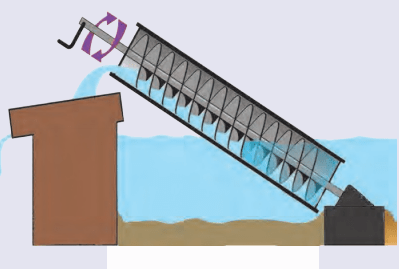
Archimedes’ screw
Answer:
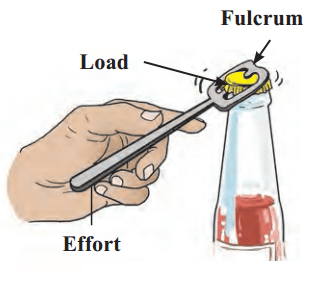
Observe the following diagram and identify the order of lever.
Question 1.
Removing the lid.
Answer:
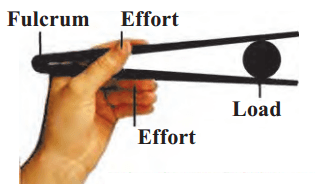
Question 2.
Picking up an object.
Answer:
Question 3.
Lifting a paper weight.
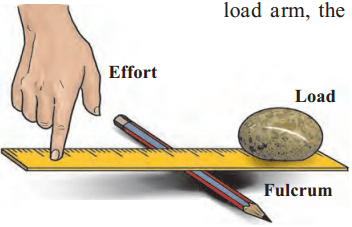
Answer:
- Lever of the second order
- lever of third order
- Level of first order.
Answer each of the question in brief:
Question 1.
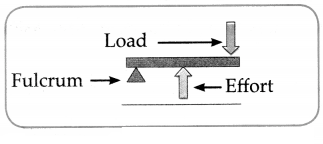
With the help of the diagram explain lever of the 1st, 2nd, 3rd order.
Answer:
1. Lever of the First order: The fulcrum is in the centre, the load is at one end, while the effort is at the other end. e.g. scissors
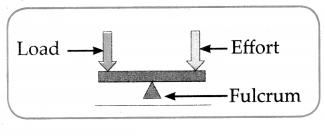
2. Lever of the Second order: The load is in the centre, the fulcrum on one side, and the effort on the other side. e.g. lid opener
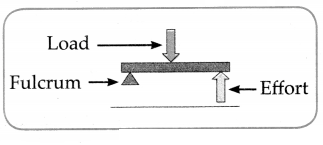
3. Lever of the Third order: The effort is in the centre, the fulcrum on one side, and the load on the other side. e.g. Tongs
Question 2.
How can machines be maintained?
Answer:
- To maintain machines, all its parts are wiped clean.
- Oil or lubricant is released between parts that rub against each other.
- Machines are covered, painted externally and always kept dry.
Question 3.
What is an inclined plane? Explain longer and shorter inclined plane.
Answer:
- A slanting plank used to lift a weight, is called an inclined plane. Because of inclined plane we will experience less weight and weight lifting become easier.
- Longer inclined plane: When the inclined plane is longer, the slope is more gradual and lesser is the weight we bear.
- Shorter inclined plane: When the inclined plane is shorter, the slope is steeper and greater is the weight we bear.
Question 6.
Explain the working of a giant wheel.
Answer:
- The giant wheel is fitted to a rod at its centre. This rod is called an axle.
- When the axle starts rotating with the help of electricity the wheel fitted to it starts rotating.
- This combination of an axle and a wheel is a simple machine.
Observe and discuss:
Question 1.
Name the devices and discuss how they help.
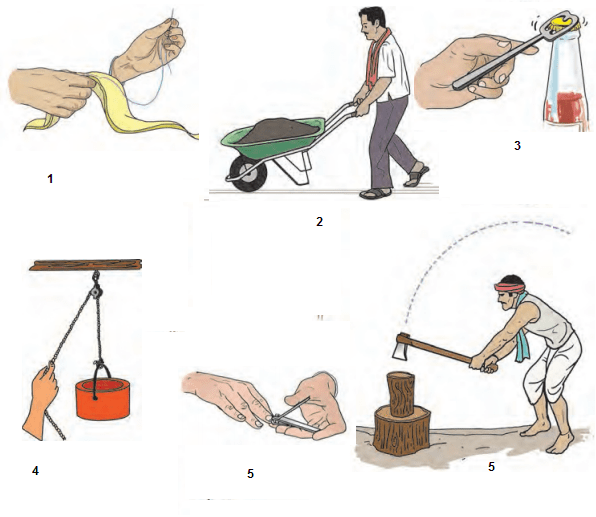
Answer:
- Needle and thread – Stitching of clothes
- Wheelbarrow – To carry materials.
- Opener – To open the lids of bottles.
- Pulley – To lift bucket
- Nail cutter – To cut nails
- Axe – To cut wood into small pieces
Can you tell?
Question 1.
Observe the machines shown in the following pictures. For what purposes are they used? Can you name some other machines of this kind?
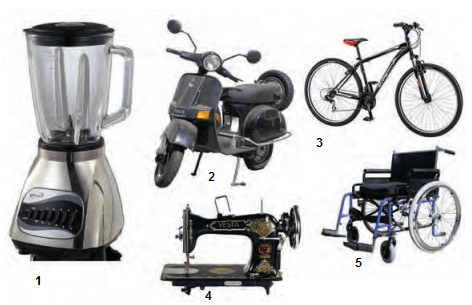
Answer:
- Mixer grinder – To grind the foodstuffs
- Scooter – To ride and reach places
- Bicycle – To ride and reach places
- Sewing machine – To stitch clothes
- Wheel chair – Specially designed for handicapped patients to move around.
Question 2.
Compare the pathway and a road, available to climb the mountain, the time and strength and your convenience, required to reach the mountain top.
Answer:
We can reach the mountain top by climbing the pathway early than by the road. The time required is less but the strength required is more. The road is easy to walk and more time consuming.
Question 3.
If the point of a needle or the edge of a knife become blunt, then the needle does not penetrate the cloth and the knife does not cut into the fruit. Why is this so?
Answer:
The tip of the needle or the edge of a knife becomes blunt due to regular use. Both the knife and the needle lose their sharpness.
Use your brain power!
Question 1.
Which task can be done using a lever?
Answer:
Task such as using a nut cracker, cutting paper with scissors, can be done using a lever.
Question 2.
Some machines we use in our day to day life are shown in picture. What is the type in each of these?
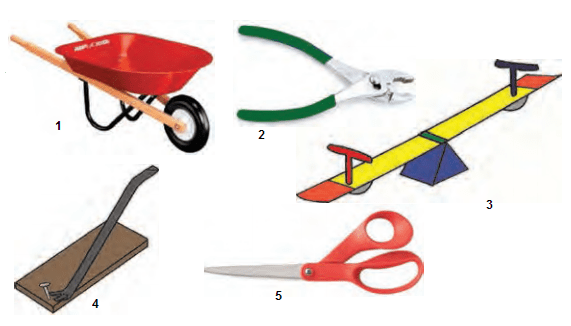
Answer:
- Wheelbarrow – Lever of the third order
- Pair of tongs – Lever of the first order
- See – saw – Lever of the first
- order Cutter – Lever of the second lever
- Pair of Scissors – Lever of the first order.
Question 3.
When the pedal of the bicycle is rotating, the wheel starts rotating. How does this happen?
Answer:
Pedals of the bicycle are connected to the wheels through the axle, when the axle starts rotating, the wheels also start rotating.
Question 4.
Examples of pulley.
Answer:
- A simple pulley is used to hoist a flag, to draw water from a well.
- The crane which is used to lift heavy loads is an example of application of pulleys and levers working together.
Download PDF
Maharashtra Board Solutions Class 6-Science: Chapter 12- Simple Machines
Download PDF: Maharashtra Board Solutions Class 6-Science: Chapter 12- Simple Machines PDF
Chapterwise Maharashtra Board Solutions Class 6 Science :
- Chapter 1- Natural Resources – Air, Water and Land
- Chapter 2- The Living World
- Chapter 3- Diversity in Living Things and their Classification
- Chapter 4- Disaster Management
- Chapter 5- Substances in the Surroundings – Their States and Properties
- Chapter 6- Substances in Daily Use
- Chapter 7- Nutrition and Diet
- Chapter 8- Our Skeletal System and the Skin
- Chapter 9- Motion and Types of Motion
- Chapter 10- Force and Types of Force
- Chapter 11- Work and Energy
- Chapter 12- Simple Machines
- Chapter 13- Sound
- Chapter 14- Light and the Formation of Shadows
- Chapter 15- Fun with Magnets
- Chapter 16- The Universe
FAQs
You can download the Maharashtra State Board Books from the eBalbharti official website, i.e. cart.ebalbharati.in or from this article.
Students can get the Maharashtra Books for primary, secondary, and senior secondary classes from here. You can view or download the Maharashtra State Board Books from this page or from the official website for free of cost. Students can follow the detailed steps below to visit the official website and download the e-books for all subjects or a specific subject in different mediums.
Step 1: Visit the official website ebalbharati.in
Step 2: On the top of the screen, select “Download PDF textbooks”
Step 3: From the “Classes” section, select your class.
Step 4: From “Medium”, select the medium suitable to you.
Step 5: All Maharashtra board books for your class will now be displayed on the right side.
Step 6: Click on the “Download” option to download the PDF book.
As of now, the MSCERT and Balbharti are responsible for the syllabus and textbooks of Classes 1 to 8, while Classes 9 and 10 are under the Maharashtra State Board of Secondary and Higher Secondary Education (MSBSHSE).
The Maharashtra State Board of Secondary & Higher Secondary Education, conducts the HSC and SSC Examinations in the state of Maharashtra through its nine Divisional Boards located at Pune, Mumbai, Aurangabad, Nasik, Kolhapur, Amravati, Latur, Nagpur and Ratnagiri.
About Maharashtra State Board (MSBSHSE)
The Maharashtra State Board of Secondary and Higher Secondary Education or MSBSHSE (Marathi: महाराष्ट्र राज्य माध्यमिक आणि उच्च माध्यमिक शिक्षण मंडळ), is an autonomous and statutory body established in 1965. The board was amended in the year 1977 under the provisions of the Maharashtra Act No. 41 of 1965.
The Maharashtra State Board of Secondary & Higher Secondary Education (MSBSHSE), Pune is an independent body of the Maharashtra Government. There are more than 1.4 million students that appear in the examination every year. The Maha State Board conducts the board examination twice a year. This board conducts the examination for SSC and HSC.
The Maharashtra government established the Maharashtra State Bureau of Textbook Production and Curriculum Research, also commonly referred to as Ebalbharati, in 1967 to take up the responsibility of providing quality textbooks to students from all classes studying under the Maharashtra State Board. MSBHSE prepares and updates the curriculum to provide holistic development for students. It is designed to tackle the difficulty in understanding the concepts with simple language with simple illustrations. Every year around 10 lakh students are enrolled in schools that are affiliated with the Maharashtra State Board.