
Class 12: Maths Chapter 1 solutions. Complete Class 12 Maths Chapter 1 Notes.
Maharashtra Board Solutions Class 12-Arts & Science Maths (Part 1): Chapter 1- Mathematical Logic
Maharashtra Board 12th Maths Chapter 1, Class 12 Maths Chapter 1 solutions
Ex 1.1
Question 1.
State which of the following sentences are statements. Justify your answer. In case of statement, write down the truth value :
(i) 5 + 4 = 13.
Solution:
It is a statement which is false, hence its truth value is ‘F’.
(ii) x – 3 = 14.
Solution:
It is an open sentence, hence it is not a statement.
(iii) Close the door.
Solution:
It is an imperative sentence, hence it is not a statement.
(iv) Zero is a complex number.
Solution:
It is a statement which is true, hence its truth value is ‘T’.
(v) Please get me breakfast.
Solution:
It is an imperative sentence, hence it is not a statement.
(vi) Congruent triangles are also similar.
Solution:
It is a statement which is true, hence its truth value is ‘T’.
(vii) x2 = x.
Solution:
It is an open sentence, hence it is not a statement,
(viii) A quadratic equation cannot have more than two roots.
Solution:
It is a statement which is true, hence its truth value is ‘T’.
(ix) Do you like Mathematics ?
Solution:
It is an interrogative sentence, hence it is not a statement.
(x) The sun sets in the west.
Solution:
It is a statement which is true, hence its truth value is ‘T’.
(xi) All real numbers are whole numbers.
Solution:
It is a statement which is false, hence its truth value is ‘F’.
(xii) Can you speak in Marathi ?
Solution:
It is an interrogative sentence, hence it is not a statement.
(xiii) x2 – 6x – 7 = 0, when x = 7.
Solution:
It is a statement which is true, hence its truth value is ‘T’.
(xiv) The sum of cuberoots of unity is zero.
Solution:
It is a statement which is true, hence its truth value is ‘T’.
(xv) It rains heavily.
Solution :
It is an open sentence, hence it is not a statement.
Question 2.
Write the following compound statements symbolically:
(i) Nagpur is in Maharashtra and Chennai is in Tamil Nadu.
Solution:
Let p : Nagpur is in Maharashtra.
q : Chennai is in Tamil Nadu.
Then the symbolic form of the given statement is P∧q.
(ii) Triangle is equilateral or isosceles,
Solution:
Let p : Triangle is equilateral.
q : Triangle is isosceles.
Then the symbolic form of the given statement is P∨q.
(iii) The angle is right angle if and only if it is of measure 90°.
Solution:
Let p : The angle is right angle.
q : It is of measure 90°.
Then the symbolic form of the given statement is p↔q
(iv) Angle is neither acute nor obtuse.
Solution:
Let p : Angle is acute.
q : Angle is obtuse.
Then the symbolic form of the given statement is
~p ∧ ~q.
(v) If ∆ ABC is right angled at B, then m∠A + m∠C = 90°.
Solution:
Let p : ∆ ABC is right angled at B.
q : m∠A + m∠C = 90°.
Then the symbolic form of the given statement is p → q
(vi) Hima Das wins gold medal if and only if she runs fast.
Solution:
Let p : Hima Das wins gold medal
q : She runs fast.
Then the symbolic form of the given statement is p ↔ q.
(vii) x is not irrational number but it is a square of an integer.
Solution:
Let p : x is not irrational number
q : It is a square of an integer
Then the symbolic form of the given statement is p ∧ q
Note : If p : x is irrational number, then the symbolic form of the given statement is ~p ∧ q.
Question 3.
Write the truth values of the following :
(i) 4 is odd or 1 is prime.
Solution:
Let p : 4 is odd.
q : 1 is prime.
Then the symbolic form of the given statement is p∨q.
The truth values of both p and q are F.
∴ the truth value of p v q is F. … [F ∨ F = F]
(ii) 64 is a perfect square and 46 is a prime number.
Solution:
Let p : 64 is a perfect square.
q : 46 is a prime number.
Then the symbolic form of the given statement is p∧q.
The truth values of p and q are T and F respectively.
∴ the truth value of p ∧ q is F. … [T ∧ F ≡ F]
(iii) 5 is a prime number and 7 divides 94.
Solution:
Let p : 5 is a prime number.
q : 7 divides 94.
Then the symbolic form of the given statement is p∧q.
The truth values of p and q are T and F respectively.
∴ the truth value of p ∧ q is F. … [T ∧ F ≡ F]
(iv) It is not true that 5 – 3i is a real number.
Solution:
Let p : 5 – 3i is a real number.
Then the symbolic form of the given statement is ~ p.
The truth values of p is F.
∴ the truth values of ~ p is T. … [~ F ≡ T]
(v) If 3 × 5 = 8, then 3 + 5 = 15.
Solution:
Let p : 3 × 5 = 8.
q : 3 + 5 = 15.
Then the symbolic form of the given statement is p → q.
The truth values of both p and q are F.
∴ the truth value of p → q is T. … [F → F ≡ T]
(vi) Milk is white if and only if sky is blue.
Solution:
Let p : Milk is white.
q : Sky is blue
Then the symbolic form of the given statement is p ↔ q.
The truth values of both p and q are T.
∴ the truth value of p ↔ q is T. … [T ↔ T ≡ T]
(vii) 24 is a composite number or 17 is a prime number.
Solution :
Let p : 24 is a composite number.
q : 17 is a prime number.
Then the symbolic form of the given statement is p ∨ q.
The truth values of both p and q are T.
∴ the truth value of p ∨ q is T. … [T ∨ T ≡ T]
Question 4.
If the statements p, q are true statements and r, s are false statements, then determine the truth values of the following:
(i) p ∨ (q ∧ r)
Solution:
Truth values of p and q are T and truth values of r and s are F.
p ∨ (q ∧ r) ≡ T ∨ (T ∧ F)
≡ T ∧ F ≡ T
Hence the truth value of the given statement is true.
(ii) (p → q) ∨ (r → s)
Solution:
(p → q) ∨ (r → s) ≡ (T → T) ∨ (F → F)
≡ T ∨ T ≡ T
Hence the truth value of the given statement is true.
(iii) (q ∧ r) ∨ (~p ∧ s)
Solution:
(q ∧ r) ∨ (~p ∧ s) ≡ (T ∧ F) ∨ (~T ∧ F)
≡ F ∨ (F ∧ F)
≡ F ∨ F ≡ F
Hence the truth value of the given statement is false.
(iv) (p → q) ∧ (~ r)
Solution:
(p → q) ∧ (~ r) ≡ (T → T) ∧ (~ F)
≡ T ∧ T ≡ T
Hence the truth value of the given statement is true.
(v) (~r ↔ p) → (~q)
Solution:
(~r ↔ p) → (~q) ≡ (~F ↔ T) → (~T)
≡ (T ↔ T) → F
≡ T → F ≡ F
Hence the truth value of the given statement is false.
(vi) [~p ∧ (~q ∧ r) ∨ (q ∧ r) ∨ (p ∧ r)]
Solution:
[~p ∧ (~q ∧ r)∨(q ∧ r)∨(p ∧ r)]
≡ [~T ∧ (~T ∧ F)] ∨ [(T ∧ F) V (T ∧ F)]
≡ [F ∧ (F ∧ F)] ∨ [F V F]
≡ (F ∧ F) ∨ F
≡ F ∨ F ≡ F
Hence the truth value of the given statement is false.
(vii) [(~ p ∧ q) ∧ (~ r)] ∨ [(q → p) → (~ s ∨ r)]
Solution:
[(~ p ∧ q) ∧ (~ r)] ∨ [(q → p) → (~ s ∨ r)]
≡ [(~T ∧ T) ∧ (~F)] ∨ [(T → T) → (~F ∨ F)]
≡ [(F ∧ T) ∧ T] ∨ [T → (T ∨ F)]
≡ (F ∧ T) ∨ (T → T)
≡ F ∨ T ≡ T
Hence the truth value of the given statement is true.
(viii) ~ [(~p ∧ r) ∨ (s → ~q)] ↔ (p ∧ r)
Solution :
~ [(~p ∧ r) ∨ (s → ~q)] ↔ (p ∧ r)
≡ ~ [(~T ∧ F) ∨ (F → ~T)] ↔ (T ∧ F)
≡ ~ [(F ∧ F) ∨ (F → F)] ↔ F
≡ ~ (F ∨ T) ↔ F
≡ ~T ↔ F
≡ F ↔ F ≡ T
Hence the truth value of the given statement is true.
Question 5.
Write the negations of the following :
(i) Tirupati is in Andhra Pradesh.
Solution:
The negations of the given statements are :
Tirupati is not in Andhra Pradesh.
(ii) 3 is not a root of the equation x2 + 3x – 18 = 0.
Solution:
3 is a root of the equation x2 + 3x – 18 = 0.
(iii) 2–√ is a rational number.
Solution:
2–√ is not a rational number.
(iv) Polygon ABCDE is a pentagon.
Solution:
Polygon ABCDE is not a pentagon.
(v) 7 + 3 > 5.
Solution :
7 + 3 > 5.
Ex 1.2
Question 1.
Construct the truth table for each of the following statement patterns:
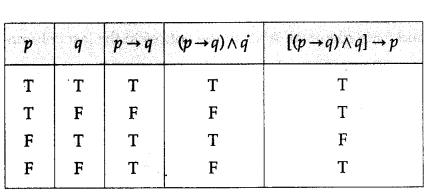
(i) [(p → q) ∧ q] → p
Solution :
Here are two statements and three connectives.
∴ there are 2 × 2 = 4 rows and 2 + 3 = 5 columns in the truth table.
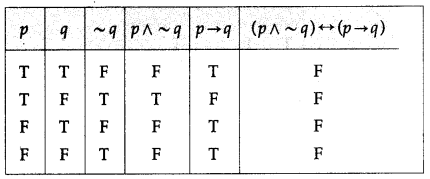
(ii) (p ∧ ~q) ↔ (p → q)
Solution:
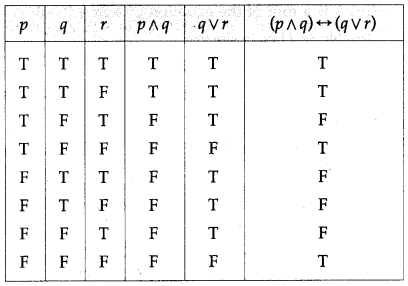
(iii) (p ∧ q) ↔ (q ∨ r)
Solution:
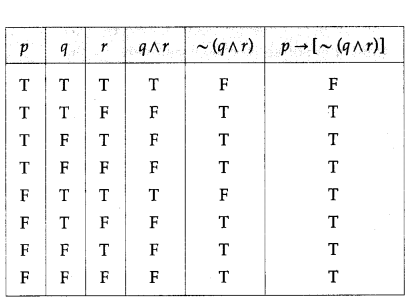
(iv) p → [~(q ∧ r)]
Solution:
(v) ~p ∧ [(p ∨ ~q ) ∧ q]
Solution:
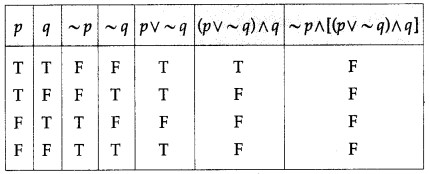
(vi) (~p → ~q) ∧ (~q → ~p)
Solution:
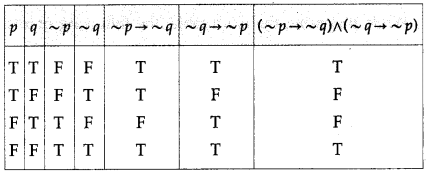
(vii) (q → p) ∨ (~p ↔ q)
Solution:
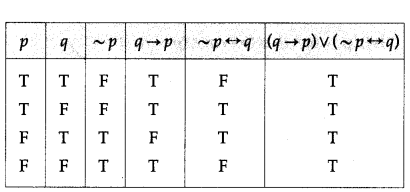
(viii) [p → (q → r)] ↔ [(p ∧ q) → r]
Solution:

(ix) p → [~(q ∧ r)]
Solution:
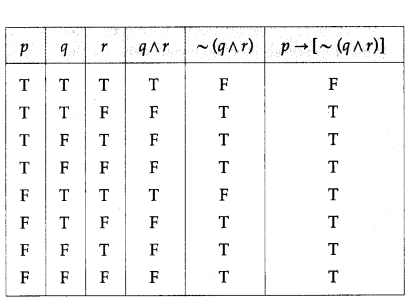
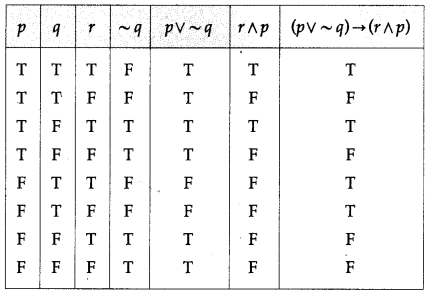
(x) (p ∨ ~q) → (r ∧ p)
Solution:
Question 2.
Using truth tables prove the following logical equivalences.
(i) ~p ∧ q ≡ (p ∨ q) ∧ ~p
Solution:
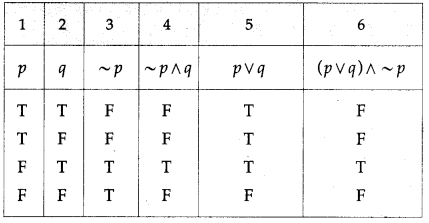
The entries in the columns 4 and 6 are identical.
∴ ~p ∧ q ≡ (p ∨ q) ∧ ~p.
(ii) ~(p ∨ q) ∨ (~p ∧ q) ≡ ~p
Solution:
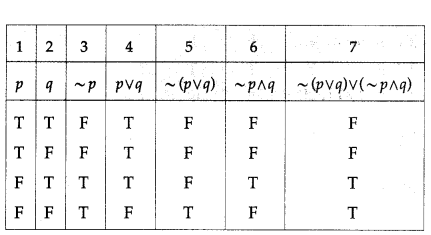
The entries in the columns 3 and 7 are identical.
∴ ~(p ∨ q) ∧ (~p ∧ q) = ~p.
(iii) p ↔ q ≡ ~[(p ∨ q) ∧ ~(p ∧ q)]
Solution:

The entries in the columns 3 and 8 are identical.
∴ p ↔ q ≡ ~[(p ∨ q) ∧ ~(p ∧ q)].
(iv) p → (q → p) ≡ ~p → (p → q)
Solution:
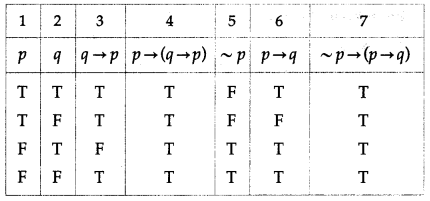
The entries in the columns 4 and 7 are identical.
∴ p → (q → p) ≡ ~p → (p → q).
(v) (p ∨ q ) → r ≡ (p → r) ∧ (q → r)
Solution:
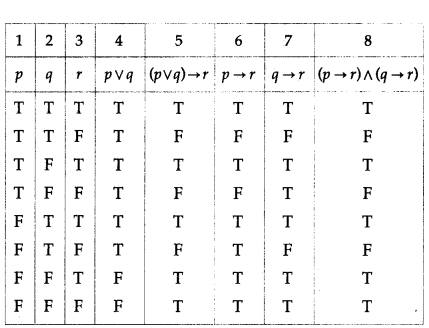
The entries in the columns 5 and 8 are identical.
∴ (p ∨ q ) → r ≡ (p → r) ∧ (q → r).
(vi) p → (q ∧ r) ≡ (p → q) ∧ (p → r)
Solution:
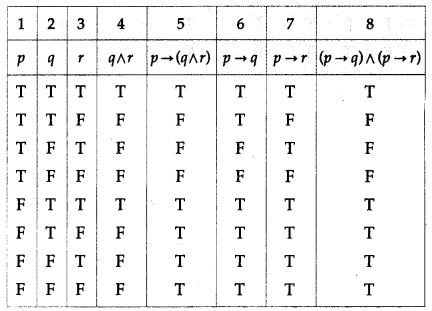
The entries in the columns 5 and 8 are identical.
∴ p → (q ∧ r) ≡ (p → q) ∧ (p → r).
(vii) p ∧ (q ∨ r) ≡ (p ∧ q) ∨ (p ∧ r)
Solution:
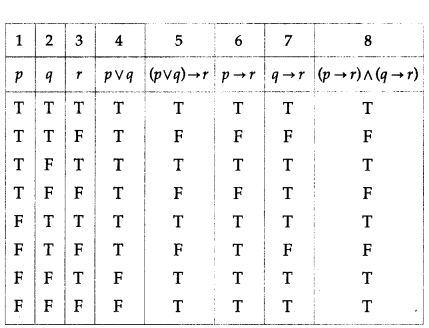
The entries in the columns 5 and 8 are identical.
∴ p ∧ (q ∨ r) ≡ (p ∧ q) ∨ (p ∧ r).
(viii) [~(p ∨ q) ∨ (p ∨ q)] ∧ r ≡ r
Solution:
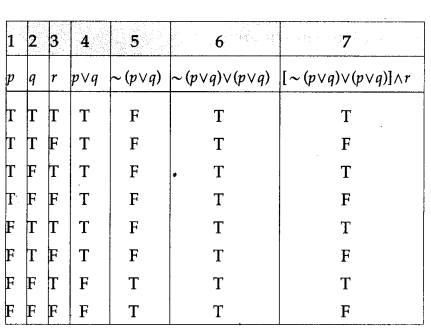
The entries in the columns 3 and 7 are identical.
∴ [~(p ∨ q) ∨ (p ∨ q)] ∧ r ≡ r.
(ix) ~(p ↔ q) ≡ (p ∧ ~q) ∨ (q ∧ ~p)
Solution:

The entries in the columns 6 and 9 are identical.
∴ ~(p ↔ q) ≡ (p ∧ ~q) ∨ (q ∧ ~p).
Question 3.
Examine whether each of the following statement patterns is a tautology or a contradiction or a contingency.
(i) (p ∧ q) → (q ∨ p)
Solution:
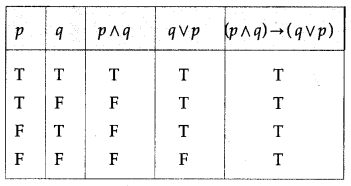
All the entries in the last column of the above truth table are T.
∴ (p ∧ q) → (q ∨ p) is a tautology.
(ii) (p → q) ↔ (~p ∨ q)
Solution:
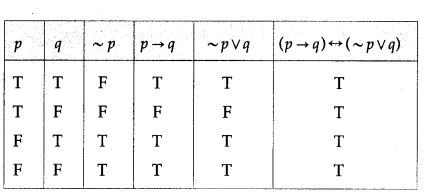
All the entries in the last column of the above truth table are T.
∴ (p → q) ↔ (~p ∨ q) p is a tautology.
(iii) [~(~p ∧ ~q)] ∨ q
Solution:
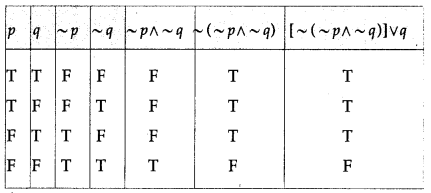
The entries in the last column of the above truth table are neither all T nor all F.
∴ [~(~p ∧ ~q)] ∨ q is a contingency.
(iv) [(p → q) ∧ q)] → p
Solution:
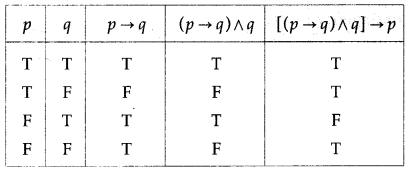
The entries in the last column of the above truth table are neither all T nor all F.
∴ [(p → q) ∧ q)] → p is a contingency
(v) [(p → q) ∧ ~q] → ~p
Solution:

All the entries in the last column of the above truth table are T.
∴ [(p → q) ∧ ~q] → ~p is a tautology.
(vi) (p ↔ q) ∧ (p → ~q)
Solution:
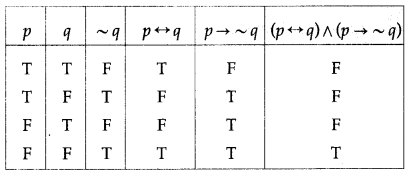
The entries in the last column of the above truth table are neither all T nor all F.
∴ (p ↔ q) ∧ (p → ~q) is a contingency.
(vii) ~(~q ∧ p) ∧ q
Solution:
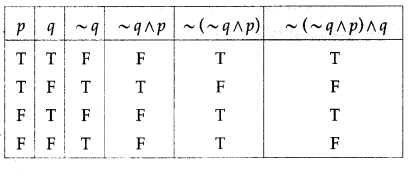
The entries in the last column of the above truth table are neither all T nor all F.
∴ ~(~q ∧ p) ∧ q is a contingency.
(viii) (p ∧ ~q) ↔ (p → q)
Solution:
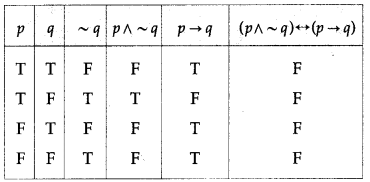
All the entries in the last column of the above truth table are F.
∴ (p ∧ ~q) ↔ (p → q) is a contradiction.
(ix) (~p → q) ∧ (p ∧ r)
Solution:
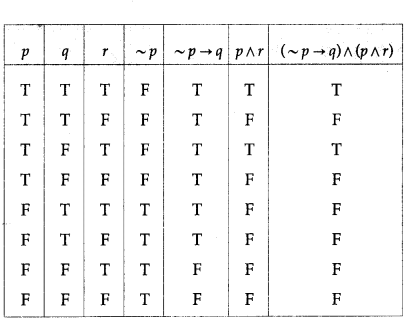
The entries in the last column of the above truth table are neither all T nor all F.
∴ (~p → q) ∧ (p ∧ r) is a contingency.
(x) [p → (~q ∨ r)] ↔ ~[p → (q → r)]
Solution:
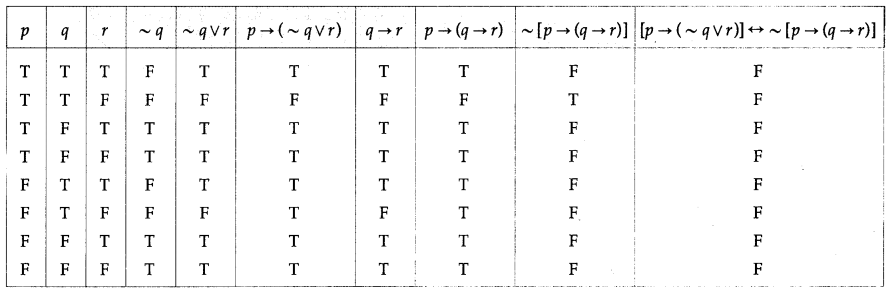
All the entries in the last column of the above truth table are F.
∴ [p → (~q ∨ r)] ↔ ~[p → (q → r)] is a contradiction
Ex 1.3
Question 1.
If A = {3, 5, 7, 9, 11, 12}, determine the truth value of each of the following.
(i) Ǝ x ∈ A such that x – 8 = 1
Solution:
Clearly x = 9 ∈ A satisfies x – 8 = 1. So the given statement is true, hence its truth value is T.
(ii) Ɐ x ∈ A, x2 + x is an even number
Solution:
For each x ∈ A, x2 + x is an even number. So the given statement is true, hence its truth value is T.
(iii) Ǝ x ∈ A such that x2 < 0
Solution:
There is no x ∈ A which satisfies x2 < 0. So the given statement is false, hence its truth value is F.
(iv) Ɐ x ∈ A, x is an even number
Solution:
x = 3 ∈ A, x = 5 ∈ A, x = 7 ∈ A, x = 9 ∈ A, x = 11 ∈ A do not satisfy x is an even number. So the given statement is false, hence its truth value is F.
(v) Ǝ x ∈ A such that 3x + 8 > 40
Solution:
Clearly x = 11 ∈ A and x = 12 ∈ A satisfies 3x + 8 > 40. So the given statement is true, hence its truth value is T.
(vi) Ɐ x ∈ A, 2x + 9 > 14
Solution:
For each x ∈ A, 2x + 9 > 14. So the given statement is true, hence its truth value is T.
Question 2.
Write the duals of each of the following.
(i) p ∨ (q ∧ r)
Solution:
The duals of the given statement patterns are :
p ∧ (q ∨ r)
(ii) p ∧ (q ∧ r)
Solution:
p ∨ (q ∨ r)
(iii) (p ∨ q) ∧ (r ∨ s)
Solution:
(p ∧ q) ∨ (r ∧ s)
(iv) p ∧ ~q
Solution:
p ∨ ~q
(v) (~p ∨ q) ∧ (~r ∧ s)
Solution:
(~p ∧ q) ∨ (~r ∨ s)
(vi) ~p ∧ (~q ∧ (p ∨ q) ∧ ~r)
Solution:
~p ∨ (~q ∨ (p ∧ q) ∨ ~r)
(vii) [~(p ∨ q)] ∧ [p ∨ ~(q ∧ ~s)]
Solution:
[ ~(p ∧ q)] ∨ [p ∧ ~(q ∨ ~s)]
(viii) c ∨ {p ∧ (q ∨ r)}
Solution:
t ∧ {p ∧ (q Ar)}
(ix) ~p ∨ (q ∧ r) ∧ t
Solution:
~p ∧ (q ∨ r) ∨ c
(x) (p ∨ q) ∨ c
Solution:
(p ∧ q) ∧ t
Question 3.
Write the negations of the following.
(i) x + 8 > 11 or y – 3 = 6
Solution:
Let p : x + 8 > 11, q : y — 3 = 6.
Then the symbolic form of the given statement is p ∨ q.
Since ~(p ∨ q) ≡ ~p ∧ ~q, the negation of given statement is :
‘x + 8 > 11 and y – 3 ≠ 6’ OR
‘x + 8 ≮ 11 and y – 3 ≠ 6’
(ii) 11 < 15 and 25 > 20
Solution:
Let p: 11 < 15, q : 25 > 20.
Then the symbolic form of the given statement is p ∧ q.
Since ~(p ∧ q) ≡ ~p ∨ ~q, the negation of given statement is :
’11 ≮ 15 or 25 > 20.’ OR
’11 ≯ 15 or 25 ≮ 20.’
(iii) Qudrilateral is a square if and only if it is a rhombus.
Solution:
Let p : Quadrilateral is a square.
q : It is a rhombus.
Then the symbolic form of the given statement is p ↔ q.
Since ~(p ↔ q) ≡ (p ∧ ~q) ∨ (q ∧ ~p), the negation of given statement is :
‘ Quadrilateral is a square but it is not a rhombus or quadrilateral is a rhombus but it is not a square.’
(iv) It is cold and raining.
Solution:
Let p : It is cold.
q : It is raining.
Then the symbolic form of the given statement is p ∧ q.
Since ~(p ∧ q) ≡ ~p ∨ ~q, the negation of the given statement is :
‘It is not cold or not raining.’
(v) If it is raining then we will go and play football.
Solution:
Let p : It is raining.
q : We will go.
r : We play football.
Then the symbolic form of the given statement is p → (q ∧ r).
Since ~[p → (q ∧ r)] ≡ p ∧ ~(q ∧ r) ≡ p ∧ (q ∨ ~r), the negation of the given statement is :
‘It is raining and we will not go or not play football.’
(vi) 2–√ is a rational number.
Solution:
Let p : 2–√ is a rational number.
The negation of the given statement is
‘ ~p : 2–√ is not a rational number.’
(vii) All natural numbers are whole numers.
Solution:
The negation of the given statement is :
‘Some natural numbers are not whole numbers.’
(viii) Ɐ n ∈ N, n2 + n + 2 is divisible by 4.
Solution:
The negation of the given statement is :
‘Ǝ n ∈ N, such that n2 + n + 2 is not divisible by 4.’
(ix) Ǝ x ∈ N such that x – 17 < 20
Solution:
The negation of the given statement is :
‘Ɐ x ∈ N, x – 17 ≯ 20.’
Question 4.
Write converse, inverse and contrapositive of the following statements.
(i) If x < y then x2 < y2 (x, y ∈ R)
Solution:
Let p : x < y, q : x2 < y2.
Then the symbolic form of the given statement is p → q.
Converse : q → p is the converse of p → q.
i.e. If x2 < y2, then x < y.
Inverse : ~p → ~q is the inverse of p → q.
i.e. If x ≯ y, then x2 ≯ y2. OR
If x ≮ y, then x2 ≮ y2.
Contrapositive : ~q → p is the contrapositive of
p → q i.e. If x2 ≯ y2, then x ≯ y. OR
If x2 ≮ y2, then x ≮ y.
(ii) A family becomes literate if the woman in it is literate.
Solution:
Let p : The woman in the family is literate.
q : A family become literate.
Then the symbolic form of the given statement is p → q
Converse : q → p is the converse of p → q.
i.e. If a family become literate, then the woman in it is literate.
Inverse : ~p → ~q is the inverse of p → q.
i.e. If the woman in the family is not literate, then the family does not become literate.
Contrapositive : ~q → ~p is the contrapositive of p → q. i e. If a family does not become literate, then the woman in it is not literate.
(iii) If surface area decreases then pressure increases.
Solution:
Let p : The surface area decreases.
q : The pressure increases.
Then the symbolic form of the given statement is p → q.
Converse : q → p is the converse of p→ q.
i.e. If the pressure increases, then the surface area decreases.
Inverse : ~p → ~q is the inverse of p → q.
i.e. If the surface area does not decrease, then the pressure does not increase.
Contrapositive : ~q → ~p is the contrapositive of p → q.
i.e. If the pressure does not increase, then the surface area does not decrease.
(iv) If voltage increases then current decreases.
Solution:
Let p : Voltage increases.
q : Current decreases.
Then the symbolic form of the given statement is p → q.
Converse : q →p is the converse of p → q.
i.e. If current decreases, then voltage increases.
Inverse : ~p → ~q is the inverse of p → q.
i.e. If voltage does not increase, then current does not decrease.
Contrapositive : ~q → ~p, is the contrapositive of p → q.
i.e. If current does not decrease, then voltage doesnot increase.
Ex 1.4
Question 1.
Using rules of negation write the negations of the following with justification.
(i) ~q → p
Solution:
The negation of ~q → p is
~(~q → p) ≡ ~ q ∧ ~p…. (Negation of implication)
(ii) p ∧ ~q
Solution:
The negation of p ∧ ~q is
~(p ∧ ~q) ≡ ~p ∨ ~(~q) … (Negation of conjunction)
≡ ~ p ∨ q … (Negation of negation)
(iii) p ∨ ~q
Solution:
The negation of p ∨ ~ p is
~ (p ∨ ~(q) ≡ ~p ∧ ~(~(q) … (Negation of disjunction)
≡ ~ p ∧ q … (Negation of negation)
(iv) (p ∨ ~q) ∧ r
Solution:
The negation of (p ∨ ~ q) ∧ r is
~[(p ∨ ~q) ∧ r] ≡ ~(p ∨ ~q) ∨ ~r … (Negation of conjunction)
≡ [ ~p ∧ ~(~q)] ∨ ~ r… (Negation of disjunction)
≡ (~ p ∧ q) ∧ ~ r … (Negation of negation)
(v) p → (p ∨ ~q)
Solution:
The negation of p → (p ∨ ~q) is
~ [p → (p ∨ ~q)] ≡ p ∧ ~ (p ∧ ~p) … (Negation of implication)
≡ p ∧ [ ~ p ∧ ~ (~(q)] … (Negation of disjunction)
≡ p ∧ (~ p ∧ q) (Negation of negation)
(vi) ~(p ∧ q) ∨ (p ∨ ~q)
Solution:
The negation of ~(p ∧ q) ∨ (p ∨ ~q) is
~[~(p ∧ q) ∨ (p ∨ ~q)] ≡ ~[~(p ∧ q)] ∧ ~(p ∨ ~q) … (Negation of disjunction)
≡ ~[~(p ∧ q)] ∧ [ p ∧ ~(~q)] … (Negation of disjunction)
≡ (p ∧ q) ∧ (~ p ∧ q) … (Negation of negation)
(vii) (p ∨ ~q) → (p ∧ ~q)
Solution:
The negation of (p ∨ ~q) → (p ∧ ~q) is
~[(p ∨ ~q) → (p ∧ ~q)]
≡ (p ∨ ~q) ∧ ~(p ∧ ~q) … (Negation of implication)
≡ (p ∨ ~q) ∧ [ ~p ∨ ~(~q)] … (Negation of conjunction)
≡ (p ∨ ~q) ∧ (~p ∨ q) … (Negation of negation)
(viii) (~ p ∨ ~q) ∨ (p ∧ ~q)
Solution:
The negation of (~ p ∨ ~q) ∨ (p ∧ ~ q) is
~ [(~p ∨ ~q) ∨ (p ∧ ~ q)]
≡ ~(~p ∨ ~q) ∧ ~(p ∧ ~q) … (Negation of disjunction)
≡ [~(~p) ∧ ~(~q)] ∧ [~p ∨ ~(~q)] … (Negation of disjunction and conjunction)
≡ (p ∧ q) ∧ (~p ∨ q) … (Negation of negation)
Question 2.
Rewrite the following statements without using if .. then.
(i) If a man is a judge then he is honest.
Solution:
Since p → ≡ ~p ∨ q, the given statements can be written as :
A man is not a judge or he is honest.
(ii) It 2 is a rational number then 2–√ is irrational number.
Solution:
2 is not a rational number or 2–√ is irrational number.
(iii) It f(2) = 0 then f(x) is divisible by (x – 2).
Solution:
f(2) ≠ 0 or f(x) is divisible by (x – 2).
Question 3.
Without using truth table prove that :
(i) p ↔ q ≡ (p∧ q) ∨ (~ p ∧ ~q)
Solution:
LHS = p ↔ q
≡ (p ↔ q) ∧ (q ↔ p) … (Biconditional Law)
≡ (~p ∨ q) ∧ (~q ∨ p) … (Conditional Law)
≡ [~p ∧ (~q ∨ p)] ∨ [q ∧ (~q ∨ p)] … (Distributive Law)
≡ [(~p ∧ ~q) ∨ (~p ∧ p)] ∨ [(q ∧ ~q) ∨ (q ∧ p)] … (Distributive Law)
≡ [(~p ∧ ~q) ∨ F] ∨ [F ∨ (q ∧ p)] … (ComplementLaw)
≡ (~ p ∧ ~ q) ∨ (q ∧ p) … (Identity Law)
≡ (~ p ∧ ~ q) ∨ (p ∧ q) … (Commutative Law)
≡ (p ∧ q) ∨ (~p ∧ ~q) … (Commutative Law)
≡ RHS.
(ii) (p ∨ q) ∧ (p ∨ ~q) ≡ p
Solution:
LHS = (p ∨ q) ∧ (p ∨ ~q)
≡ p ∨ (q ∧ ~q) … (Distributive Law)
≡ p ∨ F … (Complement Law)
≡ p … (Identity Law)
≡ RHS.
(iii) (p ∧ q) ∨ (~ p ∧ q) ∨ (p ∧ ~q) ≡ p ∨ q
Solution:
LHS = (p ∧ q) v (~p ∧ q) ∨ (p ∧ ~q)
≡ [(p ∨ ~p) ∧ q] ∨ (p ∧ ~q) … (Distributive Law)
≡ (T ∧ q) ∨ (p ∧ ~q) … (Complement Law)
≡ q ∨ (p ∧ ~q) … (Identity Law)
≡ (q ∨ p) ∧ (q ∨ ~q) … (Distributive Law)
≡ (q ∨ p) ∧ T .. (Complement Law)
≡ q ∨ p … (Identity Law)
≡ p ∨ q … (Commutative Law)
≡ RHS.
(iv) ~[(p ∨ ~q) → (p ∧ ~q)] ≡ (p ∨ ~q) ∧ (~p ∨ q)
Solution:
LHS = ~[(p ∨ ~q) → (p ∧ ~q)]
≡ (p ∨ ~q) ∧ ~(p ∧ ~q) … (Negation of implication)
≡ (p ∨ ~q) ∧ [~p ∨ ~(~q)] … (Negation of conjunction)
≡ (p ∨ ~ q) ∧ (~p ∨ q)… (Negation of negation)
≡ RHS.
Ex 1.5
Question 1.
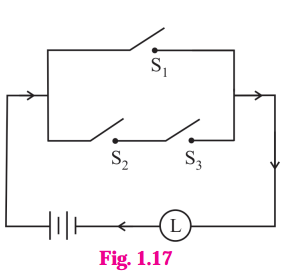
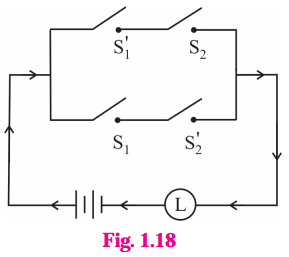
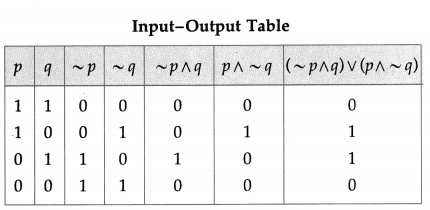
Express the following circuits in the symbolic form of logic and writ the input-output table.
(i)
Solution:
Let p : the switch S1 is closed
q : the switch S2 is closed
r : the switch S3 is closed
~p : the switch S1‘ is closed or the switch S1is open
~q : the switch S2‘ is closed or the switch S2 is open
~r : the switch S3‘ is closed or the switch S3 is open
l : the lamp L is on
(i) The symbolic form of the given circuit is : p ∨ (q ∧ r) = l
l is generally dropped and it can be expressed as : p ∨ (q ∧ r).

(ii)
Solution:
The symbolic form of the given circuit is : (~ p ∧ q) ∨ (p ∧ ~ q).
(iii)
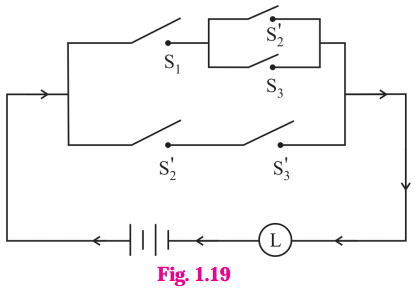
Solution:
The symbolic form of the given circuit is : [p ∧ (~q ∨ r)] ∨ (~q ∧ ~ r).
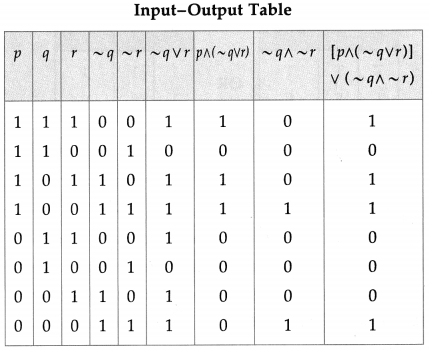
(iv)
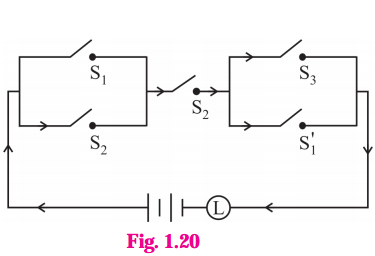
Solution:
The symbolic form of the given circuit is : (p ∨ q) ∧ q ∧ (r ∨ ~p).
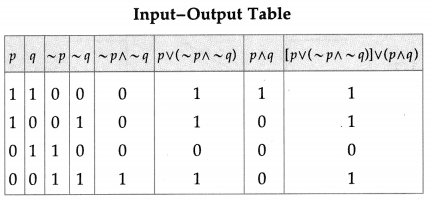
(v)
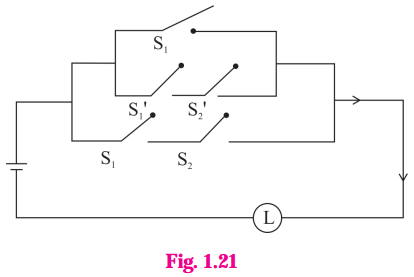
Solution:
The symbolic form of the given circuit is : [p ∨ (~p ∧ ~q)] ∨ (p ∧ q).
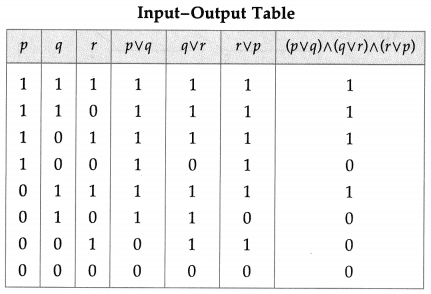
(vi)

Solution:
The symbolic form of the given circuit is : (p ∨ q) ∧ (q ∨ r) ∧ (r ∨ p)
Question 2.
Construct the switching circuit of the following :
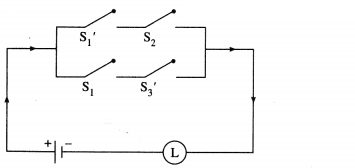
(i) (~p∧ q) ∨ (p∧ ~r)
Solution:
Let p : the switch S1 is closed
q : the switch S2 is closed
r : the switch S3 is closed
~p : the switch S1‘ is closed or the switch S1 is open
~ q : the switch S2‘ is closed or the switch S2 is open
~ r : the switch S3‘ is closed or the switch S3 is open.
Then the switching circuits corresponding to the given statement patterns are :
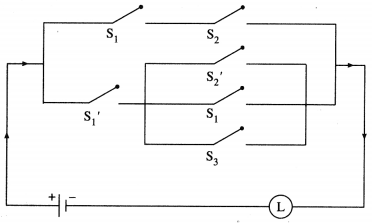
(ii) (p∧ q) ∨ [~p ∧ (~q ∨ p ∨ r)]
Solution:
(iii) [(p ∧ r) ∨ (~q ∧ ~r)] ∧ (~p ∧ ~r)
Solution:
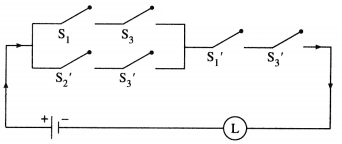
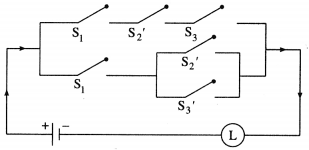
(iv) (p ∧ ~q ∧ r) ∨ [p ∧ (~q ∨ ~r)]
Solution:
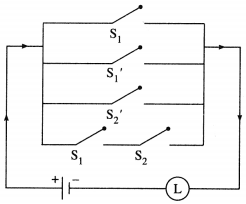
(v) p ∨ (~p ) ∨ (~q) ∨ (p ∧ q)
Solution:
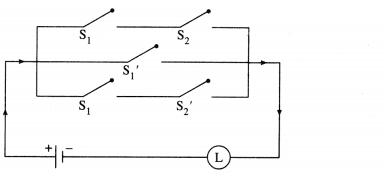
(vi) (p ∧ q) ∨ (~p) ∨ (p ∧ ~q)
Solution:
Question 3.
Give an alternative equivalent simple circuits for the following circuits :
(i)
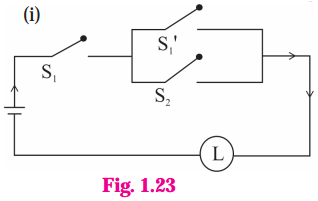
Solution:
(i) Let p : the switch S1 is closed
q : the switch S2 is closed
~ p : the switch S1‘ is closed or the switch Si is open Then the symbolic form of the given circuit is :
p ∧ (~p ∨ q).
Using the laws of logic, we have,
p ∧ (~p ∨ q)
= (p ∧ ~ p) ∨ (p ∧ q) …(By Distributive Law)
= F ∨ (p ∧ q) … (By Complement Law)
= p ∧ q… (By Identity Law)
Hence, the alternative equivalent simple circuit is :
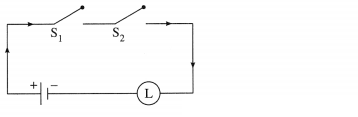
(ii)

Let p : the switch S1 is closed
q : the switch S2 is closed
r : the switch S3 is closed
~q : the switch S2‘ is closed or the switch S2 is open
~r : the switch S3‘ is closed or the switch S3 is open.
Then the symbolic form of the given circuit is :
[p ∧ (q ∨ r)] ∨ (~r ∧ ~q ∧ p).
Using the laws of logic, we have
[p ∧ (q ∨ r)] ∨ (~r ∧ ~q ∧ p)
≡ [p ∧ (q ∨ r)] ∨ [ ~(r ∨ q) ∧ p] …. (By De Morgan’s Law)
≡ [p ∧ (q ∨ r)] ∨ [p ∧ ~(q ∨ r)] … (By Commutative Law)
≡ p ∧ [(q ∨ r) ∨ ~(q ∨ r)) … (By Distributive Law)
≡ p ∧ T … (By Complement Law)
≡ p … (By Identity Law)
Hence, the alternative equivalent simple circuit is :
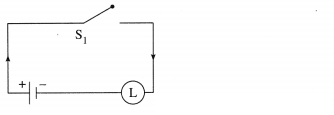
Question 4.
Write the symbolic form of the following switching circuits construct its switching table and interpret it.
i)

Solution:
Let p : the switch S1 is closed
q : the switch S2 is closed
~p : the switch S1‘ is closed or the switch S1 is open
~ q : the switch S2‘ is closed or the switch S2 is open.
Then the symbolic form of the given circuit is :
(p ∨ ~q) ∨ (~p ∧ q)
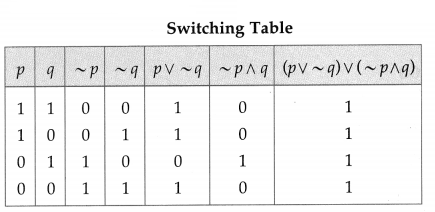
Since the final column contains all’ 1′, the lamp will always glow irrespective of the status of switches.
ii)
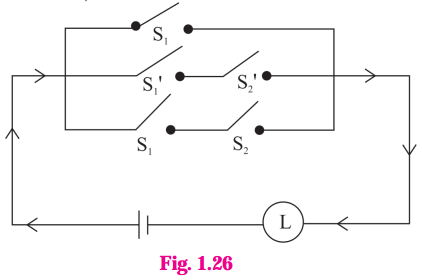
Solution:
Let p : the switch S1 is closed
q : the switch S2 is closed
~p : the switch S1 is closed or the switch S1 is open.
~q : the switch S2‘ is closed or the switch S2 is open.
Then the symbolic form of the given circuit is : p ∨ (~p ∧ ~q) ∨ (p ∧ q)
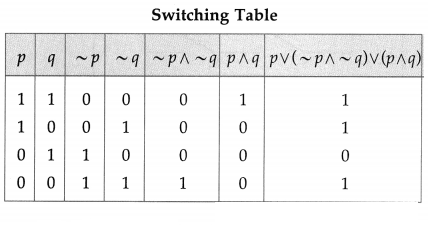
Since the final column contains ‘0’ when p is 0 and q is ‘1’, otherwise it contains ‘1′.
Hence, the lamp will not glow when S1 is OFF and S2 is ON, otherwise the lamp will glow.
iii)

Solution:
Let p : the switch S1 is closed
q : the switch S2 is closed
r : the switch S3 is closed
~q : the switch S2‘ is closed or the switch S2 is open
~r: the switch S3‘ is closed or the switch S3 is open.
Then the symbolic form of the given circuit is : [p ∨ (~q) ∨ r)] ∧ [p ∨ (q ∧ r)]
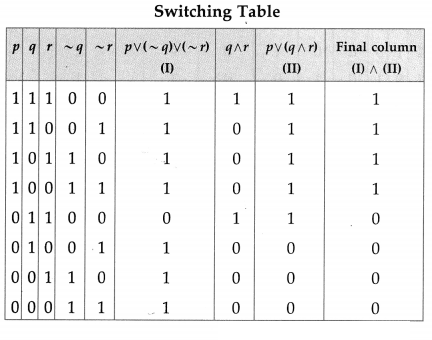
From the switching table, the ‘final column’ and the column of p are identical. Hence, the lamp will glow which S1 is ‘ON’.
Question 5.
Obtain the simple logical expression of the following. Draw the corresponding switching circuit.
(i) p ∨ (q ∧ ~ q)
Solution:
Using the laws of logic, we have, p ∨ (q ∧ ~q)
≡ p ∨ F … (By Complement Law)
≡ p … (By Identity Law)
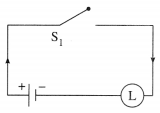
Hence, the simple logical expression of the given expression is p.
Let p : the switch S1 is closed
Then the corresponding switching circuit is :
(ii) (~p ∧ q) ∨ (~p ∧ ~q) ∨ (p ∧ ~q)]
Solution:
Using the laws of logic, we have,
(~p ∧ q) ∨ (~p ∨ ~q) ∨ (p ∧ ~q)
≡ [~p ∧ (q ∨ ~q)] ∨ (p ∧ ~ q)… (By Distributive Law)
≡ (~p ∧ T) ∨ (p ∧ ~q) … (By Complement Law)
≡ ~p ∨ (p ∧ ~q) … (By Identity Law)
≡ (~p ∨ p) ∧ (~p ∧~q) … (By Distributive Law)
≡ T ∧ (~p ∧ ~q) … (By Complement Law)
≡ ~p ∨ ~q … (By Identity Law)
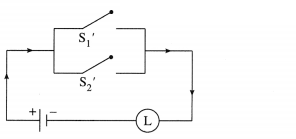
Hence, the simple logical expression of the given expression is ~ p ∨ ~q.
Let p : the switch S1 is closed
q : the switch S2 is closed
~ p : the switch S1‘ is closed or the switch S1 is open
~ q : the switch S2‘ is closed or the switch S2 is open,
Then the corresponding switching circuit is :
(iii) [p (∨ (~q) ∨ ~r)] ∧ (p ∨ (q ∧ r)
Solution:
Using the laws of logic, we have,
[p ∨ (~ (q) ∨ (~r)] ∧ [p ∨ (q ∧ r)]
= [p ∨ { ~(q ∧ r)}] ∧ [p ∨ (q ∧ r)] … (By De Morgan’s Law)
= p ∨ [~(q ∧ r) ∧ (q ∧ r) ] … (By Distributive Law)
= p ∨ F … (By Complement Law)
= p … (By Identity Law)
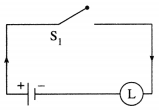
Hence, the simple logical expression of the given expression is p.
Let p : the switch S1 is closed
Then the corresponding switching circuit is :
(iv) (p ∧ q ∧ ~p) ∨ (~p ∧ q ∧ r) ∨ (p ∧ ~q ∧ r) ∨ (p ∧ q ∧ r)
Question is Modified
(p ∧ q ∧ ~p) ∨ (~p ∧ q ∧ r)∨ (p ∧ q ∧ r)
Solution:
Using the laws of logic, we have,
(p ∧ q ∧ ~p) ∨ (~p ∧ q ∧ r) ∨ (p ∧ q ∧ r)
= (p ∧ ~p ∧ q) ∨ (~p ∧ q ∧ r) ∨ (p ∧ q ∧ r) … (By Commutative Law)
= (F ∧ q) ∨ (~p ∧ q ∧ r) ∨ (p ∧ q ∧ r) … (By Complement Law)
= F ∨ (~p ∧ q ∧ r) ∨ (p ∧ q ∧ r) … (By Identity Law)
= (~p ∧ q ∧ r) ∨ (p ∧ q ∧ r) … (By Identity Law)
= (~ p ∨ p) ∧ (q ∧ r) … (By Distributive Law)
= T ∧ (q ∧ r) … (By Complement Law)
= q ∧ r … (By Identity Law)
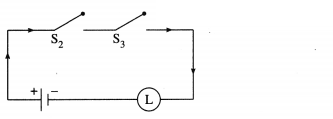
Hence, the simple logical expression of the given expression is q ∧ r.
Let q : the switch S2 is closed
r : the switch S3 is closed.
Then the corresponding switching circuit is :
Download PDF
Maharashtra Board Solutions Class 12 Maths (Part 1): Chapter 1- Mathematical Logic
Download PDF: Maharashtra Board Solutions Class 12 Maths (Part 1): Chapter 1- Mathematical Logic PDF
Chapterwise Maharashtra Board Solutions Class 12 Arts & Science Maths (Part 1) :
- Chapter 1- Mathematical Logic
- Chapter 2- Matrices
- Chapter 3- Trigonometric Functions
- Chapter 4- Pair of Straight Lines
- Chapter 5- Vectors
- Chapter 6- Line and Plane
- Chapter 7- Linear Programming