Maharashtra Board Senior Secondary (12th) Private Session 2025-26 Free Open Access

Maharashtra Board Solutions Class 11-Arts & Science Maths (Part 2): Chapter 4- Methods of Induction and Binomial Theorem

Class 11: Maths Chapter 4 solutions. Complete Class 11 Maths Chapter 4 Notes. Maharashtra Board Solutions Class 11-Arts & Science Maths (Part 2): Chapter 4- Methods of Induction and Binomial Theorem...

Curriculum Maharashtra Board
Applicable Grade Class 11
Medium English & Hindi
Resource Format Chapter Q&A / PDF

Textbook Solutions & Academic Guide

Verified chapter-wise solutions, answers, and study notes

Curriculum & Exam Preparation Note: Regular practice of NCERT textbook exercises and chapter-end questions establishes strong conceptual clarity for primary and secondary examinations.

Class 11: Maths Chapter 4 solutions. Complete Class 11 Maths Chapter 4 Notes.

Maharashtra Board Solutions Class 11-Arts & Science Maths (Part 2): Chapter 4- Methods of Induction and Binomial Theorem

Maharashtra Board 11th Maths Chapter 4, Class 11 Maths Chapter 4 solutions

Ex 4.1

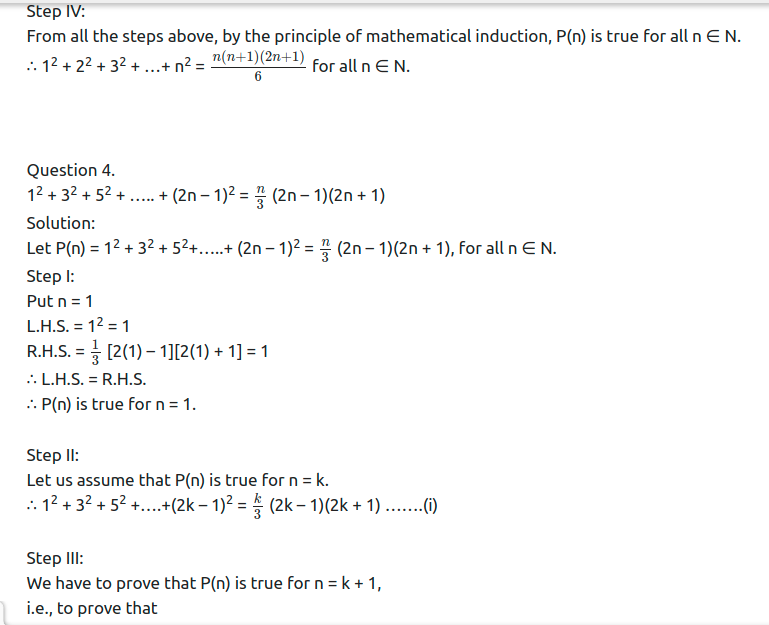
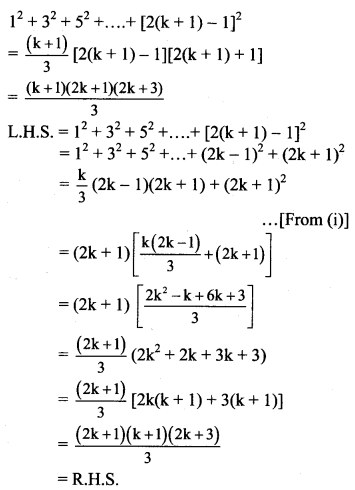
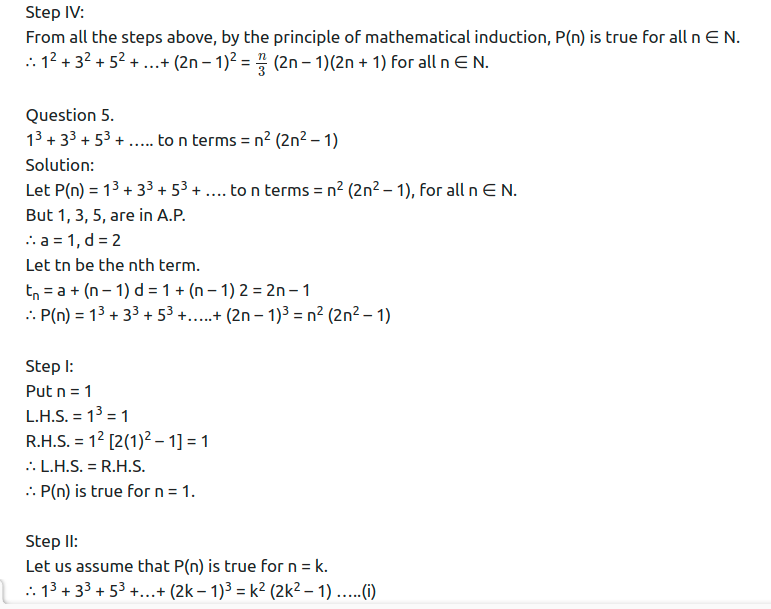
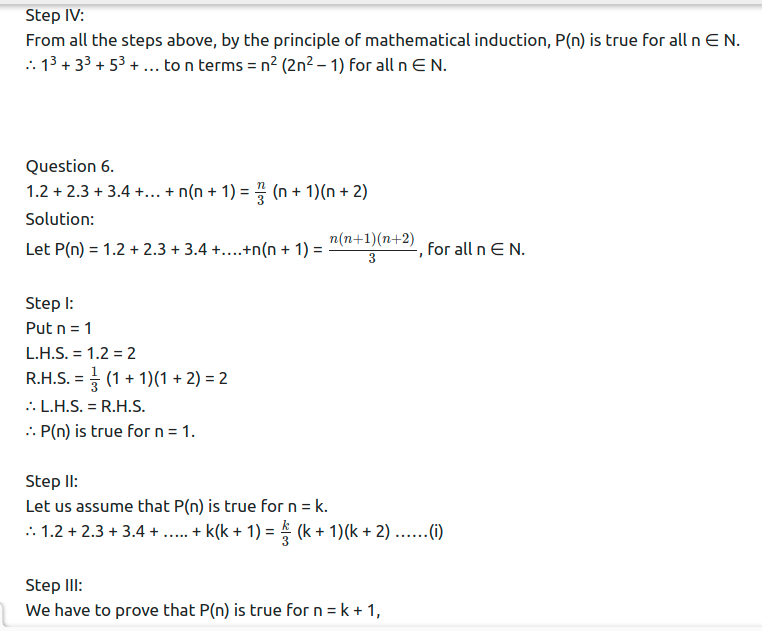
Prove by the method of induction, for all n ∈ N.

Question 1.
2 + 4 + 6 + …… + 2n = n(n + 1)
Solution:

Let P(n) = 2 + 4 + 6 + …… + 2n = n(n + 1), for all n ∈ N.
Step I:
Put n = 1
L.H.S. = 2
R.H.S. = 1(1 + 1) = 2
∴ L.H.S. = R.H.S.
∴ P(n) is true for n = 1.

Step II:
Let us assume that P(n) is true for n = k.
∴ 2 + 4 + 6 + ….. + 2k = k(k + 1) ……(i)

Step III:
We have to prove that P(n) is true for n = k + 1,
i.e., to prove that
2 + 4 + 6 + …… + 2(k + 1) = (k + 1) (k + 2)
L.H.S. = 2 + 4 + 6 + …+ 2(k + 1)
= 2 + 4 + 6+ ….. + 2k + 2(k + 1)
= k(k + 1) + 2(k + 1) …..[From (i)]
= (k + 1).(k + 2)
= R.H.S.
∴ P(n) is true for n = k + 1.

Step IV:
From all the steps above, by the principle of mathematical induction, P(n) is true for all n ∈ N.
∴ 2 + 4 + 6 + …… + 2n = n(n + 1) for all n ∈ N.

Question 2.
3 + 7 + 11 + ……… to n terms = n(2n + 1)
Solution:

Let P(n) = 3 + 7 + 11 + ……… to n terms = n(2n +1), for all n ∈ N.
But 3, 7, 11, …. are in A.P.
∴ a = 3 and d = 4
Let tn be the nth term.
∴ tn = a + (n – 1)d = 3 + (n – 1)4 = 4n – 1
∴ P(n) = 3 + 7 + 11 + ……. + (4n – 1) = n(2n + 1)

Step I:
Put n = 1
L.H.S. = 3
R.H.S. = 1[2(1)+ 1] = 3
∴ L.H.S. = R.H.S.
∴ P(n) is true for n = 1.

Step II:
Let us assume that P(n) is true for n = k.
∴ 3 + 7 + 11 + ….. + (4k – 1) = k(2k + 1) …..(i)

Sept III:
We have to prove that P(n) is true for n = k + 1,
i.e., to prove that
3 + 7 + 11 + …+ [4(k + 1) – 1] = (k + 1)(2k + 3)
L.H.S. = 3 + 7 + 11 + …… + [4(k + 1) – 1]
= 3 + 7 + 11 + ….. + (4k – 1) + [4(k+ 1) – 1]
= k(2k + 1) + (4k + 4 – 1) …..[From (i)]
= 2k2 + k + 4k + 3
= 2k2 + 2k + 3k + 3
= 2k(k + 1) + 3(k + 1)
= (k + 1) (2k + 3)
= R.H.S.
∴ P(n) is true for n = k + 1.

Step IV:
From all the steps above, by the principle of mathematical induction, P(n) is true for all n ∈ N.
∴ 3 + 7 + 11 + ….. to n terms = n(2n + 1) for all n ∈ N.
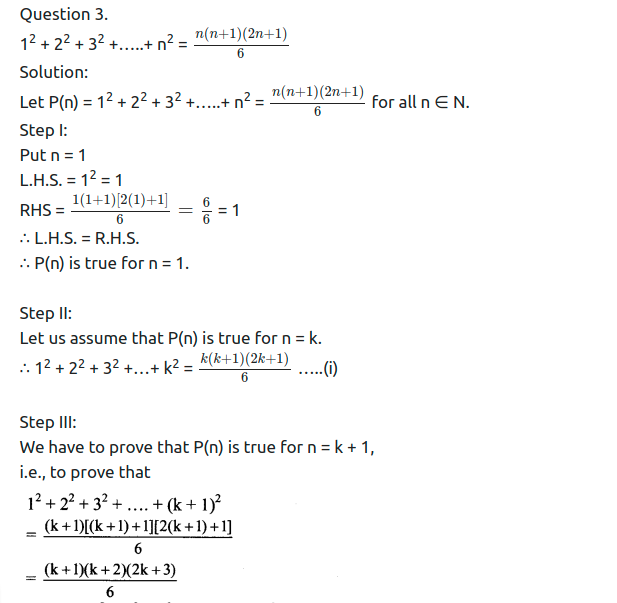
Maharashtra Board Solutions Class 11-Arts & Science Maths (Part 2): Chapter 4- Methods of Induction and Binomial Theorem Ex 4.1

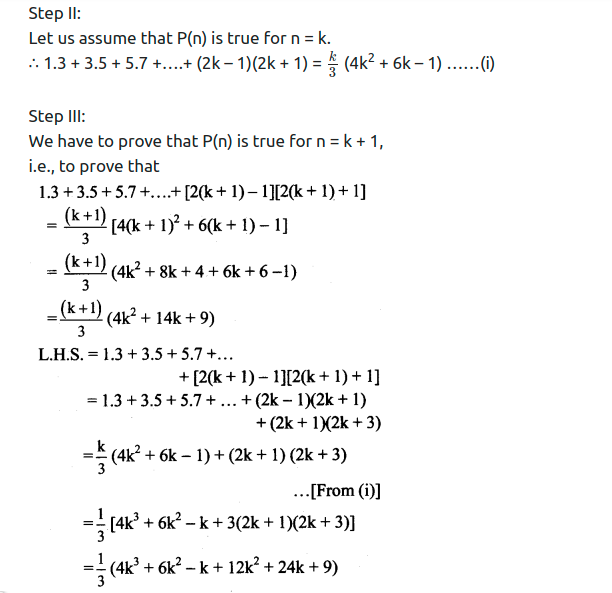
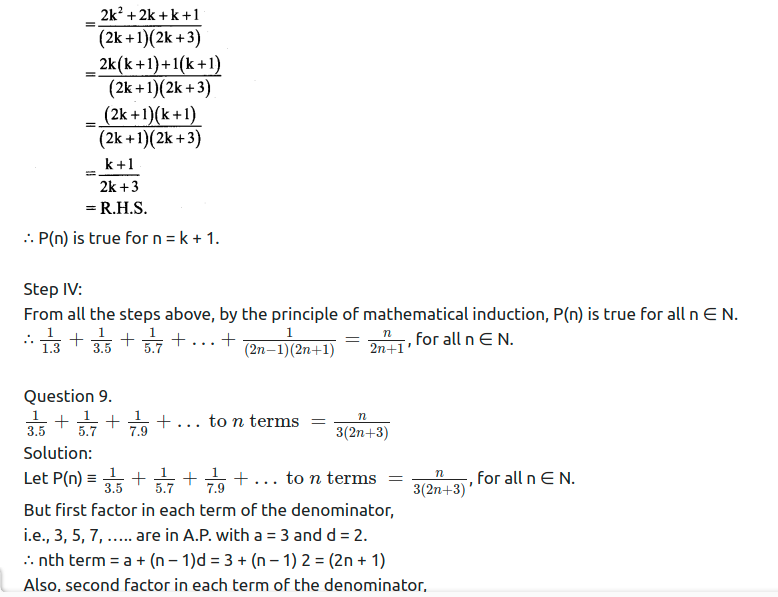
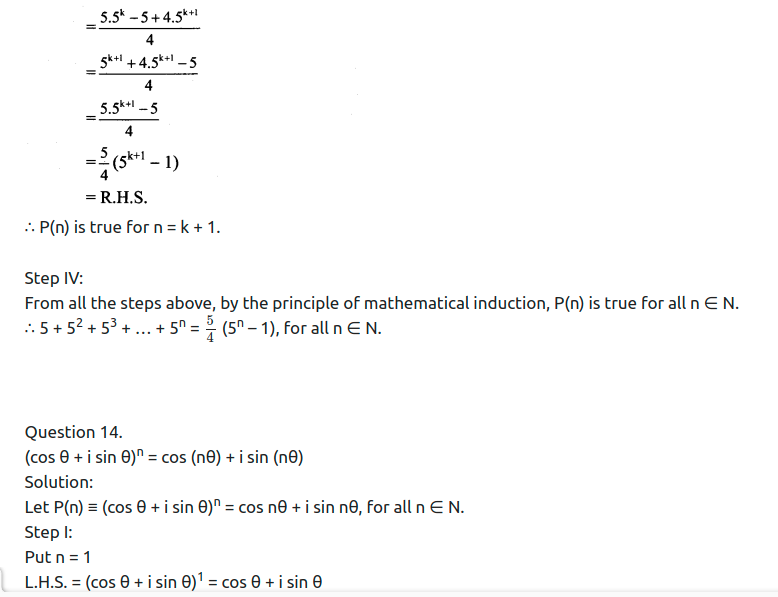
∴ P(n) is true for n = k + 1.

Maharashtra Board Solutions Class 11-Arts & Science Maths (Part 2): Chapter 4- Methods of Induction and Binomial Theorem Ex 4.1

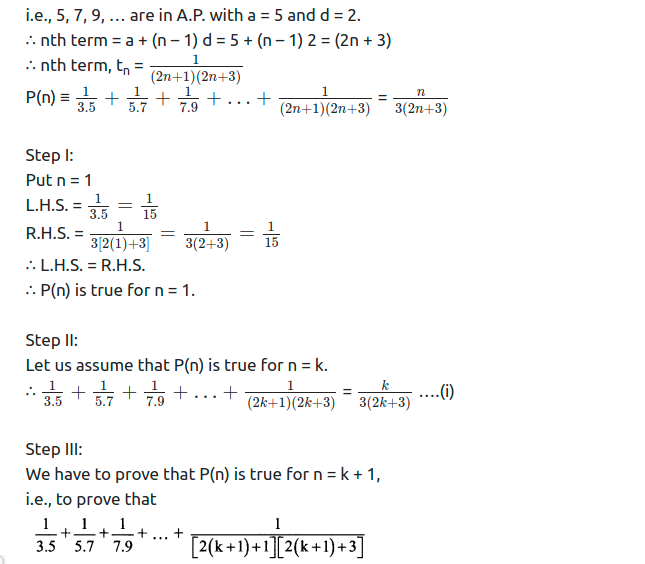
Step III:
We have to prove that P(n) is true for n = k + 1,
i.e., to prove that

Maharashtra Board Solutions Class 11-Arts & Science Maths (Part 2): Chapter 4- Methods of Induction and Binomial Theorem Ex 4.1

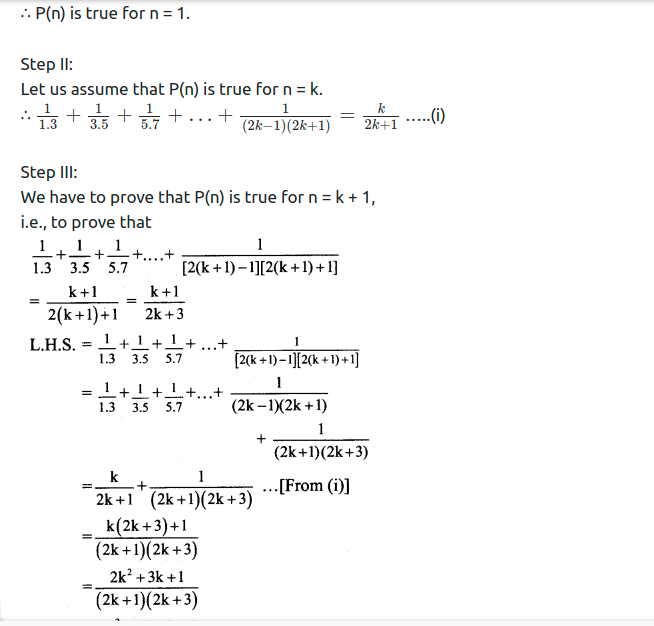
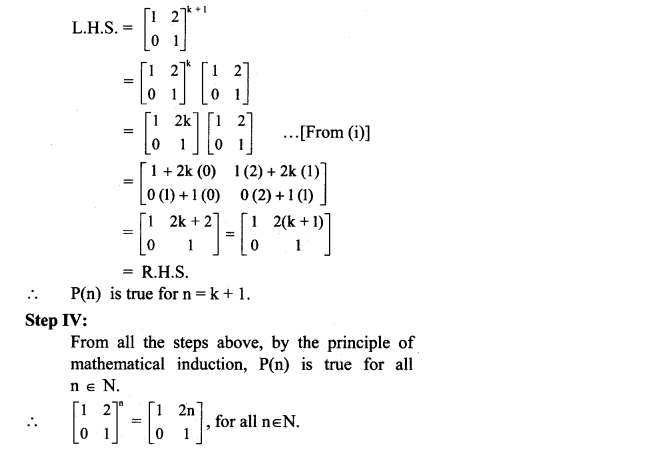
∴ P(n) is true for n = k + 1.

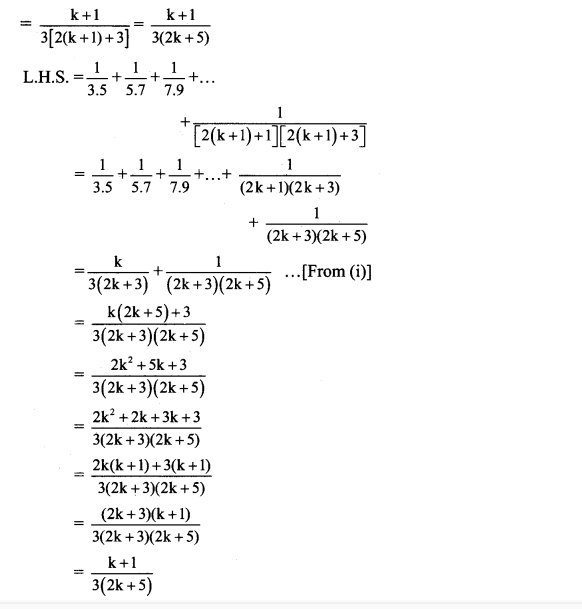
Maharashtra Board Solutions Class 11-Arts & Science Maths (Part 2): Chapter 4- Methods of Induction and Binomial Theorem Ex 4.1

i.e., to prove that

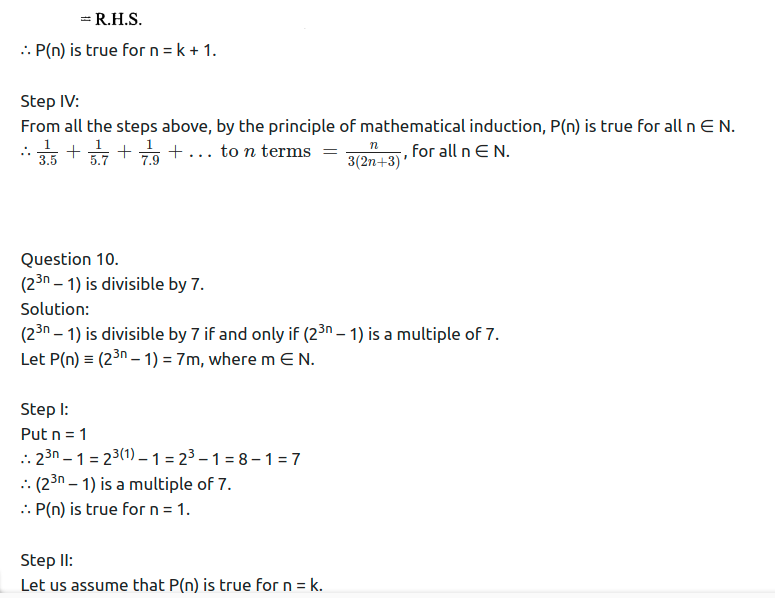
Maharashtra Board Solutions Class 11-Arts & Science Maths (Part 2): Chapter 4- Methods of Induction and Binomial Theorem Ex 4.1

∴ P(n) is true for n = k + 1.

Maharashtra Board Solutions Class 11-Arts & Science Maths (Part 2): Chapter 4- Methods of Induction and Binomial Theorem Ex 4.1

i.e., 23k – 1 is a multiple of 7.
∴ 23k – 1 = 7a, where a ∈ N
∴ 23k = 7a + 1 ……(i)

Step III:
We have to prove that P(n) is true for n = k + 1,
i.e., to prove that
23(k+1) – 1 = 7b, where b ∈ N.
∴ P(k + 1) = 23(k+1) – 1
= 23k+3 – 1
= 23k . (23) – 1
= (7a + 1)8 – 1 …..[From (i)]
= 56a + 8 – 1
= 56a + 7
= 7(8a + 1)
7b, where b = (8a + 1) ∈ N
∴ P(n) is true for n = k + 1.

Step IV:
From all the steps above, by the principle of mathematical induction, P(n) is true for all n ∈ N.
∴ (24n – 1) is divisible by 7, for all n ∈ N.

Question 11.
(24n – 1) is divisible by 15.
Solution:

(24n – 1) is divisible by 15 if and only if (24n – 1) is a multiple of 15.
Let P(n) ≡ (24n – 1) = 15m, where m ∈ N.

Step I:
Put n = 1
∴ 24(1) – 1 = 16 – 1 = 15
∴ (24n – 1) is a multiple of 15.
∴ P(n) is true for n = 1.

Step II:
Let us assume that P(n) is true for n = k.
∴ 24k – 1 = 15a, where a ∈ N
∴ 24k = 15a + 1 …..(i)

Step III:
We have to prove that P(n) is true for n = k + 1,
i.e., to prove that
∴ 24(k+1) – 1 = 15b, where b ∈ N
∴ P(k + 1) = 24(k+1) – 1 = 24k+4 – 1
= 24k . 24 – 1
= 16 . (24k) – 1
= 16(15a + 1) – 1 …..[From (i)]
= 240a + 16 – 1
= 240a + 15
= 15(16a + 1)
= 15b, where b = (16a + 1) ∈ N
∴ P(n) is true for n = k + 1.

Step IV:
From all the steps above, by the principle of mathematical induction, P(n) is true for all n ∈ N.
∴ (24n – 1) is divisible by 15, for all n ∈ N.

Question 12.
3n – 2n – 1 is divisible by 4.
Solution:

(3n – 2n – 1) is divisible by 4 if and only if (3n – 2n – 1) is a multiple of 4.
Let P(n) ≡ (3n – 2n – 1) = 4m, where m ∈ N.

Step I:
Put n = 1
∴ (3n – 2n – 1) = 3(1) – 2(1) – 1 = 0 = 4(0)
∴ (3n – 2n – 1) is a multiple of 4.
∴ P(n) is tme for n = 1.

Step II:
Let us assume that P(n) is true for n = k.
∴ 3k – 2k – 1 = 4a, where a ∈ N
∴ 3k = 4a + 2k + 1 ….(i)

Step III:
We have to prove that P(n) is tme for n = k + 1,
i.e., to prove that
3(k+1) – 2(k + 1) – 1 = 4b, where b ∈ N
P(k + 1) = 3k+1 – 2(k + 1) – 1
= 3k . 3 – 2k – 2 – 1
= (4a + 2k + 1) . 3 – 2k – 3 …….[From (i)]
= 12a + 6k + 3 – 2k – 3
= 12a + 4k
= 4(3a + k)
= 4b, where b = (3a + k) ∈ N
∴ P(n) is tme for n = k + 1.

Step IV:
From all the steps above, by the principle of mathematical induction, P(n) is tme for all n ∈ N.
∴ 3n – 2n – 1 is divisible by 4, for all n ∈ N.
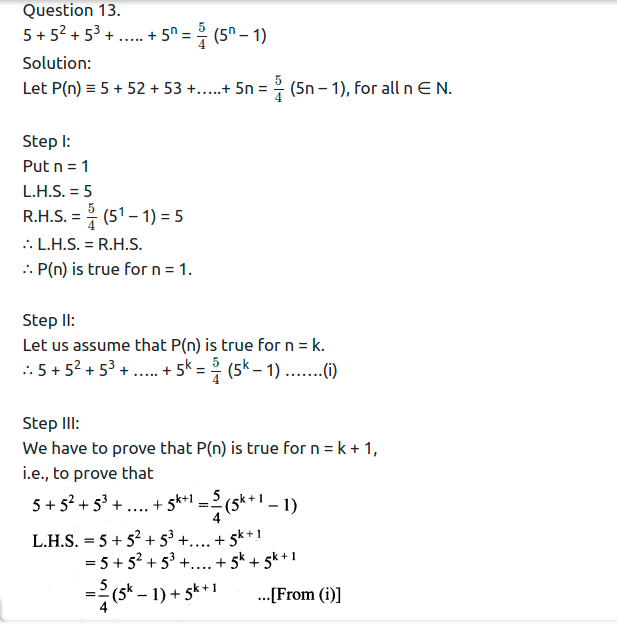
Maharashtra Board Solutions Class 11-Arts & Science Maths (Part 2): Chapter 4- Methods of Induction and Binomial Theorem Ex 4.1

R.H.S. = cos[(1)θ] + i sin[(1)θ] = cos θ + i sin θ
∴ L.H.S. = R.H.S.
∴ P(n) is true for n = 1.

Step II:
Let us assume that P(n) is true for n = k.
∴ (cos θ + i sin θ)k = cos kθ + i sin kθ …….(i)

Step III:
We have to prove that P(n) is true for n = k + 1,
i.e., to prove that
(cos θ + i sin θ)k+1 = cos (k + 1)θ + i sin (k + 1)θ
L.H.S. = (cos θ + i sin θ)k+1
= (cos θ + i sin θ)k . (cos θ + i sin θ)
= (cos kθ + i sin kθ) . (cos θ + i sin θ) ……[From (i)]
= cos kθ cos θ + i sin θ cos kθ + i sin kθ cosθ – sin kθ sin θ ……[∵ i2 = -1]
= (cos kθ cos θ – sin k θ sin θ) + i(sin kθ cos θ + cos kθ sin θ)
= cos(kθ + θ) + i sin(kθ + θ)
= cos(k + 1) θ + i sin (k + 1) θ
= R.H.S.
∴ P(n) is true for n = k + 1.

Step IV:
From all the steps above, by the principle of mathematical induction, P(n) is true for all n ∈ N.
∴ (cos θ + i sin θ)n = cos (nθ) + i sin (nθ), for all n ∈ N.

Question 15.
Given that tn+1 = 5 tn+4, t1 = 4, prove by method of induction that tn = 5n – 1.
Solution:

Let the statement P(n) has L.H.S. a recurrence relation tn+1 = 5 tn+4, t1 = 4 and R.H.S. a general statement tn = 5n – 1.
Step I:
Put n = 1
L.H.S. = 4
R.H.S. = 51 – 1 = 4
∴ L.H.S. = R.H.S.
∴ P(n) is true for n = 1.
Put n = 2
L.H.S. = t2 = 5t1 + 4 = 24
R.H.S. = t2 = 52 – 1 = 24
∴ L.H.S. = R.H.S.
∴ P(n) is true for n = 2.

Step II:
Let us assume that P(n) is true for n = k.
∴ tk+1 = 5 tk+4 and tk = 5k – 1

Step III:
We have to prove that P(n) is true for n = k + 1,
i.e., to prove that tk+1 = 5k+1 – 1
Since tk+1 = 5 tk+4 and tk = 5k – 1 …..[From Step II]
tk+1 = 5 (5k – 1) + 4 = 5k+1 – 1
∴ P(n) is true for n = k + 1.

Step IV:
From all the steps above, by the principle of mathematical induction, P(n) is true for all n ∈ N.
∴ tn = 5n – 1, for all n ∈ N.
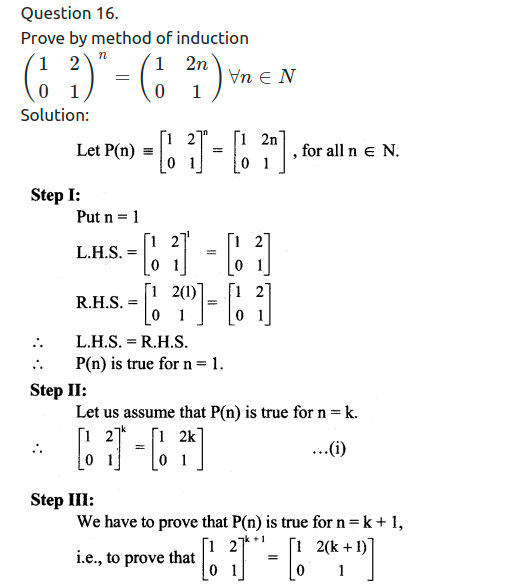
Maharashtra Board Solutions Class 11-Arts & Science Maths (Part 2): Chapter 4- Methods of Induction and Binomial Theorem Ex 4.1

Ex 4.2

Question 1.
Expand:
(i) (√3 + √2)4
Solution:

Here, a = √3, b = √2 and n = 4.
Using binomial theorem,
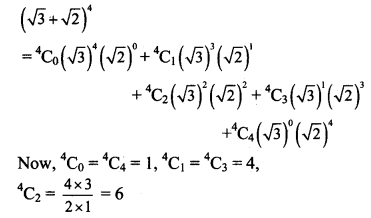
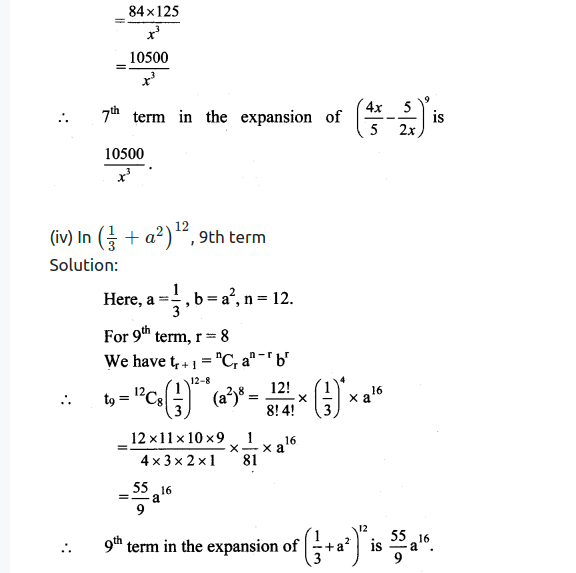
Maharashtra Board Solutions Class 11-Arts & Science Maths (Part 2): Chapter 4- Methods of Induction and Binomial Theorem Ex 4.2

∴ (√3 + √2)4 = 1(9) (1) + 4(3√3) (√2) + 6(3)(2) + 4(√3) (2√2) + 1(1)(4)
= 9 + 12√6 + 36 + 8√6 + 4
= 49 + 20√6

(ii) (√5 – √2)5
Solution:

Here, a = √5, b = √2 and n = 5.
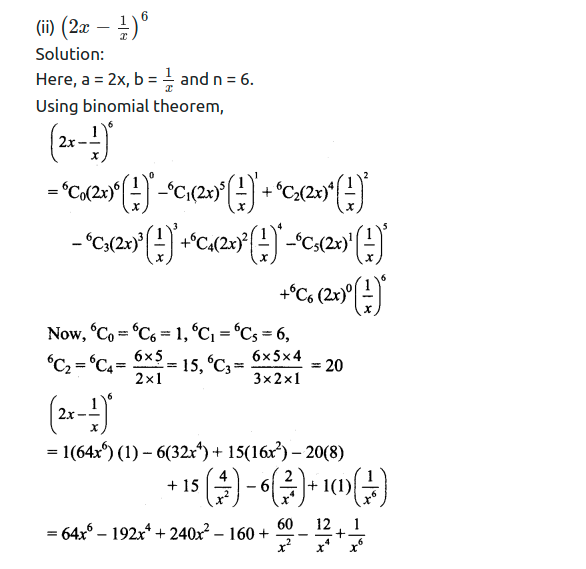
Using binomial theorem,
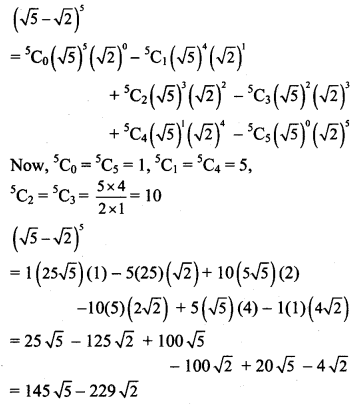
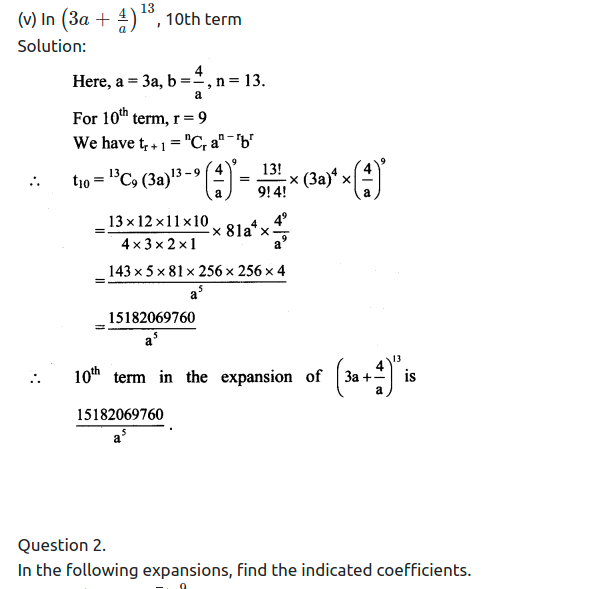
Maharashtra Board Solutions Class 11-Arts & Science Maths (Part 2): Chapter 4- Methods of Induction and Binomial Theorem Ex 4.2

Question 2.
Expand:
(i) (2x2 + 3)4
Solution:

Here, a = 2x2, b = 3 and n = 4.
Using binomial theorem,
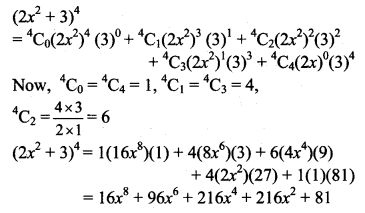
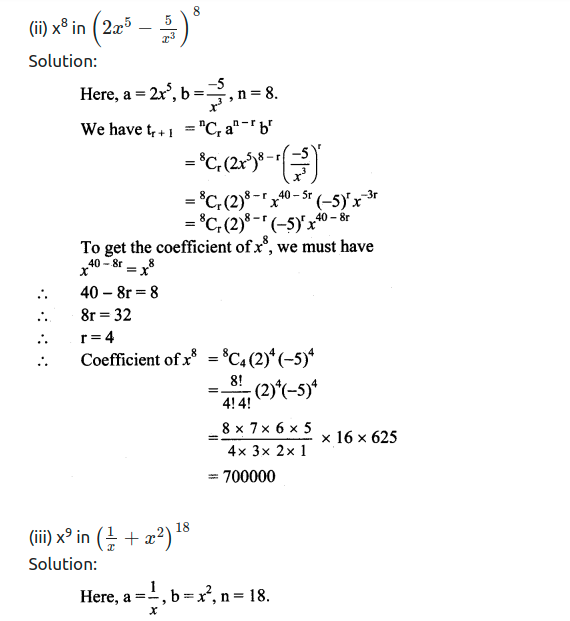
Maharashtra Board Solutions Class 11-Arts & Science Maths (Part 2): Chapter 4- Methods of Induction and Binomial Theorem Ex 4.2

Question 3.
Find the value of
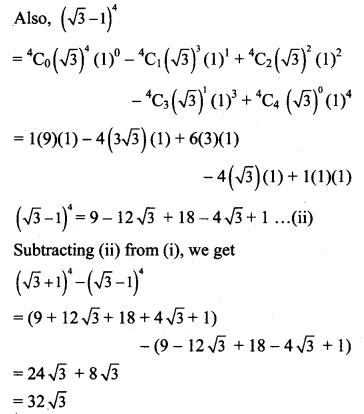
(i) (√3 + 1)4 – (√3 – 1)4
Solution:
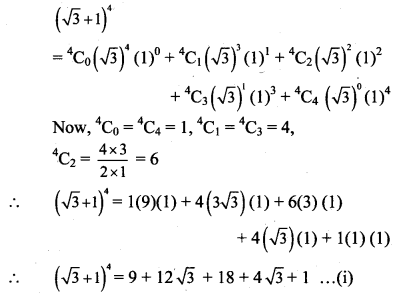
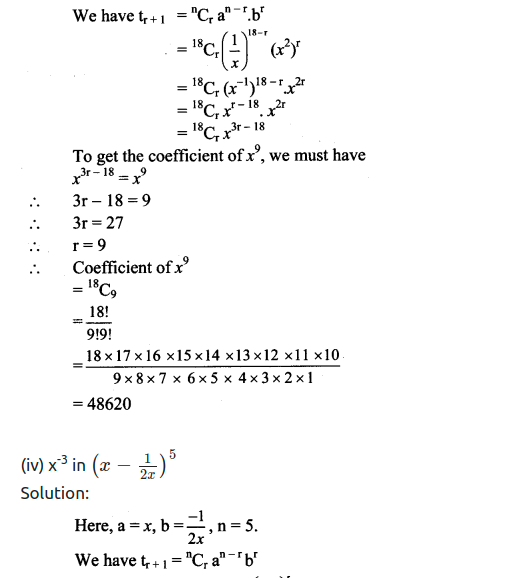
Maharashtra Board Solutions Class 11-Arts & Science Maths (Part 2): Chapter 4- Methods of Induction and Binomial Theorem Ex 4.2

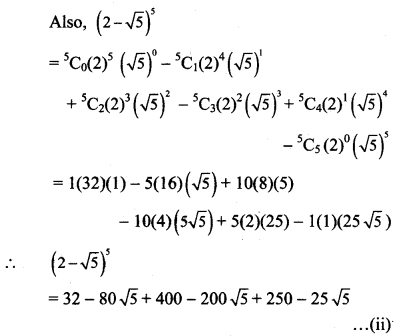
(ii) (2 + √5)5 + (2 – √5)5
Solution:
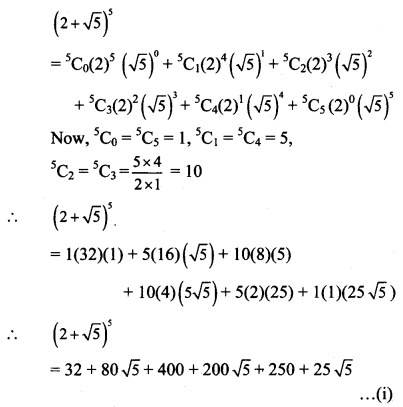
Maharashtra Board Solutions Class 11-Arts & Science Maths (Part 2): Chapter 4- Methods of Induction and Binomial Theorem Ex 4.2

Adding (i) and (ii), we get
∴ (2 + √5 )5 + (2 – √5)5 = (32 + 80√5 + 400 + 200√5 + 250 + 25√5) + (32 – 80√5 + 400 – 200√5+ 250 – 25√5 )
= 64 + 800 + 500
= 1364

Question 4.
Prove that:
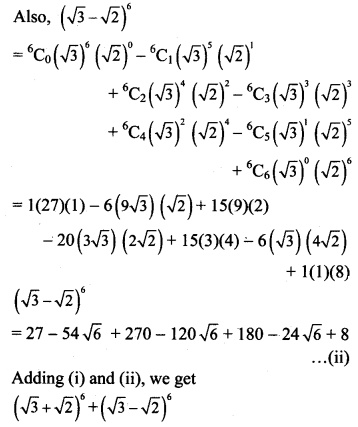
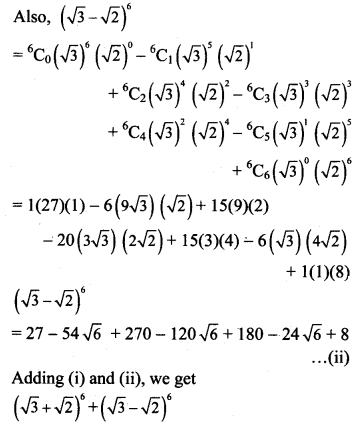
(i) (√3 + √2)6 + (√3 – √2)6 = 970
Solution:
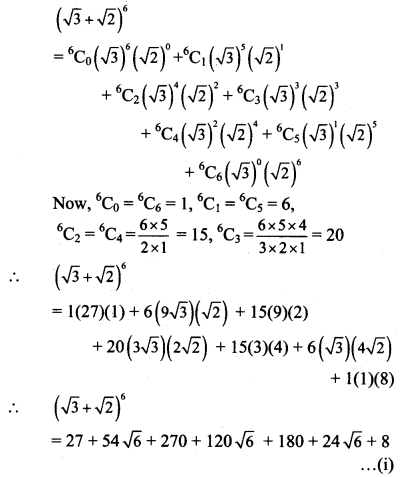
Maharashtra Board Solutions Class 11-Arts & Science Maths (Part 2): Chapter 4- Methods of Induction and Binomial Theorem Ex 4.2

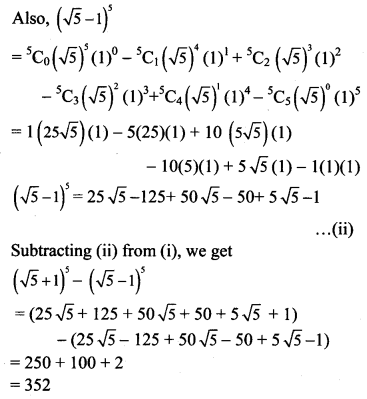
(ii) (√5 + 1)5 – (√5 – 1)5 = 352
Solution:
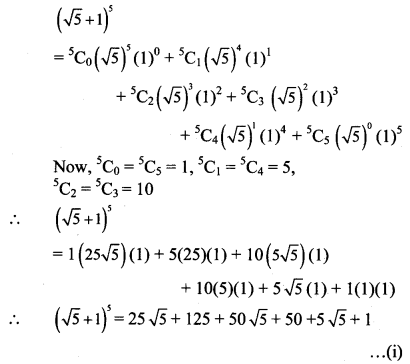
Maharashtra Board Solutions Class 11-Arts & Science Maths (Part 2): Chapter 4- Methods of Induction and Binomial Theorem Ex 4.2

Question 5.
Using binomial theorem, find the value of
(i) (102)4
Solution:

Maharashtra Board Solutions Class 11-Arts & Science Maths (Part 2): Chapter 4- Methods of Induction and Binomial Theorem Ex 4.2

(ii) (1.1)5
Solution:

Maharashtra Board Solutions Class 11-Arts & Science Maths (Part 2): Chapter 4- Methods of Induction and Binomial Theorem Ex 4.2

Question 6.
Using binomial theorem, find the value of
(i) (9.9)3
Solution:
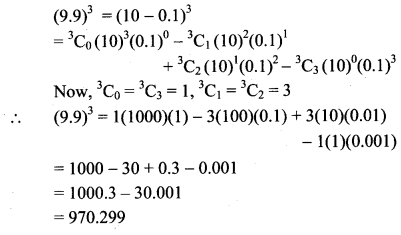
Maharashtra Board Solutions Class 11-Arts & Science Maths (Part 2): Chapter 4- Methods of Induction and Binomial Theorem Ex 4.2

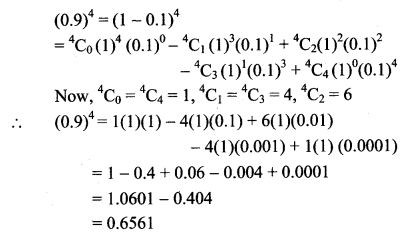
(ii) (0.9)4
Solution:

Maharashtra Board Solutions Class 11-Arts & Science Maths (Part 2): Chapter 4- Methods of Induction and Binomial Theorem Ex 4.2

Question 7.
Without expanding, find the value of
(i) (x + 1)4 – 4(x + 1)3 (x – 1) + 6(x + 1)2 (x – 1)2 – 4(x + 1) (x – 1)3 + (x – 1)4
Solution:
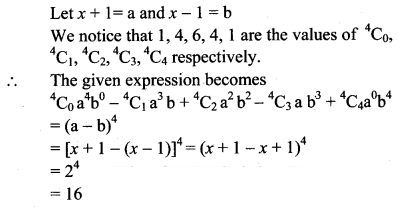
Maharashtra Board Solutions Class 11-Arts & Science Maths (Part 2): Chapter 4- Methods of Induction and Binomial Theorem Ex 4.2

(ii) (2x – 1)4 + 4(2x – 1)3 (3 – 2x) + 6(2x – 1)2 (3 – 2x)2 + 4(2x – 1)1 (3 – 2x)3 + (3 – 2x)4
Solution:
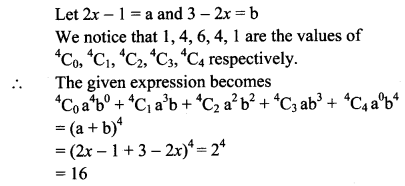
Maharashtra Board Solutions Class 11-Arts & Science Maths (Part 2): Chapter 4- Methods of Induction and Binomial Theorem Ex 4.2

Question 8.
Find the value of (1.02)6, correct upto four places of decimals.
Solution:
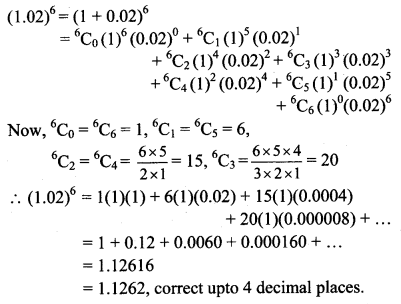
Maharashtra Board Solutions Class 11-Arts & Science Maths (Part 2): Chapter 4- Methods of Induction and Binomial Theorem Ex 4.2

Question 9.
Find the value of (1.01)5, correct upto three places of decimals.
Solution:
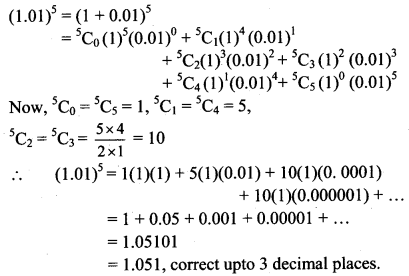
Maharashtra Board Solutions Class 11-Arts & Science Maths (Part 2): Chapter 4- Methods of Induction and Binomial Theorem Ex 4.2

Question 10.
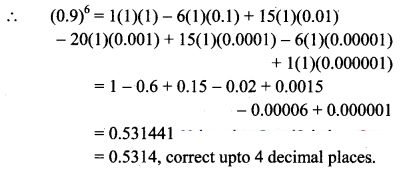
Find the value of (0.9)6, correct upto four places of decimals.
Solution:
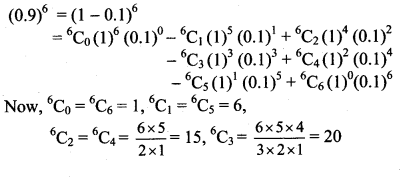
Maharashtra Board Solutions Class 11-Arts & Science Maths (Part 2): Chapter 4- Methods of Induction and Binomial Theorem Ex 4.2

Ex 4.3

Maharashtra Board Solutions Class 11-Arts & Science Maths (Part 2): Chapter 4- Methods of Induction and Binomial Theorem Ex 4.3

Ex 4.4

Question 1.
State, by writing the first four terms, the expansion of the following, where |x| < 1.
(i) (1 + x)-4
Solution:
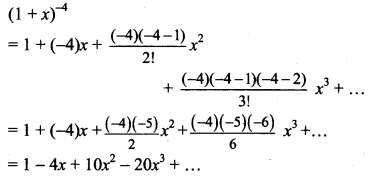
Maharashtra Board Solutions Class 11-Arts & Science Maths (Part 2): Chapter 4- Methods of Induction and Binomial Theorem Ex 4.4

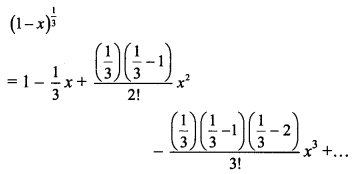
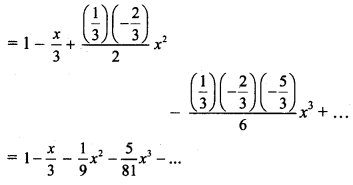
(ii) (1 – x)1/3
Solution:

Maharashtra Board Solutions Class 11-Arts & Science Maths (Part 2): Chapter 4- Methods of Induction and Binomial Theorem Ex 4.4

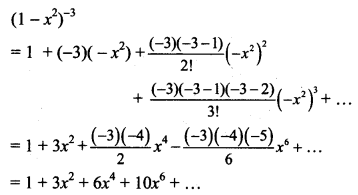
(iii) (1 – x2)-3
Solution:

Maharashtra Board Solutions Class 11-Arts & Science Maths (Part 2): Chapter 4- Methods of Induction and Binomial Theorem Ex 4.4

(iv) (1 + x)-1/5
Solution:

Maharashtra Board Solutions Class 11-Arts & Science Maths (Part 2): Chapter 4- Methods of Induction and Binomial Theorem Ex 4.4

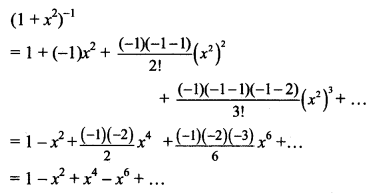
(v) (1 + x2)-1
Solution:

Maharashtra Board Solutions Class 11-Arts & Science Maths (Part 2): Chapter 4- Methods of Induction and Binomial Theorem Ex 4.4

Question 2.
State by writing first four terms, the expansion of the following, where |b| < |a|.
(i) (a – b)-3
Solution:

(a – b)-3 = [a(1−ba)]−3
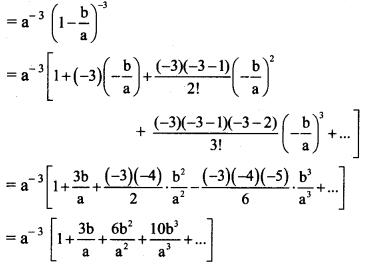
Maharashtra Board Solutions Class 11-Arts & Science Maths (Part 2): Chapter 4- Methods of Induction and Binomial Theorem Ex 4.4

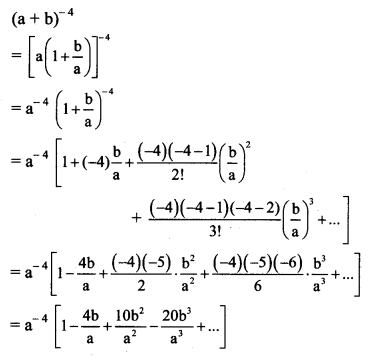
(ii) (a + b)-4
Solution:

Maharashtra Board Solutions Class 11-Arts & Science Maths (Part 2): Chapter 4- Methods of Induction and Binomial Theorem Ex 4.4

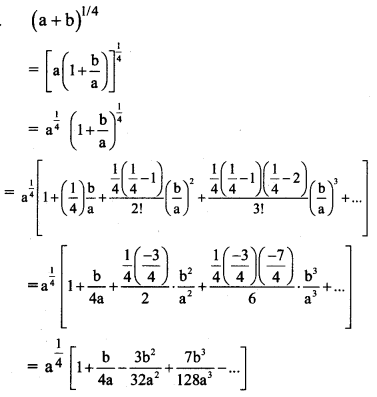
(iii) (a + b)1/4
Solution:

Maharashtra Board Solutions Class 11-Arts & Science Maths (Part 2): Chapter 4- Methods of Induction and Binomial Theorem Ex 4.4

(iv) (a – b)-1/4
Solution:

(a – b)-1/4 = [a(1−ba)]−14
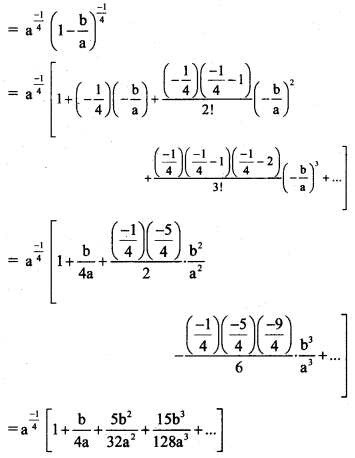
Maharashtra Board Solutions Class 11-Arts & Science Maths (Part 2): Chapter 4- Methods of Induction and Binomial Theorem Ex 4.4

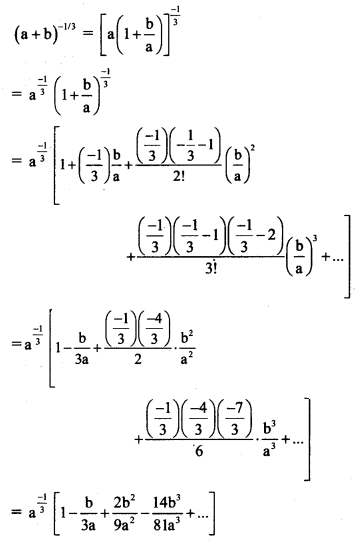
(v) (a + b)-1/3
Solution:

Maharashtra Board Solutions Class 11-Arts & Science Maths (Part 2): Chapter 4- Methods of Induction and Binomial Theorem Ex 4.4

Question 3.
Simplify the first three terms in the expansion of the following:
(i) (1 + 2x)-4
Solution:
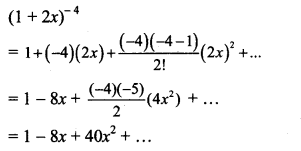
Maharashtra Board Solutions Class 11-Arts & Science Maths (Part 2): Chapter 4- Methods of Induction and Binomial Theorem Ex 4.4

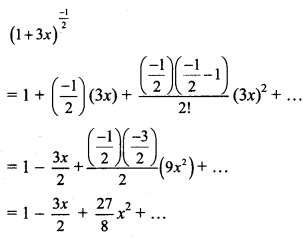
(ii) (1 + 3x)-1/2
Solution:

Maharashtra Board Solutions Class 11-Arts & Science Maths (Part 2): Chapter 4- Methods of Induction and Binomial Theorem Ex 4.4

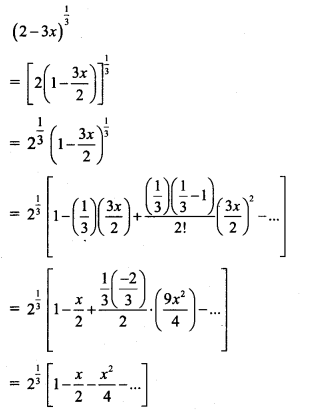
(iii) (2 – 3x)1/3
Solution:

Maharashtra Board Solutions Class 11-Arts & Science Maths (Part 2): Chapter 4- Methods of Induction and Binomial Theorem Ex 4.4

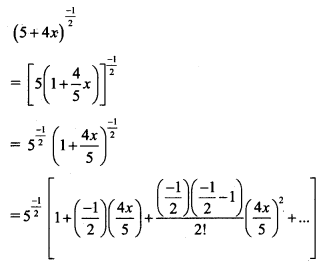
(iv) (5 + 4x)-1/2
Solution:

Maharashtra Board Solutions Class 11-Arts & Science Maths (Part 2): Chapter 4- Methods of Induction and Binomial Theorem Ex 4.4

(v) (5 – 3x)-1/3
Solution:

Maharashtra Board Solutions Class 11-Arts & Science Maths (Part 2): Chapter 4- Methods of Induction and Binomial Theorem Ex 4.4

Question 4.
Use the binomial theorem to evaluate the following upto four places of decimals.
(i) √99
Solution:
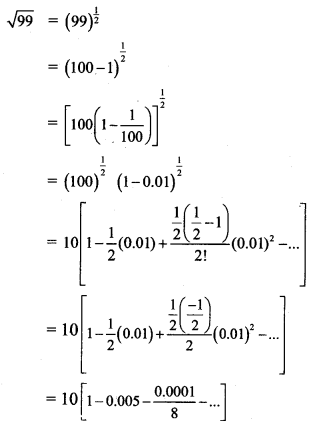
Maharashtra Board Solutions Class 11-Arts & Science Maths (Part 2): Chapter 4- Methods of Induction and Binomial Theorem Ex 4.4

= 10 [1 – 0.005 – 0.0000125 – ……]
= 10(0.9949875)
= 9.94987 5
= 9.9499

(ii) 126−−−√3
Solution:
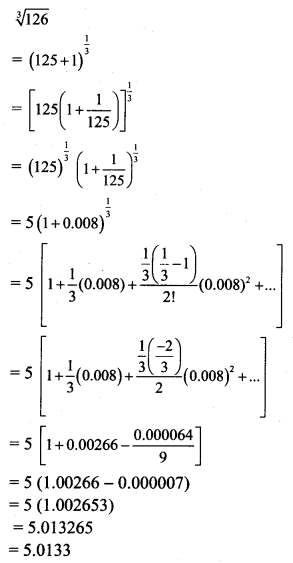
Maharashtra Board Solutions Class 11-Arts & Science Maths (Part 2): Chapter 4- Methods of Induction and Binomial Theorem Ex 4.4

(iii) 16.08−−−−√4
Solution:

Maharashtra Board Solutions Class 11-Arts & Science Maths (Part 2): Chapter 4- Methods of Induction and Binomial Theorem Ex 4.4

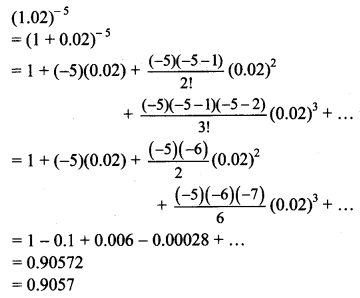
(iv) (1.02)-5
Solution:

Maharashtra Board Solutions Class 11-Arts & Science Maths (Part 2): Chapter 4- Methods of Induction and Binomial Theorem Ex 4.4

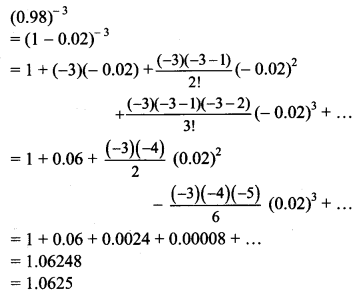
(v) (0.98)-3
Solution:

Maharashtra Board Solutions Class 11-Arts & Science Maths (Part 2): Chapter 4- Methods of Induction and Binomial Theorem Ex 4.4

Ex 4.5

Question 1.
Show that C0 + C1 + C2 + ….. + C8 = 256
Solution:

Since C0 + C1 + C2 + C3 + ….. + Cn = 2n
Putting n = 8, we get
C0 + C1 + C2 + ….. + C8 = 28
∴ C0 + C1 + C2 + ….. + C8 = 256

Question 2.
Show that C0 + C1 + C2 + …… + C9 = 512
Solution:

Since C0 + C1 + C2 + C3 + ….. + Cn = 2n
Putting n = 9, we get
C0 + C1 + C2 + ….. + C9 = 29
∴ C0 + C1 + C2 + …… + C9 = 512

Question 3.
Show that C1 + C2 + C3 + ….. + C7 = 127
Solution:

Since C0 + C1 + C2 + C3 + ….. + Cn = 2n
Putting n = 7, we get
C0 + C1 + C2 + ….. + C7 = 27
∴ C0 + C1 + C2 +….. + C7 = 128
But, C0 = 1
∴ 1 + C1 + C2 + ….. + C7 = 128
∴ C1 + C2 + ….. + C7 = 128 – 1 = 127

Question 4.
Show that C1 + C2 + C3 + ….. + C6 = 63
Solution:

Since C0 + C1 + C2 + C3 + ….. + Cn = 2n
Putting n = 6, we get
C0 + C1 + C2 + ….. + C6 = 26
∴ C0 + C1 + C2 + …… + C6 = 64
But, C0 = 1
∴ 1 + C1 + C2 + ….. + C6 = 64
∴ C1 + C2 + ….. + C6 = 64 – 1 = 63

Question 5.
Show that C0 + C2 + C4 + C6 + C8 = C1 + C3 + C5 + C7 = 128
Solution:

Since C0 + C1 + C2 + C3 + …… + Cn = 2n
Putting n = 8, we get
C0 + C1 + C2 + C3 + …… + C8 = 28
But, sum of even coefficients = sum of odd coefficients
∴ C0 + C2 + C4 + C6 + C8 = C1 + C3 + C5 + C7
Let C0 + C2 + C4 + C6 + C8 = C1 + C3 + C5 + C7 = k
Now, C0 + C1 + C2 + C3 + C4 + C5 + C6 + C7 + C8 = 256
∴ (C0 + C2 + C4 + C6 + C8) + (C1 + C3 + C5 + C7) = 256
∴ k + k = 256
∴ 2k = 256
∴ k = 128
∴ C0 + C2 + C4 + C6 + C8 = C1 + C3 + C5 + C7 = 128

Question 6.
Show that C1 + C2 + C3 + ….. + Cn = 2n – 1
Solution:

Since C0 + C1 + C2 + C3 + ….. + Cn = 2n
But, C0 = 1
∴ 1 + C1 + C2 + C3 + …… + Cn = 2n
∴ C1 + C2 + C3 + ….. + Cn = 2n – 1

Question 7.
Show that C0 + 2C1 + 3C2 + 4C3 + ….. + (n + 1)Cn = (n + 2) 2n-1
Solution:
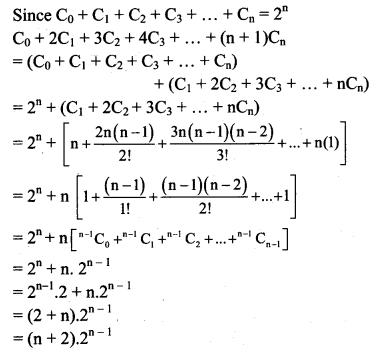
Maharashtra Board Solutions Class 11-Arts & Science Maths (Part 2): Chapter 4- Methods of Induction and Binomial Theorem Ex 4.5

Download PDF

Maharashtra Board Solutions Class 11-Arts & Science Maths (Part 2): Chapter 4- Methods of Induction and Binomial Theorem

Download PDF: Maharashtra Board Solutions Class 11-Arts & Science Maths (Part 2): Chapter 4- Methods of Induction and Binomial Theorem PDF

Chapterwise Maharashtra Board Solutions Class 11 Arts & Science Maths (Part 2) :

Read More

NCERT Solutions for All Classes (1 to 12)

Jump to free NCERT solutions, chapter Q&A, and textbooks for any grade

Popular Reference Solutions & Help Books

Step-by-step solutions for Mathematics and Science reference textbooks

Latest School & Board Updates

Real-time date sheets, admit cards, syllabus revisions, and exam notifications

Haryana Board Senior Secondary (12th) 20 Feb 2025
HBSE 12th 2024 Question Papers
View
Haryana Board Secondary (10th) 20 Feb 2025
HBSE 10th 2024 Question Papers
View
Haryana Board Senior Secondary (12th) 19 Feb 2025
HBSE 9th Model Papers 2025
View
Haryana Board Senior Secondary (12th) 19 Feb 2025
HBSE 11th Model Papers 2025
View
State Board Primary (1-5) 15 Feb 2025
BHU SET 2025 Application Form
View

Frequently Asked Questions

Common queries regarding NCERT textbook solutions & school curriculum

Are these NCERT solutions available 100% free of charge?

Yes. All NCERT solutions, chapter questions, textbook exercises, and download guides published on IndCareer Schools are completely free for students, parents, and educators without requiring any paid subscription or login.

Which subjects are covered for Class 11?

For Class 1, comprehensive NCERT solutions are provided for Mathematics (Math-Magic / गणित का जादू), English (Marigold & Mridang), and Hindi (Rimjhim / रिमझिम), alongside printable worksheets and textbook PDF downloads.

Are these solutions updated according to the latest CBSE / NCERT guidelines?

Yes. Our academic editorial team continually aligns all solutions and textbook references with the latest National Education Policy (NEP) and the rationalized curriculum issued by NCERT and the Central Board of Secondary Education (CBSE).

How can I download the official NCERT books in PDF format?

You can access official NCERT textbooks by clicking on the textbook links provided in the study content section above or by visiting the Class 1 to 12 NCERT Directory on IndCareer Schools.