
Class 8: Biology Chapter 7 solutions. Complete Class 8 Biology Chapter 7 Notes.
Selina Class 8 ICSE Solutions Biology : Chapter 7- The Nervous System
Selina 8th Biology Chapter 7, Class 8 Biology Chapter 7 solutions
Multiple Choice Questions:
1. Put a tick mark against the correct alternative in the following statements:
(a) Medulla oblongata controls
1. Smelling
2. Beating of heart and respiratory movement
3. Intelligence and will power
4. Balancing the body
Answer: Beating of heart and respiratory movement
(b) Balance of body is controlled by:
1. Spinal cord
2. Cerebellum
3. Cerebrum
4. Medulla
Answer: Cerebellum
(c) The smell of good food causes watering of your mouth. It is a
1. Natural reflex
2. Acquired reflex
3. Inborn reflex
4. Ordinary reflex
Answer: Acquired reflex
(d) The structural and functional unit of the nervous system is a
1. Axon
2. Nephron
3. Neuron
4. Texon
Answer: Nephron
Short Answer Questions:
Question 1.
Name the two types of coordination which take place in our body.
Solution:
(a) Nervous coordination: By nerves and brain
(b) Chemical coordination: By hormones
Question 2.
You are driving your bicycle at a fast speed. Suddenly, a small boy comes in front of your cycle and, without wasting any time in thinking, you immediately apply the brakes and accident is avoided. What name is given to such an action?
Solution:
Reflex action (acquired).
Question 3.
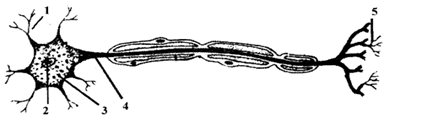
Given below is the diagram of a neuron. Name the parts numbered 1-5.
Solution:
1. Dendrite
2. Nucleus
3. Cell Body (Nyton)
4. Axon (Nerve fibre)
5. Node of Ranvier
Question 4.
Write one word in the space provided to complete the second pair of the related words pertaining to the nervous system.
Memory: cerebrum:: breathing: ?
Balance: cerebellum:: reasoning: ?
Solution:
Memory: cerebrum:: breathing: medulla oblongata
Balance: cerebellum:: reasoning: cerebrum
Question 5.
Differentiate between the following pair of terms:
(a) Stimulus and impulse
Solution:
Stimulus: Any change in the environment that usually results in a change in the activity of the body. It is actually an influence.
Impulse: A wave of electrical disturbance that runs through the nerves.
(b) Receptor and effector
Solution:
Receptor: The nerve cell on receiving the stimulus sets up the waves of impulses towards the central nervous system.
Effector: Any muscle or gland will contract or secrets when receiving an impulse from the brain.
(c) Motor nerve and sensory nerve
Solution:
Motor nerve: It contains only motor neurons, Example: Nerves going to the muscles of the eyeball. Sensory nerve: It contains only sensory neurons. Example: the optic nerve of the eye.
Question 6.
(a) Name the three major divisions of the human nervous system.
Solution:
1. The peripheral nervous system
2. The central nervous system
3. The autonomic nervous system
(b) Name the three main parts of the human brain.
Solution:
1. Cerebrum
2. Cerebellum
3. Medulla oblongata
Question 7.
Give the function of each of the following:
(a) Olfactory nerve:
(b) Optic nerve:
(C) Facial nerve:
Solution:
(a) Olfactory nerve: The epithelial layers of the nasal chambers has a sense of smell. The sense of smell is carried to the brain by the olfactory nerve. They arise from the anterior ends of the olfactory lobes and are distributed to the lining of nasal chambers.
(b) Optic nerve: optic nerves carries the reflection of the object from the retina to the brain. The image formed on the retina is in a reverted position and the correct picture is formed in the brain as the object is. The optic nerves arise from the side of the diencephalon. They innervate the retina of the eve and are sensory in nature.
(c) Facial nerve: Message and all expressions of the face, mastication work alone by the teeth, movement of the neck and the activities of the salivary glands to the brain are carried by the facial nerve. It arises from the side of the medulla. On the whole facial nerves are mixed in nature.
Long Answer questions
Question 1.
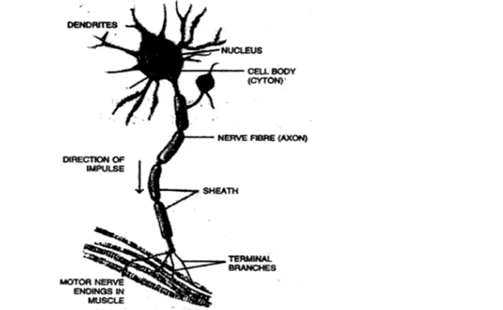
With the help of a suitable diagram describe the structures of a neuron.
Solution:
The nervous system consists of special cells called nerve cells or neurons. Cyton is the main cell body which gives out many processes called dendrites. From it, a very long process is given out. It is called axon or nerve fibre.
The cell body has a nucleus. The message from the organs and send this message to the axon through the cell body is organized by a cell body called dendrites. Then the axon sends the message to the muscle to contrast or to the gland for secretion.
The neurons make contact with one another through their processes. The axon at its end branches and meets the dendrites of another neuron. The meeting point is called a synapse. The message is passed on from one axon to the dendrites of another neuron. How the message goes?
It is like this:
Organ Message goes to dendrites Cell body Axon Muscles or glands
Question 2.
Briefly describe the structure of the cerebrum in the human brain and mention its functions.
Solution:
The brain consists of the main three parts and lies in the cranial cavity of the skull.
1. The cerebrum
2. The cerebellum
3. The medulla oblongata
Cerebrum: It is very large and forms two-thirds of the whole brain. A deep longitudinal groove separates the two hemispheres from each other is the median fissure. The outer surface is folded with ridges and grooves. The hemispheres are hollow from inside and their walls have outer and inner portions. The outer portion has cell bodies of the neurons and it is called grey matter. The wavery edges of the folded layer have numerous neurons to the extent of nine billion. The inner portion of the cerebrum has axons and it is called white matter.
Functions:
1. It controls all the voluntary activities.
2. It is the seat of intelligence, consciousness and will power.
Download PDF
Selina Class 8 ICSE Solutions Biology : Chapter 7- The Nervous System
Download PDF: Selina Class 8 ICSE Solutions Biology : Chapter 7- The Nervous System PDF
Chapterwise Selina Publishers ICSE Solutions for Class 8 Biology :
- Chapter 1- Transportation in Plants
- Chapter 2- Reproduction in Plants
- Chapter 3- Reproduction in Humans
- Chapter 4- Ecosystem
- Chapter 5- Endocrine System and Adolescence
- Chapter 6- The Circulatory System
- Chapter 7- The Nervous System
- Chapter 8- Disease and First Aid
About Selina Publishers ICSE
Selina Publishers has been serving the students since 1976 and is one of the quality ICSE school textbooks publication houses. Mathematics and Science books for classes 6-10 form the core of our business, apart from certain English and Hindi literature as well as a few primary books. All these books are based upon the syllabus published by the Council for the I.C.S.E. Examinations, New Delhi. The textbooks are composed by a panel of subject experts and vetted by teachers practising in ICSE schools all over the country. Continuous efforts are made in complying with the standards and ensuring lucidity and clarity in content, which makes them stand tall in the industry.