
Class 7: Biology Chapter 3 solutions. Complete Class 7 Biology Chapter 3 Notes.
Selina Class 7 ICSE Solutions Biology (Unit 1) - Tissue: Chapter 3- Classification of Animals
Selina 7th Biology Chapter 3, Class 7 Biology Chapter 3 solutions
Activity 3
Look at the four animals shown alongside.
Which four classes of vertebrates are represented by them ? Name these classes.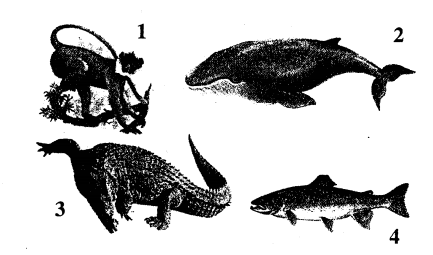
Answer:
1. Class Mammalia
2. Class Mammalia
3. Class Reptilia
4. Class Pisces
Review Questions
MULTIPLE CHOICE QUESTIONS
1. Tick (✓) the appropriate answer:
(i) Identify the aquatic animal with scaly skin which breathe with gills –
(a) Rohu
(b) Tortoise
(c) Sparrow
(d) Rat
(ii) The unicellular organism causing malaria –
(a) Amoeba
(b) Paramecium
(c) Euglena
(d) Plasmodium
(iii) Identify the animal which is not an Arthropoda —
(a) Prawn
(b) Butterfly
(c) Earthwonn
(d) Spider
(iv) Scientist who introduced binomial nomenclature is —
(a) Charles Darwin
(b) Carolus Linnaeus
(c) Robert Hooke
(d) Gregor Mendel
Short Answer Questions
1. Give two examples of each of the following:
(i) Amphibians:
Ans. Amphibians: 1. Frog 2. Toad
(ii) Segmented worms:
Ans. Segmented worms: 1. Earthworm 2. Leech
(iii) Reptiles:
Ans. Reptiles: 1. Snake 2. Lizard
(iv) Coelenterates:
Ans. Coelenterates : 1. Hydra 2. Jellyfish
(v) Arthropods:
Ans. Arthropods: 1. Crab 2. Centipede
(vi) Flatworms:
Ans. Flatworms: 1. Tapeworm 2. Liverfluke
2. Give names of two animals which are found as parasites inside the human intestine.
Ans. (a) Tapeworm (b)Ascaris ’
3. Name one example each of an animal which shows the following characteristics:
(i) Fixed animals with a pore-bearing body:
Ans. Fixed animals with a pore-bearing body: sponge
(ii) Star-shaped body:
Ans. Star-shaped body: Star-fish
(iii) Can live in water as well as on land:
Ans. Can live in water as well as on land: Frog
(iv) Has a flattened ribbon-like body:
Ans. Has a flattened ribbon-like body: Tapeworm
4. Write one difference each between the following pairs:
(i) Porifera and Coelenterata.
(ii) Arthropoda and mollusca.
(iii) Invertebrates and Vertebrates
(iv) Platyheminthes and Nematoda
Answer:
(i) Porifera and Coelenterata.
Porifera
- Body is porous i. e. bears many tiny pores to draw water into the body cavity.
- e.g. Sponge
Coelenterata
- Sac-like body with only one opening i.e. mouth.
- e.g. Jelly fish, hydra,sea-anemone.
(ii) Arthropoda and mollusca.
Arthropoda
- These are animals with
- They have segmented body.
- They may or may not have wings
Example: Crab.
Mollusca
- Move with the help of a muscular foot.
- Soft body which is not segmented.
- Body enclosed in a hard shell Example: Octopus
(iii) Invertebrates and Vertebrates
Invertebrates
- The animals which do not have a back bone.
- They are further classified into nine groups.
Example: Octopus, Starfish.
Vertebrates
- The animals which have a back bone or a vertebral column.
- They are further classified in to five groups.
Example: Human Being, Lizard.
(iv) Platyheminthes and Nematoda
Platyheminthes
- Body thin and flattened.
- Mostly live as parasites in the bodies of other animals (hosts)
e.g. Tapeworm.
Nematoda
- Body is rounded and unsegmented.
- Mostly live as parasites in the body of animals including humans.
e.g. Roundworm commonly called Ascaris.
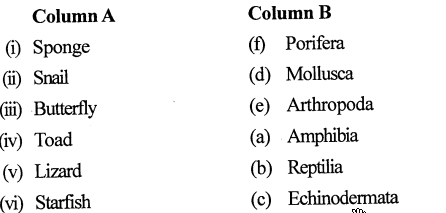
5. Match the animals given under column A with their respective classification group given under column B –
Column A Column B
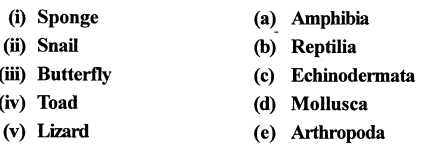

Answer:
6. Write the characteristics of class Aves with reference to their body covering and jaws.
Answer:
The characteristics of class Aves are:
- Body is covered with feathers.
- They have wings to aid flying
- They have scales on legs.
- They have no teeth.
- They have jaws provided with homy beaks
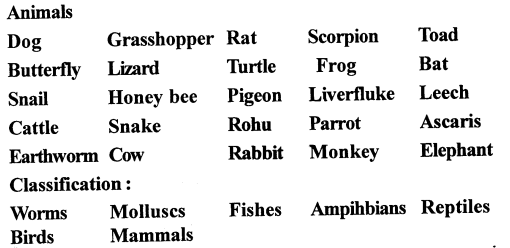
7. Categorise the following animals under their appropriate columns of classification.
Answer:
Worms – Arthropods, Butterfly, Ascaris, Scorpion, Honey bee, Liverfluke, Leech, grasshopper, Eathworm
Molluscs – Snail
Fishes – Rohu
Amphibians – Toad, Frog
Reptiles – Snake, Lizard, Turtle
Birds – Parrot, Pigeon
Mammals – Rat, Bat, Dog, Cattle, Cow, Rabbit, Monkey, Elephant
Download PDF
Selina Class 7 ICSE Solutions Biology (Unit 1) - Tissue: Chapter 3- Classification of Animals
Chapterwise Selina Publishers ICSE Solutions for Class 7 Biology :
Unit 1
- Chapter 1- Plant And Animal Tissues
- Chapter 2- Classification of Plants
- Chapter 3- Classification of Animals
Unit 2
Unit 3
About Selina Publishers ICSE
Selina Publishers has been serving the students since 1976 and is one of the quality ICSE school textbooks publication houses. Mathematics and Science books for classes 6-10 form the core of our business, apart from certain English and Hindi literature as well as a few primary books. All these books are based upon the syllabus published by the Council for the I.C.S.E. Examinations, New Delhi. The textbooks are composed by a panel of subject experts and vetted by teachers practising in ICSE schools all over the country. Continuous efforts are made in complying with the standards and ensuring lucidity and clarity in content, which makes them stand tall in the industry.