
Class 6: Biology Chapter 3 solutions. Complete Class 6 Biology Chapter 3 Notes.
Selina Class 6 ICSE Solutions Biology (Unit 2) - The Cell: Chapter 3- The Structure and Functions
Selina 6th Biology Chapter 3, Class 6 Biology Chapter 3 solutions
Review Questions
Multiple Choice Questions:
1. Put a tick mark (✓) against the correct alternative in the following statements:
(i) Identify the part which contain pigment:
(a) cell membrane
(b) plastid
(c) centrosome
(d) cell wall
(ii) The organelle that controls all activities in
(a) nucleus
(b) vacoule
(c) plastids
(d) cytoplasm
(iii) A cell that is spherical in shape is:
(a) white blood cell
(b) nerve cell
(c) red blood cell
(d) amoeba
(iv)The vacuole contains:
(a) water
(b) cell sap
(c) salts
(d) food
Short Answer Questions:
Question 1.
Name the scientist who invented the first microscope.
Answer :
Antony Von Leeuwenhoek.
Question 2.
Who coined the term “cell” ?
Answer :
The term “cell” was coined by Robert Hooke.
Question 3.
Briefly describe the three essential basic parts of a cell.
Answer :
The essential basic parts of a cell are:
- Cell membrane
- Cytoplasm
- Nucleus
- Cell membrane — It is a very thin, delicate and flexible membrane which surrounds each cell. It is also called plasma membrane. It consists of fine pores which allow only certain molecules to pass through it and prohibit the others and therefore, due to its function, also called selectively permeable membrane.
- Cytoplasm: This is the living portion of the cell which is a semi-liquid, translucent and colourless liquid. It is the portion of the cell where major functions of the cell are carried out through various finer parts of the cell. The finer structures which are contained in this are called the cell organelles.
- Nucleus: The small spherical dark coloured body usually located in the centre of the cell. It is the most important part of the cell which regulates and co-ordinates various life processes. Its major role is during cell division. It contains hereditary factors called the genes.
Question 4.
The cell membrane is called selectively permeable. Why?
Answer :
The cell membrane of the cell is composed of fine pores through which only certain molecules of the different substances can pass into the cell. Since it allows only specific molecules to enter prohibiting the other it is referred to as Selectively Permeable.
Question 5.
State the difference between
Answer :
(i) Nucleus and nucleolus
Nucleus
- It is a cell organelle.
- It is the most important part of the cell.
- It is present in the cytoplasm of the cell.
- It is bounded by a delicate nuclear membrane
Nucleolus
- It is a component of the nucleus.
- It is the most important part of the nucleus.
- It is present in the nucleoplasm.
- It does not have any such membrane around it
(ii) Cytoplasm and protoplasm
Answer :
Cytoplasm
- The living portion of the cell inside the cell except the nucleus.
- It has many finer parts contained in it like golgi bodies, mitochondria etc.
Protoplasm
The living substance of a cell is called the protoplast.
It consists of two main parts
- cytolasm
- nucleus.
(iii) Cell wall and cell membrane.
Answer :
Cell wall
- It is made up of cellulose.
- It gives shape and rigidity to the plant cell.
- It is a non-living structure.
- It protects the cell from the entry of disease-causing agents, as well the underlying protoplasm against mechanical injuries.
Cell Membrane
- It is very thin, delicate and flexible.
- This allows the entry of certain molecules only, while holding back the others.
- It is living structure.
- It has fine pores in it, through which only certain substances carfpass in and out, while others cannot.
Question 6.
List the major differences between a plant cell and an animal cell.
Answer :
Plant cell
- Cell is comparatively larger with distinct outlines.
- Has a definite and rigid cell wall.
- Has negligible amount of cytoplasm.
- Cytoplasm is not very dense.
- Contains plastids.
- No centrosome.
- Have prominent one or more vacuoles.
- Has simple golgi apparatus composed of units called dictyosomes.
Animal cell
- Size is small with less distinct outlines.
- Cell wall absent.
- Cytoplasm fills almost the entire cell.
- Cytoplasm is granular and relatively dense.
- Do not contain plastids
- Centrosomes are present.
- Have temporary vacuoles which are small and concerned with secretion or excretion.
- Have complex and prominent golgi apparatus.
Question 7.
Briefly discuss the importance of chromosomes to an organism.
Answer :
The most important feature of a living cell is that it can divide or reproduce of its own kind and this function is regulated by the nucleus of the cell. The nucleus in its nucleoplasm contain a network of dark stained thread like structures called chromatin fibres. These fibres during cell division become thick and ribbon like which are then called chromosomes. The chromosomes are the actual hereditary factors. These are unique for each species both in number and in character.
Human body has 46 chromosomes which occur in pairs.
They are further categorised as:
- Chromosomes specific for determining the sex of the species called the sex chromosomes.
- Other chromosomes are called autosomes.
8. Fill up the blanks with the terms given below in the box.
Pigments, wall, pre-existing, cell, vacoules
- The cell is the structural unit of all living things.
- All cells arise from pre-existing cells.
- Animal cells have no cell wall.
- Plastids contain pigments.
- Vacoules are filled with water and dissolved substance
Question 9.
Try to find the names of four cell organells hidden in this maze, (hint: The hidden words can appear horizontally or vertically; forwards or backward or even mixed up). Write them in the lines provided. For example :
“NUCLEUS” in the last row, seven backward letters.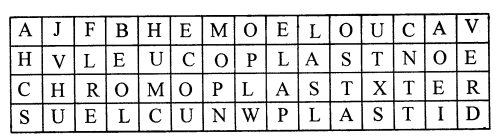
Answer :
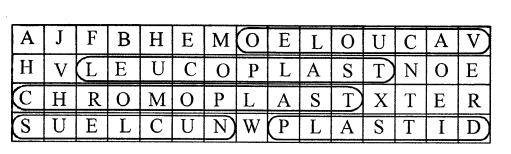
- Vacuole
- Leucoplast
- Chromoplast
- Nucleus, Plastid
Download PDF
Selina Class 6 ICSE Solutions Biology (Unit 2) - The Cell: Chapter 3- The Structure and Functions
Chapterwise Selina Publishers ICSE Solutions for Class 6 Biology :
Unit 1
Unit 2
- Chapter 3- The Structure and Functions
- Chapter 4- Digestive System
- Chapter 5- Respiratory System
- Chapter 6- The Circulatory System
Unit 3
About Selina Publishers ICSE
Selina Publishers has been serving the students since 1976 and is one of the quality ICSE school textbooks publication houses. Mathematics and Science books for classes 6-10 form the core of our business, apart from certain English and Hindi literature as well as a few primary books. All these books are based upon the syllabus published by the Council for the I.C.S.E. Examinations, New Delhi. The textbooks are composed by a panel of subject experts and vetted by teachers practising in ICSE schools all over the country. Continuous efforts are made in complying with the standards and ensuring lucidity and clarity in content, which makes them stand tall in the industry.