
Class 8: History (Part I) Chapter 10 solutions. Complete Class 8 History (Part I) Chapter 10 Notes.
NCERT Solutions for 8th Class History (Part II):Chapter 10-The Changing World of Visual Arts Our Past
NCERT 8th History (Part I) Chapter 10, class 8 History (Part I) Chapter 10 solutions
Page No: 139
Let's Recall
1. Fill in the blanks:
(a) The art form which observed carefully and tried to capture exactly what the eye saw is called ___________.
(b) The style of painting which showed Indian landscape as a quaint, unexplored land is called __________.
(c) Paintings which showed the social lives of Europeans in India are called _________.
(d) Paintings which depicted scenes from British imperial history and their victories are called ____________.
Answer
(a) The art form which observed carefully and tried to capture exactly what the eye saw is called portraiture.
(b) The style of painting which showed Indian landscape as a quaint, unexplored land is called picturesque.
(c) Paintings which showed the social lives of Europeans in India are called Kalighat paintings.
(d) Paintings which depicted scenes from British imperial history and their victories are called history paintings.
NCERT 8th History (Part I) Chapter 10, class 8 History (Part I) Chapter 10 solutions
Page No: 140
2. Point out which of the following were brought in with British art:
(a) oil painting (b) miniatures (c) life-size portrait painting (d) use of perspective (e) mural art
Answer
(a) Oil painting, (c)life-size portrait painting and (d) use of perspective.
3. Describe in your own words one painting from this chapter which suggests that the British were more powerful than Indians. How does the artist depict this?
Answer
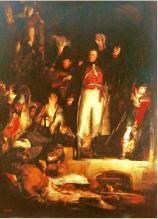
The painting which depicts the discovery of the body of Tipu Sultan shows the British as more powerful than Indians. In this painting, the British General is shown as if standing on a high pedestal and exuding all the confidence. On the other hand, Tipu Sultan is shown half naked and lifeless; lying in the dark recess. The painting appears to announce that those who dare to challenge the British authority would meet the same fate.
4. Why did the scroll painters and potters come to Kalighat? Why did they begin to paint new themes?
Answer
The scroll painters and potters come to Kalighat in the hope of new patrons and neve buyers of their art. After the 1 &lOs, a new trend was visible within the Kalighat artists. Living in a society where values, tastes, social norms and customs were undergoing rapid changes, Kalighat artists responded to the world around and produced paintings on social and political themes.
5. Why can we think of Raja Ravi Varma's paintings as national?
Answer
Raja Ravi Varma was one of the first artists who tried to create a style that was both modern and national. He used the Western art of oil painting and realistic life study to paint themes from Indian mythology. He dramatised on canvas scene after scene from the Indian epics Ramayana and Mahabharata. This portrayal of an Indian consciousness is what makes his paintings national. This was perhaps one of the reasons why his paintings were popular not only among Indian princes and art collectors but also among the masses.
NCERT 8th History (Part I) Chapter 10, class 8 History (Part I) Chapter 10 solutions
Let's Discuss
6. In what way did the British history paintings in India reflect the attitudes of imperial conquerors?
Answer
The British history paintings sought to dramatise and recreate various episodes of British imperial history. These paintings celebrated the British power, their victories and their supremacy. The imperial history paintings attempted to create a public memory of imperial triumphs. Victories had to be remembered, implanted in the memory of people, both in India and Britain. Only then could the British appear invincible and all-powerful.
7. Why do you think some artists wanted to develop a national style of art?
Answer
Some artists rejected the art of Ravi Varma as imitative and westernised and declared that such a style was unsuitable for depicting the nations ancient myths and legends. They felt that a genuine Indian style of painting had to draw inspiration from non-Western art traditions, and try to capture the spiritual essence of the East. These artists broke away from the convention of oil painting and the realistic style, and turned for inspiration to medieval Indian traditions of miniature painting and the ancient art of mural painting in the Ajanta caves. Abanindranath Tagore was one of the first artists who wanted to develop a national style of art.
8. Why did some artists produce cheap popular prints? What influence would such prints have had on the minds of people who looked at them?
Answer
By the late nineteenth century, mechanical printing presses were set up in different parts of India. This allowed prints to be produced in large numbers. These prints could therefore be sold cheap in the market. As a result, even the poor could buy them. With the spread of nationalism, the popular prints of the early twentieth century began carrying nationalist messages. Such popular prints would have inspired people to fight British rule.
NCERT 8th History (Part I) Chapter 10, class 8 History (Part I) Chapter 10 solutions
NCERT Solutions for 8th Class History (Part II):Chapter 10: Download PDF
NCERT Solutions for 8th Class History (Part II):Chapter 10-The Changing World of Visual Arts Our Past
Chapterwise NCERT Solutions for Class 8 History (Part I) :
- Chapter 1 – How, When and Where
- Chapter 2 – From Trade to Territory The Company Establishes Power
- Chapter 3 – Ruling the Countryside
- Chapter 4 – Tribals, Dikus and the Vision of a Golden Age
- Chapter 5 – When People Rebel 1857 and After
- Chapter 6 – Weavers, Iron Smelters and Factory Owners
- Chapter 7 – Civilising the “Native”, Educating the Nation
- Chapter 8 – Women, Caste and Reform
- Chapter 9 – The Making of the National Movement: 1870s–1947
- Chapter 10 – India After Independence
- Chapter 11 - The Making of the National Movement: 1870s-1947
- Chapter 12 - India After Independence
About NCERT
The National Council of Educational Research and Training is an autonomous organization of the Government of India which was established in 1961 as a literary, scientific, and charitable Society under the Societies Registration Act. Its headquarters are located at Sri Aurbindo Marg in New Delhi. Visit the Official NCERT website to learn more.