
Class 12: Biology Chapter 5 solutions. Complete Class 12 Biology Chapter 5 Notes.
NCERT Solutions for 12th Class Biology: Chapter 5-Principle and Inheritance of variation
NCERT 12th Biology Chapter 5, class 12 Biology chapter 5 solutions
Exercises (NCERT 12th Class Biology Chapter 5)
Page No: 93 (NCERT 12th Class Biology Chapter 5)
1. Mention the advantages of selecting pea plant for experiment by Mendel.
Answer
The advantages of selecting pea plant for experiment by Mendel:
• Peas have many visible contrasting characters such as smooth or wrinkled seeds, yellow or green seeds, smooth or inflated pods, green or yellow pods and tall or dwarf plants.
• It undergoes self-pollination easily producing offsprings with same traits generation after generation.
• Cross-pollination can be also done manually by emasculation in which the stamen of the flower is removed without affecting the pistil.
• Pea plants have a short life span and produce many seeds in one generation.
2. Differentiate between the following –
(a) Dominance and Recessive
| Dominance | Recessive |
| Dominance allele is able to express itself even in the presence of its recessive allele. | Recessive allele or factor is unable to express its effect in the presence of dominant allele. |
| It does not require another similar allele to produce its effect on the phenotype, e.g., Tt is tall. | It produces its phenotypic effect only in the presence of a similar allele, e.g., tt is dwarf. |
(b) Homozygous and Hetrozygous
| Homozygous | Heterozygous |
| It is pure for a trait and breeds true, i.e., gives rise to similar homozygous individuals. | It is rarely pure and produces offspring with different genotypes on selling, e.g., TT. Tt and tt on selfing of Tt individuals. |
| Both the alleles of a character are similar. Example: TT, tt | It carries dissimilar alleles, Example: Tt |
| It produces only one type of gamete. | It produces two different kinds of gametes. |
(c) Monohybrid and Dihybrid
| Monohybrid | Dihybrid |
| It is a cross between two pure organisms in order to study the inheritance of a single pair of alleles. | It is a cross between two pure organisms of a species in order to study the inheritance of two pairs of alleles. |
| It produces genotypic ratio of 1: 2: 1 in F2 generation. | It produces a phenotypic dihybrid ratio of 9: 3: 3: 1 in F2 generation. |
3. A diploid organism is heterozygous for 4 loci, how many types of gametes can be produced?
Answer
By applying the formula 2n (where n = number of loci)
4 loci can produce = 24 = 16 types of gametes.
4. Explain the Law of Dominance using a monohybrid cross.
Answer
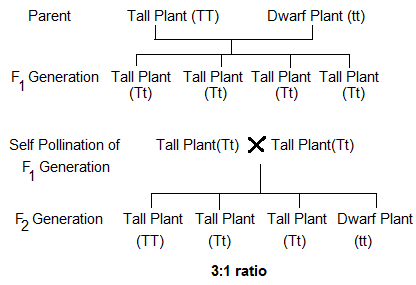
Law of Dominance states that when two genes are present in an organism then dominant gene expresses itself and recessive gene does not show its effect and remain hidden.
When a cross pollination experiments is conducted between two organisms taking a single contrasting character at a time it is called monohybrid cross.
When two pea plants, one is pure tall (TT) and other is pure dwarf (tt) are crossed. All pants in F1 generation were found to be Tal l(TT). When these tall plants (Tt) were self fertilized, both the tall and dwarf seeds appeared in F2 generation in 3: 1 ratio. Hence, in F1generation, the dominant character (Tall) appeared and the recessive character (dwarf) got suppressed, which reappeared in F2 generation. Thus, this monohybrid cross explains Law of Dominance.
5. Define and design a test - cross?
Answer
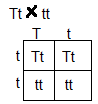
A test cross is one in which an individual with an unknown dominant phenotype is crossed with a recessive individual for that trait. It is used to determine whether the individual is homozygous or heterozygous for a trait.
If the unknown is homozygous tall (TT), then crossing with dwarf recessive (tt) gives all tall offspring (Tt).

If the unknown is heterozygous tall (Tt), then crossing with dwarf results in 50% tall (Tt) and 50% dwarf (tt) progeny.
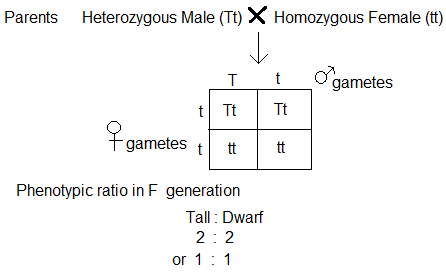
6. Using a Punnett square, work out the distribution of phenotypic features in the first filial generation after a cross between a homozygous female and a heterozygous male for a single locus.
7. When a cross in made between tall plant with yellow seeds (TtYy) and tall plant with green seed (Ttyy), what proportions of phenotype in the offspring could be expected to be
(a) tall and green.
(b) dwarf and green.
Answer
A cross between tall plant with yellow seeds and tall plant with green seeds will produce
(a) three tall and green plants
(b) one dwarf and green plant
Page No: 94 (NCERT 12th Class Biology Chapter 5)
8. Two heterozygous parents are crossed. If the two loci are linked, then what would be the distribution of phenotypic features in the F1generation for a dihybrid cross?
Answer
If two loci are linked, they lie close on the same locus of a chromosome, they would separate. However, the chromosomes do segregate and end up in different gametes.
9. Briefly mention the contribution of T.H. Morgan in genetics.
Answer
TH Morgan's contribution in genetics are
• Morgan contributed to the understanding of sex-linked traits.
• He carried out several experiments on fruit flies and his dihybrid crosses revealed that genes for some traits did not segregate independently and the F2 ratio was a lot different from 9:3:3:1.
• He inferred that when two genes were situated on the same chromosome, the proportions of parental gene combinations were significantly higher than the non-parental type.
• He established the principle of linkage crossing over, sex-linked inheritance and discovered the relation.
• He established the technique of chromosome mapping.
• He observed and worked on mutation.
10. What is pedigree analysis? Suggest how such an analysis, can be useful.
Answer
Pedigree analysis is a record of occurrence of a trait in several generations of a family. It is based on the heritability of certain characteristic features in families.
Its usefulness are:
• It shows the origin of a trait and flow of that trait in a family.
• It is useful in knowing the possibility of expressive or recessive allele which may cause genetic disorder, such as colour blindness.
• It predicts the harmful effects of marriage between close relatives.
• It helps in genetic counselling to avoid disorders in children.
11. How is sex determined in human beings?
Answer
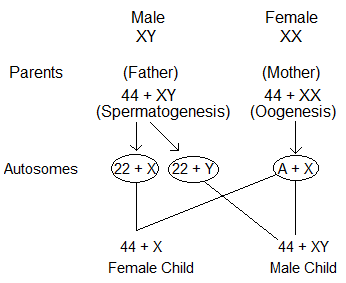
Human beings have 23 pairs of chromosomes in which 22 pairs of autosomes and one pair of sex chromosomes. The females have a pair of XX-chromosomes (homogametic) and the males XY (heterogametic) composition. The sex of the baby is determined by the type of male gamete that fuses with the female gamete. If the fertilizing sperm contains X chromosome, then the baby produced will be a girl and if the fertilizing sperm contains Y chromosome, then the baby produced will be a boy.
12. A child has blood group O. If the father has blood group A and mother blood group B, work out the genotypes of the parents and the possible genotypes of the other offsprings.
Answer
The child with blood group ‘O’ will have homozygous recessive alleles. Therefore, both the parents should be heterozygous, i.e., the genotype of the father will be IiA and of mother will be IiB.
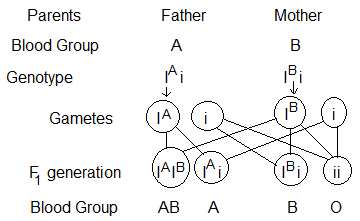
Blood group: AB
The possible blood groups of other offsprings will be AB, A, B and O.
13. Explain the following terms with example
(a) Co-dominance
(b) Incomplete dominance
Answer
Co-dominance: Co-dominance is the phenomenon in which F1 generation resembles both the parents and both the parental characters are expressed simultaneously.
Example: If a plant with yellow coloured flower crosses with a plant of red coloured flower and in F 1 generation, all progeny show orange flowers because of co-dominance of both alleles for red and yellow colours.
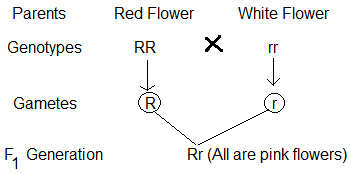
Incomplete dominance: Incomplete dominance is a phenomenon in which the genes of allelomorphic pairs are not expressed as dominant and recessive but express themselves partially when present together in the hybrid.
Example: 4' O clock plant exhibit two types of flowers, red and white and hybrids are pink cloured flowers.
14. What is point mutation? Give one example.
Answer
Point mutation is a change in single base pair of DNA molecule. Example: Sickle cell anaemia. It involves mutation in a single base pair in the beta-globin chain of haemoglobin pigment of the blood. Glutamic acid in short arm of chromosome II gets replaced with valine at the sixth position.
15. Who had proposed the chromosomal theory of the inheritance?
Answer
Sutton and Boveri proposed the chromosomal theory of inheritance in 1902.
16. Mention any two autosomal genetic disorders with their symptoms.
Answer
Sickle cell anaemia: This is an autosome linked recessive trait that can be transmitted from parents to the offspring when both the partners are carrier for the gene or heterozygous.
Symptoms: Rapid heart rate, breathlessness, delayed growth and puberty, jaundice, weakness, fever, excessive thirst, chest pain, and decreased fertility are the major symptoms of sickle cell anaemia disease.
Down's syndrome: It is an autosomal disorder that is caused by the trisomy of chromosome 21.
Symptoms: The individual is short statured with round head, open mouth, protruding tongue, short neck, slanting eyes, and broad short hands. The individual also shows retarded mental and physical growth.
NCERT Solutions for 12th Class Biology: Chapter 5: Download PDF
NCERT Solutions for 12th Class Biology: Chapter 5-Principle and Inheritance of variation
Chapterwise NCERT Solutions for Class 12 Biology:
- Chapter 1: Reproduction in Organisms
- Chapter 2: Sexual Reproduction in Flowering Plants
- Chapter 3: Human Reproduction
- Chapter 4: Reproductive Health
- Chapter 5: Principles of Inheritance and Variation
- Chapter 6: Molecular Basis of Inheritance
- Chapter 7: Evolution
- Chapter 8: Human Health and Disease
- Chapter 9: Strategies for Enhancement in Food Production
- Chapter 10: Microbes in Human Welfare
- Chapter 11: Biotechnology Principles and Processes
- Chapter 12: Biotechnology: and its Application
- Chapter 13: Organisms and Populations
- Chapter 14: Ecosystem
- Chapter 15: Biodiversity and Conservation
- Chapter 16: Environmental Issues
About NCERT
The National Council of Educational Research and Training is an autonomous organization of the Government of India which was established in 1961 as a literary, scientific, and charitable Society under the Societies Registration Act. Its headquarters are located at Sri Aurbindo Marg in New Delhi. Visit the Official NCERT website to learn more.