

Class 6: Maths Chapter 11 solutions. Complete Class 6 Maths Chapter 11 Notes.
Contents
ML Aggarwal Solutions for Class 6 Maths Chapter 11- Understanding Symmetrical Shapes
ML Aggarwal 6th Maths Chapter 11, Class 6 Maths Chapter 11 solutions
1. Why is it better to use a divider and a ruler than a ruler only, while measuring the length of a line segment?
Solution:-
The divider gives up accurate measurement whereas the ruler may cause difficulties in reading of length. Therefore, it is better to use a divider while measuring the length of a line segment.
2. In the given figure, compare the line segments with the help of a divider and fill in the blanks by using the symbol >, = or <:
(i) AB ………. CD
(ii) BC ………. AB
(iii) AC ………. BD
(iv) CD ………. BD

Solution:-
(i) From the figure,
AB = CD … [in parallelograms opposites are equal]
(ii) BC < AB
(iii) AC > BD
(iv) CD < BD
3. If A, B and C are collinear points such that AB = 6 cm, BC = 4 cm and AC = 10 cm, which one of them lies between the other two?
Solution:-
From the question it is given that,
A, B and C are collinear points
AB = 6 cm
BC = 4 cm
AC = 10 cm
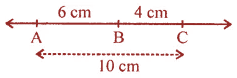
Here, point B lies between the other two i.e A and C.
4. In the given figure, verify the following by measurement:
(i) AB + BC = AC
(ii) AC – BC = AB

Solution:-
From the figure,
By using the divider and ruler we measured the given figure,
So,
AB = 3 cm, BC = 1.5 cm and AC = 4.5 cm
(i) AB + BC = AC
3 cm + 1.5 cm = 4.5 cm
4.5 cm = 4.5 cm
(ii) AC – BC = AB
4.5 cm – 1.5 cm = 3 cm
3 cm = 3 cm
5. In the given figure, verify by measurement that:
(i) AC + BD = AD + BC
(ii) AB + CD = AD – BC

Solution:-
From the figure,
By using the divider and ruler we measured the given figure,
So,
AB = 1.8 cm, BC = 0.8 cm, BD = 2.7 cm CD = 1.9 cm, AC = 2.6 cm and AD = 4.5 cm
(i) AC + BD = AD + BC
Consider Left hand side (LHS) = AC + BD
= 2.6 cm + 2.7 cm
= 5.3 cm
Now, Right hand side (RHS) = AD + BC
= 4.5 cm + 0.8 cm
= 5.3 cm
By comparing LHS and RHS
LHS = RHS
5.3 cm = 5.3 cm
Therefore, AC + BD = AD + BC
(ii) AB + CD = AD – BC
Consider Left hand side (LHS) = AB + CD
= 1.8 cm + 1.9 cm
= 3.7 cm
Now, Right hand side (RHS) = AD – BC
= 4.5 cm – 0.8 cm
= 3.7 cm
By comparing LHS and RHS
LHS = RHS
3.7 cm = 3.7 cm
Therefore, AB + CD = AD – BC
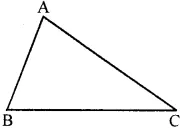
6. In the given figure, measure the lengths of the sides of the triangle ABC and verify:
(i) AB + BC > AC
(ii) BC + AC > AB
(iii) AC + AB > BC
Solution:-
From the figure,
By using the divider and ruler we measured the given figure,
So,
AB = 2.6 cm, BC = 3.9 cm, AC = 4 cm
(i) AB + BC > AC
2.6 + 3.9 cm > 4 cm
6.5 cm > 4 cm
(ii) BC + AC > AB
3.9 + 4 cm > 2.6 cm
7.9 cm > 2.6 cm
(iii) AC + AB > BC
4 cm + 2.6 cm > 3.9 cm
6.6 cm > 3.9 cm
Download PDF
ML Aggarwal Solutions for Class 6 Maths Chapter 11- Understanding Symmetrical Shapes
Chapterwise ML Aggarwal Solutions for Class 6 Maths :
- Chapter 1- Knowing Our Numbers
- Chapter 2- Whole Numbers
- Chapter 3- Integers
- Chapter 4- Playing with Numbers
- Chapter 5- Sets
- Chapter 6- Fractions
- Chapter 7- Decimals
- Chapter 8- Ratio and Proportion
- Chapter 9- Algebra
- Chapter 10- Basic Geometrical Concept
- Chapter 11- Understanding Symmetrical Shapes
- Chapter 12- Symmetry
- Chapter 13- Practical Geometry
- Chapter 14- Mensuration
- Chapter 15- Data Handling
About ML Aggarwal
M. L. Aggarwal, is an Indian mechanical engineer, educator. His achievements include research in solutions of industrial problems related to fatigue design. Recipient Best Paper award, Manipal Institute of Technology, 2004. Member of TSTE.