
Class 9: English Kumarbharati Chapter 3 solutions. Complete Class 9 English Kumarbharati Chapter 3 Notes.
Maharashtra Board Solutions for Class 9- English Kumarbharati: Chapter 1.3- Have you ever seen…?
Maharashtra Board 9th English Kumarbharati Chapter 3, Class 9 English Kumarbharati Chapter 3 solutions
Questions and Answers
Warming Up:
1. Words that have the same spelling, but differ in meaning when used in different contexts are called homographs. For example,
(a) A temple fair attracts a lot of crowd.
Her performance in the test was fair.
(b) A rose is the king of flowers.
The sun rose with a golden glow.
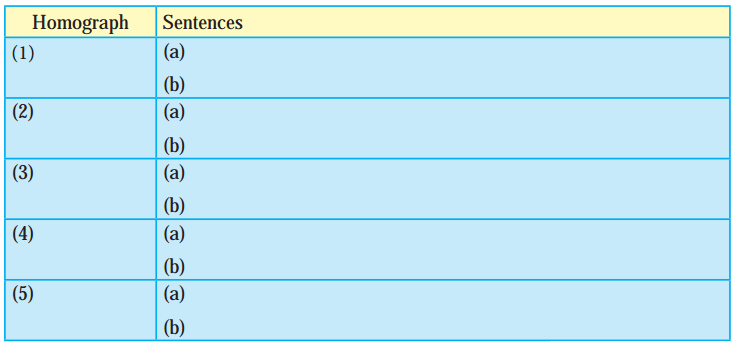
Think of 5 homographs and list them below. Then write 2 sentences of your own, to bring out the difference in meanings.
Question 1.
Think of five homographs and list them down. Then write two sentences of your own, to bring out the difference in meaning :
Words that have the same spelling but differ in meaning when used in different contexts are called homographs.
Answer:
| Homographs | Sentences |
| 1. bow | (a) The prince slowly put down the bow and arrow. (b) “Should I bow if I see the king?” asked the little boy. |
| 2. content | (a) One should always be content with what one has. (b) You must always check the nutritional content of what you eat. |
| 3. live | (a) One must learn to live within one’s means. (b) It is dangerous to touch a live wire. |
| 4. minute | (a) His voice was getting louder every minute. (b) There were minute particles of dust in the air. |
| 5. tear | (a) A tear fell from the eye of the old woman. (b) “Tear the paper into four pieces,” said the teacher. |
2. When words with the same spelling or pronunciation are used in such a way that they convey more than one meaning, the figure of speech involved is called pun. A pun is a play upon words. For example,
A: Hello! How’s life?
B: Hell, O! It’s a strife.
Find other examples of pun with the help of your parents/teacher.
- ………………….
- ………………..
- ………………….
- ………………….
Question 1.
Find other examples of pun with the help of your parents/teacher.
Answer:
Some examples :
1. Where do you find giant snails?
On the ends of giants’ fingers.
2. How do turtles talk to each other?
By using shell phones!
3. You can communicate with a fish by dropping it a line.
4. What do you get from a pampered goat?
Spoilt milk.
3. In poetry, when a question is asked, not to get an answer, but to emphasise a point or fact, it is an example of Interrogation.
For example :
When can their glory fade?
Isn’t it time for the autumn’s glow?
From a popular book of poems/the internet, write down 3-4 examples of Interrogation used in poetry.
- ………………….
- ………………….
- ………………….
- ………………….
Question 1.
write down 3-4 examples of Interrogation used in poetry.
Answer:
- If Winter comes, can Spring be far behind?
- If you prick us, do we not bleed?
- What’s in a name?
English Workshop:
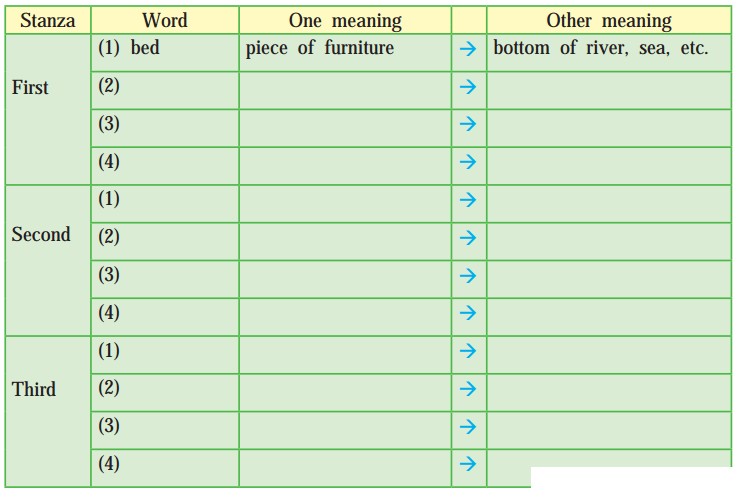
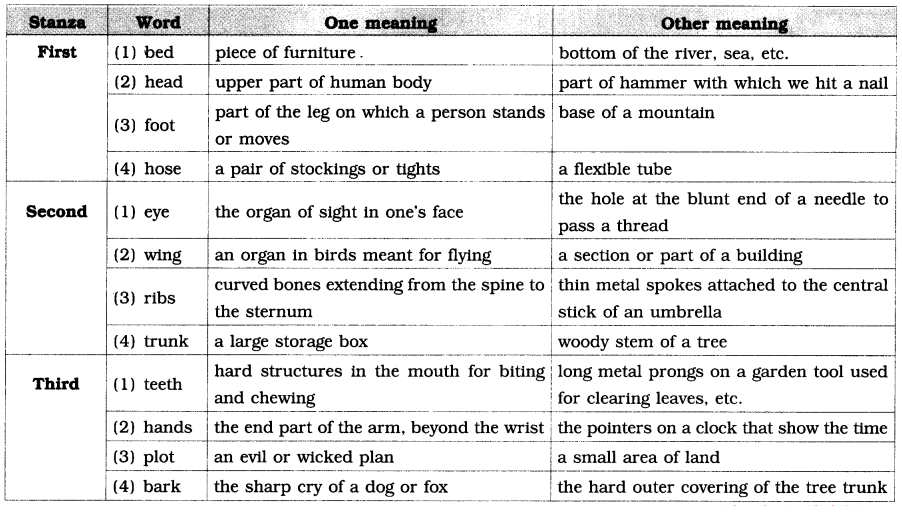
1. From each line in the poem, pick out the word that is a homograph. Write its meaning in the context of the phrase used in the poem. Then write the other meaning implied in the question.
Question 1.
1. From each line in the poem, pick out the word that is a homograph. Write its meaning in the context of the phrase used in the poem. Then write the other meaning implied in the question.
Answer:
2. Write 2 lines from this poem which you find most humorous. Justify your choice.
…………………………………………………………………………………………………………………………………………………
…………………………………………………………………………………………………………………………………………………
Question 1.
Write two lines from the poem that you find the most humorous. Justify your choice.
Answer:
1. Can you tickle the ribs of a parasol?
I find this humorous because I can just imagine someone tickling the spokes of an umbrella and trying to get it to respond!
2. Does the needle ever wink its eye?
I find this humorous because I think of myself holding a needle that is winking!
3. Find from the poem, three examples of each :
(a) Interrogation
1. …………………….
2. ……………………
3. ……………………
(b) Pun
1. …………………….
2. ……………………
3. ……………………
(c) Personification
1. …………………….
2. ……………………
3. ……………………
(d) Alliteration
1. …………………….
2. ……………………
3. ……………………
Question 1.
Find from the poem, three examples of each:
(a) Interrogation
(b) Pun
(c) Personification
(d) Alliteration
Answer:
(a) Interrogation :
- Have you seen a sheet on a river bed?
- Does the needle ever wink its eye?
- Are the teeth of a rake ever going to bite?
(b) Pun :
- Has the foot of the mountain any toes?
- Can you tickle the ribs of a parasol?
- Have the hands of a clock any left or right?
(c) Personification :
- Has the foot of the mountain any toes?
- Does the needle ever wink its eye?
- Can you tickle the ribs of a parasol?
(d) Alliteration :
- Or a single hair from a hammer’s head?
- Or open the trunk of a tree at all?
- And what is the sound of the birch’s bark?
4. Form groups of four or five. Think, discuss and add at least one more stanza, using the same style and devices as the poet has used. It should include homographs, interrogation and the same rhythm and rhyme scheme.
Question 1.
‘Form groups of four or five. Think, discuss and add at least one more stanza, using the same style and devices as the poet has used. It should include homographs, interrogation and the same rhythm and rhyme scheme.
Have/Does/Are ………………………………………………………….
………………………………………………………………………………………..
………………………………………………………………………………………..
………………………………………………………………………………………..
Answer:
- Do elephants bathe with their trunks on, all in a batch?
- Have scientists created a flea from scratch?
- Are the bees having a house swarming party with honey?
- Did the lion spit out the clown because he tasted funny?
5. Read the following sentences carefully. Then fill in the blanks using appropriate words from the brackets, to make puns.
(struck, numbered, too tired, developed, put down, homeless, old fashioned, reaction)
Question 1.
Read the following sentences carefully. Then fill in the blanks using appropriate words from the brackets, to make puns.
(struck, numbered, too tired, developed, put down, homeless, old fashioned, reaction)
- She had a photographic memory but never …………………
- He was struggling to work out how lightning works when it …………………
- Every calendar’s days are …………………
- A bicycle cannot stand on its own because it is …………………
- I’m reading a book on anti-gravity. It’s impossible to ……………….. the book.
- I’d tell you a chemistry joke but I know I wouldn’t get …………………
- What do you call Watson when Sherlock isn’t around?………………..
- I would tell a history joke, but it is too ………………..
Answer:
- She had a photographic memory but never developed it.
- He was struggling to work out how lightning works when it struck him.
- Every calendar’s days are numbered.
- A bicycle cannot stand on its own because it is too tired.
- I’m reading a book on anti-gravity. It’s impossible to put down the book.
- I’d tell you a chemistry joke but I know I wouldn’t get a reaction.
- What do you call Watson when Sherlock isn’t around? homeless.
- I would tell a history joke, but it is too old-fashioned.
6. ‘Read: ‘Alice in Wonderland’ – by Lewis Carroll.
Question 1.
‘Read: ‘Alice in Wonderland’ – by Lewis Carroll.
Additional Important Questions and Answers
Read the following poem carefully and complete the activities :
Simple Factual Activity :
Question 1.
Fill in the blanks :
(The answers are given directly and underlined.)
The poet wonders if:
- the teeth of a rake will ever bite.
- the foot of a mountain has any toes.
- the ribs of an umbrella can be tickled.
- there can be a sheet on a river bed.
Complex Factual Activities :
Question 1.
What does the poet want to know about a hammer?
Answer:
The poet asks if anyone has seen a single hair on the head of a hammer.
Question 2.
What is the pun in the word ‘plot’ here?
Answer:
A plot means ‘an evil or wicked plan’. A plot ’ also means an area in a garden or some place. The poet asks how a garden ‘plot’ (one meaning of the word) can be evil and dark (the other meaning of the word).
Activities based on Poetic Devices :
Question 1.
Find the rhyming words from the poem.
Answer:
- Stanza 1 – bed-head, toes-hose.
- Stanza 2 – eye-fly, parasol-all.
- Stanza 3 – bite-right, dark-bark.
Download PDF
Maharashtra Board Solutions for Class 9- English Kumarbharati: Chapter 1.3- Have you ever seen…?
Chapterwise Maharashtra Board Solutions Class 9 English :
English Kumarbharati
Unit 1
- Chapter 1.1- Life
- Chapter 1.2- A Synopsis – The Swiss Family Robinson
- Chapter 1.3- Have you ever seen…?
- Chapter 1.4- Have you thought of the verb ‘have’ …
- Chapter 1.5- The Necklace
Unit 2
- Chapter 2.1- Invictus
- Chapter 2.2- A True Story of Sea Turtles
- Chapter 2.3- Somebody’s Mother
- Chapter 2.4- The Fall of Troy
- Chapter 2.5- Autumn
- Chapter 2.6- The Past in the Present
Unit 3
- Chapter 3.1- Silver
- Chapter 3.2- Reading Works of Art
- Chapter 3.3- The Road Not Taken
- Chapter 3.4- How the First Letter was Written
Unit 4
- Chapter 4.1- Please Listen
- Chapter 4.2- The Storyteller
- Chapter 4.3- Intellectual Rubbish
- Chapter 4.4- My Financial Career
- Chapter 4.5- Tansen
My English
Unit 1
- Chapter 1.1- Walk a Little Slower
- Chapter 1.2- The Fun they Had
- Chapter 1.3- ‘Hope’ is the Thing with Feathers
- Chapter 1.4- The Story of Tea
- Chapter 1.5- The Necklace
Unit 2
- Chapter 2.1- Comparisons
- Chapter 2.2- Helen Keller and Anne Sullivan
- Chapter 2.3- Mark Twain
- Chapter 2.4- Please Listen!
- Chapter 2.5- A Play
Unit 3
- Chapter 3.1- Coromandel Fishers
- Chapter 3.2- The Fall of Troy
- Chapter 3.3- To a Butterfly
- Chapter 3.4- Think Before You Speak!
- Chapter 3.5- Great Scientists
Unit 4