
Class 7: English Chapter 2.1 solutions. Complete Class 7 English Chapter 2.1 Notes.
Maharashtra Board Solutions for Class 7- English: Chapter 2.1- From a Railway Carriage
Maharashtra Board 7th English Chapter 2.1, Class 7 English Chapter 2.1 solutions
Questions and Answers
1. Read the poem aloud with proper rhythm. What does the rhythm remind you of?
Question 1.
Read the poem aloud with proper rhythm. What does the rhythm remind you of?
2. Find pairs of rhyming words from the poem.
Question 1.
Find pairs of rhyming words from the poem.
Answer:
witches – ditches, battle – cattle, plain – rain – again, eye – by, scrambles – brambles, gazes – daisies, road – load, river – ever.
3. Write the following:
Question 1.
The sights seen through a railway carriage mentioned in the first stanza.
Answer:
The sights seen through a railway carriage mentioned in the first stanza are bridges, houses, hedges, ditches, horses and cattle in the meadows.
Question 2.
The sights mentioned in the second stanza.
Answer:
The sights seen in the second stanza are hills, plains and painted stations.
Question 3.
The sights mentioned in the third stanza.
Answer:
The sights mentioned in the third stanza are a child clambering and scrambling to gather brambles, a tramp gazing at the train in wonder and green creepers for stringing the daisies.
4. Think and answer:
Question 1.
Why are the sights said to ‘fly’?
Answer:
The sights are said to ‘fly’ because the poet is sitting in a fast-moving train and all the beautiful scenes he gets to see as glimpses just rush past him and disappear because of the speed of the train.
Question 2.
Does the last line make you happy or sad? Why?
Answer:
The last line ‘and gone forever’ makes me feel sad because all the pleasure and happiness got from enjoying the beauty of nature comes to an end and disappears forever as the railway carriage speeds ahead.
5. List the lines that begin with ‘Here’ or ‘And here’.
Also list the sentences or phrases that begin with ‘And there’.
These phrases and sentences tell us about things that appear one after the other as the carriage moves. Can we tell which ones are closer to the train and which ones are at a distance? How?
Question 1.
List the lines that begin with ‘Here’ or ‘And there’.
Also list the sentences or phrases that begin with ‘And there’.
Answer:
The lines that begin with ‘Here’ or ‘And here’. ‘Here’ is an adverb which suggests ‘closeness’ of an object.
- Here is a child.
- Here is a tramp.
- Here is a cart.
- Here is a mill.
The above phrases show closeness to the train. ‘There’ is an adverb which suggests ‘distance’ of an object.
- And there is the green.
- And there is a river.
The above phrases show distance from the train.
6. Read the following:
Question 1.
Read the following:
Charging along like troops in a battle
Fly as thick as driving rain
Using your imagination, write one or two comparisons each with:
i. like…, ii. as… as
Answer:
i. like…
- This house looks like a castle.
- Her cheeks are red like a rose.
- He runs like a horse.
- The child chattered like a magpie.
ii. as… as
- He is as smart as a fox.
- He is as big as an elephant.
- He is as funny as a monkey.
- Our soldiers are as brave as lions.
7. Write about the sights you may see from a bus or an aeroplane.
You may write it in the form of a short poem.
Question 1.
Write the sights you may see from a bus or an aeroplane.
Answer:
The Red Bus
I’m out sightseeing in the red bus
With people around making a lot of fuss
I know I’m going to see wonderful sights
That’ll soar me to the heights
The greenery
The scenery
Oh! The wonderful luxury
Of travelling in the red, red bus.
Additional Important Questions and Answers
Answer the following questions.
Question 1.
What is the speed of the railway carriage compared to?
Answer:
The speed of the railway carriage is compared to the speed of fairies and witches.
Question 2.
Why is the child clambering and scrambling?
Answer:
The child is clambering and scrambling to collect brambles.
Question 3.
What does the rhythm of the poem remind you of?
Answer:
The rhythm of the poem reminds me of the rhythm of the train.
Question 4.
Have you travelled during a rainy day? What was your experience?
Answer:
Yes, I have travelled during the rainy season. Travelling on a rainy day is an awesome experience. You actually come in contact with nature’s beauty. The smell of the wet earth, the greenery, the colourful flowers, the waterfalls, etc. We get to see nature at its best.
Reading Skills and Poetic Device
Read the following extract and do the activities.
Simple Factual Questions:
Question 1.
Complete the web diagram with words from the extract.
Answer:
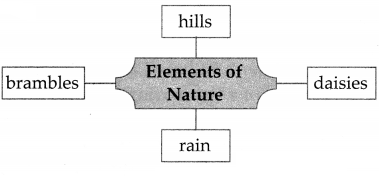
Question
What flies as thick as driving rain?
(Choose the right alternative)
i. Bridges and houses.
ii. Hill and plain.
iii. Hedges and ditches.
Answer:
ii. Hill and plain.
Complex Factual Questions:
Question 1.
How do the sights of the hills and plains move?
Answer:
The sights of the hills and plains move as thick as driving rain.
Question 2.
What does the poet see the child doing?
Answer:
The poet sees the child clambering and scrambling and gathering brambles all by himself.
Question 3.
To what is the charging train compared?
Answer:
The charging train is compared to troops in a battle.
Poetic Device:
Question 1.
Pick out two pairs of rhyming words from the 1st stanza.
Answer:
witches – ditches, battle – cattle.
Question 2.
Name the figure of speech for the following line.
“Faster than fairies, faster than witches”
Answer:
- Repetition: The word ‘faster’ is repeated for poetic effect, or
- Antithesis: The opposite words ‘fairies’ and ‘witches’ are used in the same line for better poetic effect.
Question 3.
Pick out a word from the extract which means ‘a woman having evil magical powers’.
Answer:
Witch.
‘From a Railway Carriage’ written by R. L. Stevenson describes the scenes he sees through the window of a fast moving train. He is so amazed at the speed of the train and tries to grasp every glimpse he sees because they are out of sight the very next moment. The train moves with such great speed that everything he sees seems to be moving.
Introduction:
‘From a Railway Carriage’ written by Robert Louis Stevenson is a poem in which he shares his experience of a railway journey with us.
Glossary:
- fairy (n) – a small imaginary being of the human form that has magical powers, especially good ones
- witch (n) – a woman thought to have magical powers especially evil ones
- hedge (n) – a fence or boundary formed by closely growing bushes or shrubs
- ditch (n) – a narrow channel dug at the side of a road or field, to hold or carry away water
- meadow (n) – a piece of grassland, especially one used for hay
- clamber (v) – climb or move in an awkward and laborious way, using both hands and feet
- scramble (v) – make one’s way quickly over rough ground by using one’s hands as well as feet
- tramp (n) – a person who travels from one place to another on foot in search of work, a homeless person
- lumping (v) – carry a heavy load somewhere with difficulty
- glimpse (n) – quick look, (v) – to catch sight of briefly
- bramble (v) – any rough, wild tangled prickly shrub, specifically the blackberry bush
- carriage (n) – a passenger train
- cart (n) – a horse-drawn vehicle with four wheels, used for transportation
- cattle (n) – domesticated animals like cow and bull
- gaze (v) – to look at something for a long time
- mill (n) – a building with a machine to grind grain into flour
- plain (n) – flat land having trees and grass
- sights (n)- things that one sees
- stringing (v) – with strings
- troop (n) – a group of soldiers
- meadow (n) – a field with grass and often wildflowers in it.
- daisy (n) – a small flower with white petals and a yellow centre, which often grows in the grass.
Download PDF
Maharashtra Board Solutions for Class 7- English: Chapter 2.1- From a Railway Carriage
Chapterwise Maharashtra Board Solutions Class 7 English :
Unit 1
- Chapter 1.1- Past, Present, Future
- Chapter 1.2- Odd One In
- Chapter 1.3- In Time of Silver Rain
- Chapter 1.4- The King’s Choice
- Chapter 1.5- Seeing Eyes Helping Hands
- Chapter 1.6- A Collage
Unit 2
- Chapter 2.1- From a Railway Carriage
- Chapter 2.2- The Souvenir
- Chapter 2.3- Abdul Becomes a Courtier
- Chapter 2.4- How Doth the Little Busy Bee
- Chapter 2.5- Learn Yoga from Animals
- Chapter 2.6- Chasing the Sea Monster
- Chapter 2.7- Great Scientists
Unit 3
- Chapter 3.1- Tartary
- Chapter 3.2- Compere a Programme
- Chapter 3.3- A Crow in the House
- Chapter 3.4- The Brook
- Chapter 3.5- News Analysis
- Chapter 3.6- Think Before You Speak
Unit 4