
Class 6: English Chapter 2.5 solutions. Complete Class 6 English Chapter 2.5 Notes.
Maharashtra Board Solutions for Class 6- English (Voyage 2): Chapter 2.5- The Silver House
Maharashtra Board 6th English Chapter 2.5, Class 6 English Chapter 2.5 solutions
Questions and Answers
1. What do the following words in the poem mean?
(a) crown (b) round (c) draw (d) blind
Do these words have other meanings? List them.
Question 1.
What do the following words in the poem mean?
(a) crown (b) round (c) draw (d) blind
Do these words have other meanings? List them.
Answer:
a. Crown: (in the poem) a princely ornament worn as a badge of royalty.
(Other meanings):
- A wreath for the head given as a reward of victory.
- The topmost part of the head.
- An award gained by a victory.
- An artificial replacement for the upper part of the tooth.
b. Round: (in the poem) spherical, having gentle curves
(Other meanings):
- Complete, whole
- Outspoken, plain and direct
- Finished; polished; not defective or abrupt
c. Draw: (in the poem) to move something by pulling
(Other meanings):
- To develop something (to sketch)
- To pull out (as a gun from a holster).
d. Blind: (in the poem) window coverings
(Other meanings):
- Unable to see
- Closed at one end or having a dead end
- Without prior knowledge
2. Find four pairs of rhyming words from the poem.
Question 1.
Find four pairs of rhyming words from the poem.
Answer:
The pairs of rhyming words in the poem are:
- crown – down
- way – say
- blind – find
- bare – there
3. In each of the following line, spot the sound that is used repeatedly.
Question 1.
There’s a silver house in the lovely sky.
Answer:
The sound of the letter ‘s’ is used repeatedly.
Question 2.
As round as a silver crown.
Answer:
The sound of the letter ‘a’ in the word ‘as’ is used repeatedly.
Question 3.
It takes two weeks to build it up. And two to pull it down.
Answer:
The sound of the letter ‘t’ is used repeatedly in the words ‘two’ and ‘to’. The sound of the letter ‘p’ is used repeatedly in the words ‘up’ and ‘puli’.
4. What is implied in the following phrases or lines?
Question a.
A silver house in the lovely sky.
Answer:
It is implied in this sentence that the ‘silver house’, is actually the moon in the sky.
Question b.
It takes two weeks to build it up.
Answer:
It is implied in this sentence that the two weeks that are used to build the ‘silver house’ up are the weeks that are required for the moon to complete its journey from the ‘new moon phase’ to the ‘full moon phase’ (waxing).
Question c.
And two to pull it down.
Answer:
It is implied in this sentence that the period of two weeks is the time taken by the moon to change from the ‘full moon phase’ to the ‘new moon phase’ (waxing).
5. Make a pair presentation’ of the poem, in the class.
Question 1.
Make a pair presentation’ of the poem, in the class.
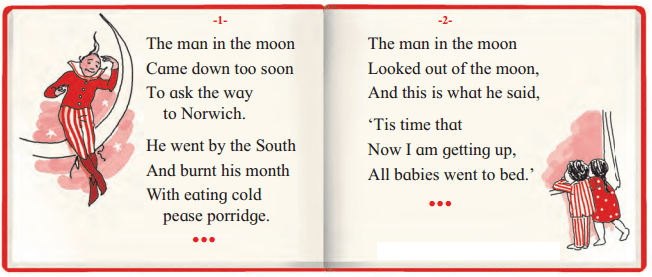
6. The man in the moon is mentioned in many nursery rhymes and stories. When people see the spots on the surface of the moon, they imagine that it’s a human face, or the figure of a man who lives on the moon. Sometimes, other characters like rabbits are also imagined to live with the man. Here are two nursery rhymes about the man in the moon.
7. Are there any stories/legends about the moon or special names for the moon in your language? Talk to your friends and family members and collect this information.
Question 1.
Are there any stories/legends about the moon or special names for the moon in your language? Talk to your friends and family members and collect this information.
Answer:
Legend:
In the 1820s, the Bavarian astronomer Franz Von Paula Gruithuisen claimed to have glimpsed entire cities on the moon with his telescope. He wrote that the ‘lunarians who lived there had built sophisticated buildings, roads and forts. Most of his colleagues scoffed at his assertion, but he eventually got a small lunar crater named after him.
Sir William Herschel, a prominent British astronomer and composer, also thought aliens lived on the moon and made regular observations about the progress of their construction projects. In 1835, when the New York Sun published a series of fraudulent articles about the supposed existence of life on earth on the moon (pulling off the so-called “Great Moon Hoax”), it falsely credited Herschel’s son John, a famous astronomer in his own right, with the shocking discovery.
Special names of the moon in different languages:
- Sanskrit: Himanshu
- Marathi: Chandra ;
- Hindi: Chand ‘
- French: Lune German: Mond
(The students are expected to find out more legends and words on their own.)
8. Do you know any poem or song about the moon in your own language? Sing it in the class.
Question 1.
Do you know any poem or song about the moon in your own language?:Sing it in the class.
9. Form pairs. Write a poem with rhyming lines on at least one of the following:
the moon, stars, a tree, a flower, a river/luke, rain, the wind, clouds.
Question 1.
Form pairs. Write a poem with rhyming lines on at least one of the following:
the moon, stars, a tree, a flower, a river/luke, rain, the wind, clouds.
Answer:
- White (Poem in cloud)
- Swirling clouds and shimmering sunlight,
- Shifting in between dim and bright
- Could stare all day and just night,
- Spectacular delight,
- Unable to fight,
- Amazing night,
- Outranks night,
- Just right
- White.
Important Questions and Answers
Reading Skills and Poetic Device:
Read the following extract and answer the questions given below.
Question 1.
What is there in the lovely sky?
Answer:
There is a silver house in the lovely sky.
Question 2.
How much time does it take to build up and pull up the house?
Answer:
It takes two weeks to build up and pull down the silver house.
Question 3.
Who lives in the silver house? How is he?
Answer:
A man who seems to be lonely, whose name no one knows or no one likes to say; stays in the silver house.
Question 4.
What is the rhyme scheme of stanza 1 and 2?
Answer:
abed
Read the following extracts and answer the questions given below.
Question 1.
When and what should you do to find the lonely man?
Answer:
You should draw the blinds of the window and peep out at the silver moon at night in order to find the lonely man.
Question 2.
List the pair of rhyming words in this
stanza.
Answer:
The pair of rhyming words in this stanza is
- bare – there
- blind – find.
Paraphrase:
The poet John Lea is comparing the silver house in the sky to a moon. He describes the different phases of the moon as the time to build up and pull down the said ‘Silver House’.
The poet talks about a man that lives in the ‘Silver House’ and how no one knows or talks about the man. The poet further advises us to draw the window blind at night, before calling it a day, in order to see the lonely man. John Lea, the poet, states that if you cease to find the poor man in the sky, it is because the ‘Silver House’ has been taken down. The ‘Silver House’ will of course not be there due to the moon being in the ‘new moon’ phase.
Introduction:
The poem The Silver House’ is a poem written by the poet John Lea that indirectly describes the phases of the moon. The poem describes a silver house which is as round as a silver crown in the sky which in fact, is the moon. The poem gradually explains that the house which actually is the moon, takes two weeks to build up and two weeks to pull down, which is the time the moon takes to change from the new moon phase to the full moon phase.
Glossary:
- crown (n) – a silver coin that was used in England in the past
- window blind (n) – a protective covering for the window. A window blind keeps out light.
- taken down (ph) – pulled down, dismantled
Download PDF
Maharashtra Board Solutions for Class 6- English (Voyage 2): Chapter 2.5- The Silver House
Chapterwise Maharashtra Board Solutions Class 6 English :
Voyage 1
- Chapter 1.1- Don’t Give Up!
- Chapter 1.2- Who’s the Greatest?
- Chapter 1.3- Autobiography of a Great Indian Bustard
- Chapter 1.4- Children are Going to School ...
- Chapter 1.5- Kabaddi Match
- Chapter 1.6- The Peacock and the Crane
- Chapter 1.7- Param Vir Chakra: Our Heroes
Voyage 2
- Chapter 2.1- The Clothesline
- Chapter 2.2- The Worth of a Fabric
- Chapter 2.3- A Wall Magazine for your Class!
- Chapter 2.4- Anak Krakatoa
- Chapter 2.5- The Silver House
- Chapter 2.6- Ad‘wise’ Customers
- Chapter 2.7- Yonamine and Bushi
Voyage 3
- Chapter 3.1- It Can Be Done
- Chapter 3.2- Seven Sisters
- Chapter 3.3- Stone Soup
- Chapter 3.4-Sushruta
- Chapter 3.5- The Donkey
- Chapter 3.6- The Merchant of Venice
- Chapter 3.7- At the Science Fair
Voyage 4