

Class 6: Geography Chapter 3 solutions. Complete Class 6 Geography Chapter 3 Notes.
Contents
Maharashtra Board Solutions Class 6-Geography: Chapter 3- Comparing a Globe and a Map; Field Visits
Maharashtra Board 6th Geography Chapter 3, Class 6 Geography Chapter 3 solutions
Questions and Answers
Question 1.
What characteristics of two and three dimensional devices did you note?
Answer:
Two-dimensional objects have length and width and its product is area. Three-dimensional objects have length, width and height and its product is volume.
Question 2.
What features can be shown on a very small globe?
Answer:
On a very small globe the entire earth can be represented.
Question 3.
Which device will be suitable for understanding the concept of day and night on the earth?
Answer:
The globe is suitable for understanding the concept of day and night on the earth.
Question 4.
Which device will be useful to show your village/city?
Answer:
A map can be useful to show a village/city.
Question 5.
Which device can be easily carried from one place to another?
Answer:
A map can be easily carried from one place to another.
Activity:
Make two groups. Each group should ask the other group to find the locations of different places on the globe. You may also do this with a map.
Questions and Answers
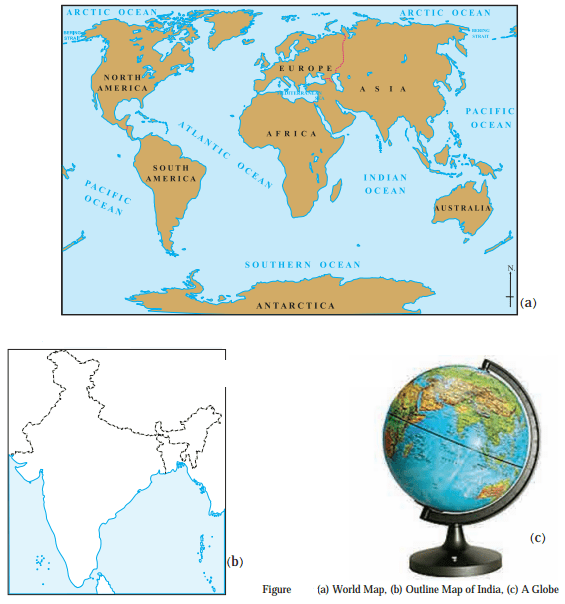
Study the world map, a map of India and the globe and answer the following questions:
Question 1.
Which device is flat?
Answer:
The world map and map of India are flat.
Question 2.
Which device is spherical?
Answer:
The globe is spherical.
Question 3.
Which of these devices allows you to see the entire area of the earth at the same time?
Answer:
The globe allows us to see the entire area of the earth at the same time.
Question 4.
Which device allows you to see only one side of the earth at a time?
Answer:
The map allows us to see only one side of the earth at a time.
Question 5.
Which device can be used for studying a particular region in detail?
Answer:
A map can be used for studying a particular region in detail.
Question 6.
Which device can be called a model of the earth?
Answer:
The globe can be called a model of the earth.
Questions and Answers
Fill in the blanks with the correct option from the brackets:
Question 1.
Map is ______ dimensional whereas a globe is ______ dimensional. (one, tvo, three, four)
Answer:
two, three
Question 2.
______ is a representative model of theentire earth. (map, sphere, globe)
Answer:
Globe
Question 3.
A field visit is an important method of studying ________.(political science, geography, history)
Answer:
geography
Question 4. _______ is the largest operational globe in the world. (EARTHA, Earth, Earthia)
Answer:
EARTHA
Name the following:
Question 1.
Two objects which are two-dimensional.
Answer:
Map, land
Question 2.
Two objects which are three-dimensional.
Answer:
Globe, duster
Question 3.
Two places for students to be taken for field visit.
Answer:
Post office, mall
Question 4.
Place where EARTHA is housed.
Answer:
Yarmouth in the State of Maine in the United States of America.
Answer the following questions in detail:
Question 1.
How is a field visit an important method of studying geography?
Answer:
- A field visit helps us to understand the geographical and social conditions of a place.
- It provides an opportunity to directly interact with the local people and understand their problems.
Question 2.
Write a note on – EARTHA.
Answer:
- EARTHA is the largest operational globe in the world.
- It is housed at Yarmouth in the State of Maine in the United State of America.
- The rotation and revolution speed of this globe is maintained as per that of the earth.
Question 3.
How is a map drawn?
Answer:
Various steps to draw a map:
- A wire globe is prepared.
- A source of light is placed inside the globe.
- Thereafter projection of the wire graticule is obtained on a paper
- This projection is used to drawmaps.
Download PDF
Maharashtra Board Solutions Class 6-Geography: Chapter 3- Comparing a Globe and a Map; Field Visits
Chapterwise Maharashtra Board Solutions Class 6 Geography:
- Chapter 1- The Earth and the Graticule
- Chapter 2- Let us Use the Graticule
- Chapter 3- Comparing a Globe and a Map; Field Visits
- Chapter 4- Weather and Climate
- Chapter 5- Temperature
- Chapter 6- Importance of Oceans
- Chapter 7- Rocks and Rock Types
- Chapter 8- Natural Resources
- Chapter 9- Energy Resources
- Chapter 10- Human Occupations
FAQs
You can download the Maharashtra State Board Books from the eBalbharti official website, i.e. cart.ebalbharati.in or from this article.
Students can get the Maharashtra Books for primary, secondary, and senior secondary classes from here. You can view or download the Maharashtra State Board Books from this page or from the official website for free of cost. Students can follow the detailed steps below to visit the official website and download the e-books for all subjects or a specific subject in different mediums.
Step 1: Visit the official website ebalbharati.in
Step 2: On the top of the screen, select “Download PDF textbooks”
Step 3: From the “Classes” section, select your class.
Step 4: From “Medium”, select the medium suitable to you.
Step 5: All Maharashtra board books for your class will now be displayed on the right side.
Step 6: Click on the “Download” option to download the PDF book.
As of now, the MSCERT and Balbharti are responsible for the syllabus and textbooks of Classes 1 to 8, while Classes 9 and 10 are under the Maharashtra State Board of Secondary and Higher Secondary Education (MSBSHSE).
The Maharashtra State Board of Secondary & Higher Secondary Education, conducts the HSC and SSC Examinations in the state of Maharashtra through its nine Divisional Boards located at Pune, Mumbai, Aurangabad, Nasik, Kolhapur, Amravati, Latur, Nagpur and Ratnagiri.
About Maharashtra State Board (MSBSHSE)
The Maharashtra State Board of Secondary and Higher Secondary Education or MSBSHSE (Marathi: महाराष्ट्र राज्य माध्यमिक आणि उच्च माध्यमिक शिक्षण मंडळ), is an autonomous and statutory body established in 1965. The board was amended in the year 1977 under the provisions of the Maharashtra Act No. 41 of 1965.
The Maharashtra State Board of Secondary & Higher Secondary Education (MSBSHSE), Pune is an independent body of the Maharashtra Government. There are more than 1.4 million students that appear in the examination every year. The Maha State Board conducts the board examination twice a year. This board conducts the examination for SSC and HSC.
The Maharashtra government established the Maharashtra State Bureau of Textbook Production and Curriculum Research, also commonly referred to as Ebalbharati, in 1967 to take up the responsibility of providing quality textbooks to students from all classes studying under the Maharashtra State Board. MSBHSE prepares and updates the curriculum to provide holistic development for students. It is designed to tackle the difficulty in understanding the concepts with simple language with simple illustrations. Every year around 10 lakh students are enrolled in schools that are affiliated with the Maharashtra State Board.