
Class 5: Environmental Studies Chapter 4 solutions. Complete Class 5 Environmental Studies Chapter 4 Notes.
Maharashtra Board Solutions Class 5-Environmental Studies (Part 2): Chapter 4- Evolution
Maharashtra Board 5th Environmental Studies Chapter 4, Class 5 Environmental Studies Chapter 4 solutions
Questions and Answers
1. Fill in the blank.
Question a.
The first systematic explanation of the concept of evolution was given by ………………… .
Charles Darwin
Willard Libby
Louis Leakey
Answer:
The first systematic explanation of the concept of evolution was given by Charles Darwin.
Question b.
……………… are the most evolved animals among vertebrates
Aquatic animals
Amphibians
Mammals
Answer:
Mammals are the most evolved animals among vertebrates
2. Answer the question in one sentence.
What do we call animals which live in water and also on land?
Answer:
Amphibians live in water and also on land.
Where did the first humans appear?
Answer:
The first human appeared on the African continent.
3. Give reasons for the following:
Question a.
The species of dinosaurs, which were enormous in size, suddenly became extinct.
Answer:
The species of dinosaurs, which were enormous in size, suddenly became extinct, because –
1. According to Darwin, the species that cannot adapt to environmental changes become extinct in the process of evolution.
2. Some sudden natural disaster or environmental change is believed to be responsible for the extinction of enormous dinosaurs.
Question b.
In the course of time, a new species with characteristics different from the original species is created.
Answer:
In the process of survival by adapting to environmental changes, certain internal physical changes occur in some species of animals.
Over a period of time, these changes become inherited characteristics seen in all subsequent generations. Thus, in the course of time, a new species with characteristics different from the original species is created.
4. Fill in the blanks in the concept chart given below.
Question 1.
Fill in the blanks in the concept chart given below.
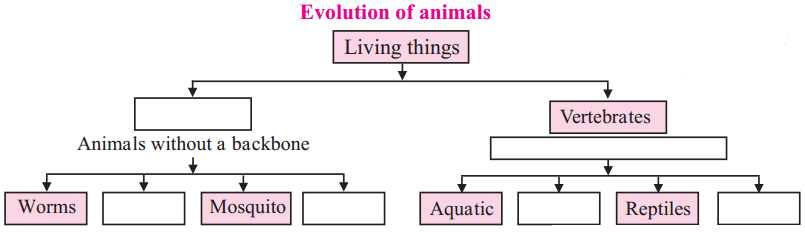
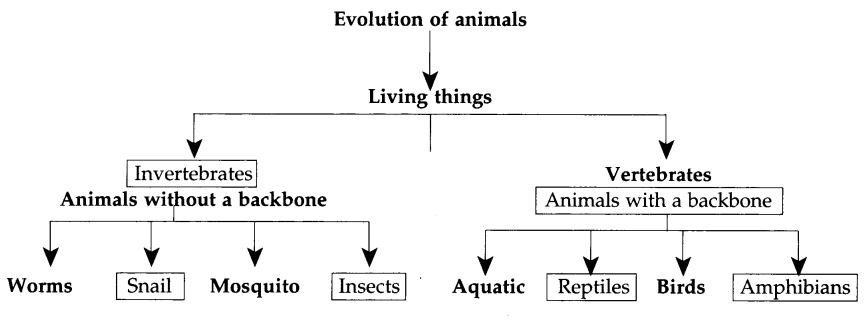
Answer:
Activity :
Question 1.
Make a model of a dinosaur.
Project :
Queston 1.
Collect pictures of invertebrates and vertebrates. Stick them in a notebook and write down their characteristics.
Additional Important Questions and Answers
Fill in the blanks :
- The word ……… generally means a gradual and continuous change.
- In the process of survival by adapting to environmental changes, certain internal ……………. changes occur in some animals of a species.
- Sometimes during evolution, the original species becomes ………..
- During evolution, sometimes more than one species evolve from the ………….. species.
- The first systematic explanation of the concept of evolution was given by …………
- Species which are capable of adapting to environmental changes are able to …………
- Species that cannot adapt to environmental changes become ………….
- …………………… means a ‘terrible lizard’.
- Some sudden natural………………….. is believed to be responsible for the extinction of Dinosaurs.
- Fossils of dinosaurs with ………………… have been discovered
- It is supposed that some species of two legged and winged dinosaurs evolved into …………..
- The ……………………… organisms evolved gradually and various classes of plants and animals came into being.
- Animals without a backbone are called ……………
- Animals which have a backbone are called ……….
- …………………….. are animals which live in water and also on land.
- Animals which crawl are called ………………..
- A mammals baby is …………………. on the mother’s milk for some time after birth.
- The platypus and anteater are also considered as ……………
- ………………… are somewhat like humans in appearance.
- Apes mostly lived on ………….
- Some ape species that evolved give rise to ………….. species.
- The first human species is called the …………… man.
- Primitive means ………………..
Answer:
- evolution
- physical
- extinct
- original
- Charles Darwin
- survive
- extinct
- Dinosaurs
- disaster
- wings
- birds
- multicellular
- invertebrates
- Vertebrates
- Amphibians
- Reptiles
- fed
- mammals
- Apes
- trees
- human
- primitive
- the first
Match the columns :
Question 1.
| Column ‘A’ | Column ‘B’ |
| 1. Charles Darwin | a. a gradual and continuous change |
| 2. Evolution | b. means ‘terrible lizard’ |
| 3. Dinosaur | c. gradually evolved into plants and animals |
| 4. Multicellular | d. explained the concept of evolution |
| 5. Invertebrates | e. frogs |
| 6. Aquatic | f. snake |
| 7. Amphibians | g. cow |
| 8. Reptiles | h. snails |
| 9. Mammals | i. fish |
Answer:
| Column ‘A’ | Column ‘B’ |
| 1. Charles Darwin | d. explained the concept of evolution |
| 2. Evolution | a. a gradual and continuous change |
| 3. Dinosaur | b. means ‘terrible lizard’ |
| 4. Multicellular | c. gradually evolved into plants and animals |
| 5. Invertebrates | e. frogs |
| 6. Aquatic | i. fish |
| 7. Amphibians | e. frogs |
| 8. Reptiles | f. snake |
| 9. Mammals | g. cow |
Answer each question in one sentence:
Question 1.
What does evolution mean?
Answer:
Evolution means a gradual and continuous change
Question 2.
What changes occur in some species, during the process of survival?
Answer:
In the process of survival, by adapting to environmental changes, certain internal physical changes occur in some animals of a species.
Question 3.
What happens to the internal changes over a period of time?
Answer:
Over a period of time, these internal changes become inherited characteristics seen in all generations.
Question 4.
When does an original species become extinct?
Answer:
During evolution, a new species with characteristics different from the original may be created. Sometimes the original species becomes extinct.
Question 5.
Name the scientist who explained the concept of evolution.
Answer:
The first scientist to give us a systematic explanation of the concept of evolution was Charles Darwin
Question 6.
Which species are able to survive?
Answer:
Species which are capable of adapting to environmental changes are able to survive.
Question 7.
Which species become extinct in the process of evolution?
Answer:
The species that cannot adapt to environmental changes become extinct in the process of evolution
Question 8.
What does dinosaur mean?
Answer:
Dinosaur means a ‘terrible lizard’.
Question 9.
How did the dinosaurs suddenly become extinct?
Answer:
Some sudden natural disaster or environmental change is believed to be responsible for the extinction of dinosaurs.
Question 10.
Why do we suppose that some species of dinosaurs have evolved into birds?
Answer:
Fossils of dinosaurs with wings have been discovered. Hence, it is supposed that some species of two-legged and winged dinosaurs evolved into birds.
Question 11.
How did plants and animals come into being?
Answer:
Unicellular organisms gave rise to multicellular organisms which in turn gradually evolved into various classes of plants and animals.
Question 12.
What are invertebrates?
Answer:
Animals without a backbone are called ‘invertebrates’. For example: a snail.
Question 13.
What are vertebrates?
Answer:
Animals which have a backbone are called vertebrates. For example: A cow
Question 14.
What do we call animals which live in water and also on land?
Answer:
Animals which live in water and also on land are called ‘Amphibians’. For example: Frog
Question 15.
What are Aquatic animals?
Answer:
Living organisms that live only in water are called ‘Aquatic animals’. For example Fish
Question 16.
What are Reptiles?
Answer:
Animals which crawl are called Reptiles. For example: Snake
Question 17.
Which species are the most evolved animals among vertebrates?
Answer:
Mammals are the most evolved animals among vertebrates.
Question 18.
Where do apes mostly live?
Answer:
Apes mostly lived on trees.
Question 19.
How did the Human species evolve?
Answer:
Some ape species found in grasslands were forced to move around on ground. These species evolved gradually and in time gave rise to human species.
Question 20.
What is the first human species called?
Answer:
The first human species is called the ‘primitive man’.
Question 21.
What does primitive mean?
Answer:
‘Primitive’ means ‘the first’.
Question 22.
Who are Apes?
Answer:
Apes are somewhat like humans in appearance.
Give reasons for the following :
Question 1.
In the course of time, a new species with characteristics different from the original species is created. Answer:
- In the process of survival by adapting to environmental changes, certain physical changes occur in some animals of a species.
- These internal changes become inherited characteristics in the following generations.
- Thus a new species with characteristics different from the original is created.
Question 2.
A frog is an amphibian.
Answer:
- Animals which are able to live in water and also on land are called amphibiAnswer:
- Therefore a frog is considered an amphibian.
Question 3.
The platypus and some species of anteaters are considered mammals.
Answer:
- Platypus and some species of anteaters are exceptions to the characteristics of mammals.
- Though they lay eggs, they suckle their young ones.
- Therefore, they are considered mammals.
Answer the following questions in brief :
Question 1.
Explain the concept Evolution as stated by Charles Darwin.
Answer:
- Charles Darwin explained ‘evolution’ in the following manner. In the process of survival by adapting to environmental changes, certain internal physical changes occur in some animals of a species.
- Over a period of time, these internal changes become inherited characteristics of the following generation.
- Thus a new evolved species with characteristics different from the original is created
- Sometimes the original species become extinct.
- Sometimes more than one species evolve from the original one.
Question 2.
Give the characteristics of mammals.
Answer:
The characteristics of most of the mammals are as follows:
- Growth of the baby in the mother’s womb, sometime before birth.
- The baby is fed on the mother’s milk for sometime after birth.
Question 3.
How and where did the human species evolve?
Answer:
- Apes are somewhat like humans in appearance
- They mostly lived on trees. Those species of apes which continued to live on trees retained their original ape like form.
- Some ape species found in grasslands were forced to move on the ground.
- These species evolved gradually, giving rise to the human species.
- This happened first on the ‘African continent’.
Question 4.
How did various classes of plants and animals come into being?
Answer:
- Life on earth began with unicellular organisms known as protozoa.
- These unicellular organisms gave rise to multicellular living things.
- Multicellular organisms evolved gradually and thus various classes of plants and animals came into being
Question 5.
How did birds form from dinosaurs?
Answer:
- Dinosaurs became extinct because of some sudden natural disaster or environmental change
- Fossils of dinosaurs with wings have been discovered
- It is thus believed that some species of two legged and winged dinosaurs evolved into birds.
Question 6.
How many and which are the stages of evolution of animals?
Answer:
There are two stages of evolution of animals. They are:
- Invertebrates: These are animals without a backbone.
- Vertebrates: Animals which have a backbone are vertebrates. Aquatic animals, amphibians, birds, reptiles and mammals are all vertebrates.
Glossary :
- gradual : taking place in stages over an extended period.
- adapt : become adjusted to new conditions.
- extinction : the process on state of becoming extinct.
- species : group of living organisms
- survival : the state or fact of surviving
- inherited : receive or be left with something from predecessor
Download PDF
Maharashtra Board Solutions Class 5-Environmental Studies (Part 2): Chapter 4- Evolution
Chapterwise Maharashtra Board Solutions Class 5 Environmental Studies :
Part 1
- Chapter 1- Our Earth and Our Solar System
- Chapter 2- Motions of the Earth
- Chapter 3- The Earth and its Living World
- Chapter 4- Environmental Balance
- Chapter 5- Family Values
- Chapter 6- Rules are for Everyone
- Chapter 7- Let us Solve Our own Problems
- Chapter 8- Public Facilities and My School
- Chapter 9- Maps - Our Companions
- Chapter 10- Getting to Know India
- Chapter 11- Our Home and Environment
- Chapter 12- Food for All
- Chapter 13- Methods of Preserving Food
- Chapter 14- Transport
- Chapter 15- Communication and Mass Media
- Chapter 16- Water
- Chapter 17- Clothes - Our Necessity
- Chapter 18- The Environment and Us
- Chapter 19- Constituents of Food
- Chapter 20- Our Emotional World
- Chapter 21- Busy at Work - Our Internal Organs
- Chapter 22- Growth and Personality Development
- Chapter 23- Infectious Diseases and how to Prevent them
- Chapter 24- Substances, Objects and Energy
- Chapter 25- Community Health and Hygiene
Part 2
- Chapter 1- What is History?
- Chapter 2- History and the Concept of ‘Time’
- Chapter 3- Life on Earth
- Chapter 4- Evolution
- Chapter 5- Evolution of Mankind
- Chapter 6- Stone Age: Stone Tools
- Chapter 7- From Shelters to Village-settlements
- Chapter 8- Beginning of Settled Life
- Chapter 9- Settled Life and Urban Civilization
- Chapter 10- Historic Period