
Class 11: Political Science Chapter 7 solutions. Complete Class 11 Political Science Chapter 7 Notes.
Maharashtra Board Solutions Class 11-Political Science: Chapter 7- Public Administration
Class 11: Political Science Chapter 7 solutions. Complete Class 11 Political Science Chapter 7 Notes.
1A. Choose the correct alternative and complete the following statements.
Question 1.
The backbone of any administrative system is _____________ (material resource, human resource, natural resource, geographic resource)
Answer:
human resource
Question 2.
Gullick and _____________ put forth the acronym POSDCORB. (Woodrow Wilson, Herbert Simon, Urwick, Dwight Waldo)
Answer:
Urwick
1B. Identify the incorrect pair in every set, correct it and rewrite.
Question 1.
(a) Kautilya – Arthashastra
(b) Aristotle – The Politics
(c) Machiavelli – Republic
Answer:
Machiavelli – The Prince or Plato – Republic
1C. State the appropriate concept for the given statements.
Question 1.
The systematic management of governmental affairs in 18th century Germany and Austria.
Answer:
Cameralism
Question 2.
Efforts of companies to integrate social and environmental concerns.
Answer:
Corporate Social Responsibility
2. State whether the following statements are true or false with reasons.
Question 1.
The first step in administration is staffing.
Answer:
This statement is False.
- According to Gullick and Urwick, public administration should focus on aspects related to the executive branch of government.
- It is explained by the acronym POSDCORB. Thus, the first step in administration is Planning, followed by Organisation and then Staffing.
Question 2.
Public Administration as an academic discipline was born in India.
Answer:
This statement is False.
- Public Administration as an academic discipline originated in the USA and Woodrow Wilson was the first person to emphasize the need to study it.
- However, Kautilya’s ‘Arthashastra’ was a text on administration and political economy in ancient India.
3. Explain the co-relation between the following.
Question 1.
Narrow and Broad perspective of Public Administration (Private administration and Public administration).
Answer:
Private administration is concerned with achieving the goals of private business organizations. The similarities between private and public administration are that both aim to serve the people, have similar types of hierarchy and management systems, and rely on common skills, techniques, and procedures.
The differences between private and public administration relate to aspects like scope, motive, responsibility, weakness, and financial control. Private administration is business-like with a narrower scope, wealth creation as the motive, responsibility to the owners, fewer chances of red-tapism, and internal financial control.
Public administration is bureaucratic with a very wide scope and motive as public service, responsibility to the ministers, intrinsic weakness of red-tapism, and external financial controls.
Question 2.
National Administration and State Administration (Rural administration and Urban administration).
Answer:
At the local level, the administration is either urban or rural. Urban administration includes political and administrative dimensions. For cities, there are Municipal Corporations (with a population of 3 lakhs and more) headed by the Mayor, Municipal Councils (Nagar Palika), City Councils (Nagar Panchayats), and Cantonment Boards. There is also a Municipal Commissioner who performs administrative functions and a Collector who looks after revenue, law, and order, land records, etc.
Rural administration includes three tiers i.e., Zilla Parishad, Panchayat Samiti, and Gram Panchayat. Developmental administration includes Chief Executive Officer, Block Development Officer, and Gram Sevak. There is also the Collector and Tehsildar.
4. Answer the following.
Question 1.
Explain the functioning of the administration.
Answer:
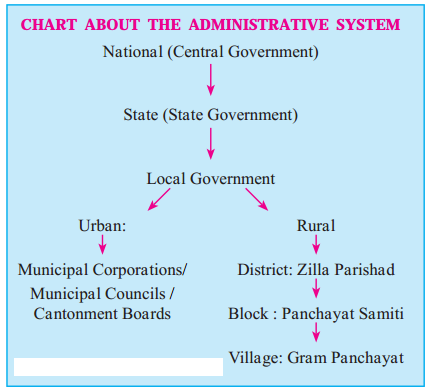
(i) At the national level, the work of the Central Government is conducted by various ministries (departments). For example, there are ministries of Agriculture, Health, Home, Defence, etc. Each ministry (or department) is headed by a Minister. Below the Minister is the bureaucracy or the administrative machinery. Besides the ministries, there are such institutions as the Election Commission, Union Public Service Commission. NITI Aayog, etc. These also require administrators or a bureaucracy.
(ii) At the State level also, there are various ministries and commissions that do the work of the government. The ministries of the State are also headed by a Minister and staffed by the bureaucracy.
(iii) At the local level, the administration is of two types: urban and rural administration. At the district level_ the highest administrative officer is the collector. In large cities, the Municipal Commissioner is in charge of the Municipality or Municipal Corporation. In rural areas, at the level of the Tehsil, the Tehsildar looks after the administration.
(iv) There is a close link between political leadership and administrative machinery. At the national, state levels and local levels, the political leaders are closely linked to the administrative machinery.
(v) The recruitment for all administrative posts at all levels is done through competitive examinations conducted by the government. At the central government level, the UPSC and Staff Selection Commission are the bodies that conduct these examinations.
Question 2.
Explain the steps in public policymaking.
Answer:
Public Policy refers to the new approach to understanding aspects of government activities for public welfare ‘ that is beyond simple administrative activities for e.g., Ayushman Bharat which aims to provide universal access to good quality health care in India.
Public policy can be understood in three steps.
- Policy Choice: Elected representatives, bureaucrats, and others decide the on which concerns of citizens to deal with, various options available about how to deal with it, and the formulation of a programme are then decided for e.g., anti-malaria programme (its objectives and implementation).
- Policy Output: Actual implementation of the policy takes place and policy output is determined
- Policy Impact (evaluation stage): This involves assessment of the objectives to determine policy impact and any improvements if required.
5. Answer the following in detail with reference to the given points.
Question 1.
Define public administration and explain its scope with reference to the following points.
(a) narrow perspective
(b) wider perspective
Answer:
Public Administration is a sub-discipline of Political Science. It focuses on ‘government in action’ i.e., implementation of government decisions, policies, and programmes in fields of social security and welfare, law and order, transport and communication, health and sanitation, etc.
The executive branch of government consists of the Political Executive (council of ministers) and Permanent/ Non-political Executive or Bureaucracy. Public Administration as a subject studies the activity and process of the government. According to Waldo, ‘Public Administration is the art and science of management as applied to the affairs of the state’.
Public Administration broadly includes the following:
- Activities of all three branches of government, especially that of the executive branch.
- Non-political public bureaucracy operating in a political system.
- Management of public affairs and policy execution.
- Concerned with public welfare and hence provides service and regulatory functions to the people to attain a good life.
Scope of public Administration.
Public Administration can be studied as two categories.
(a) Narrow perspective – It focuses on aspects related only to the executive branch of government. Gullick and Urwick sum this view in the acronym POSDCORB to denote Planning, Organisation, Staffing, Directing, Coordinating, Reporting, Budgeting.
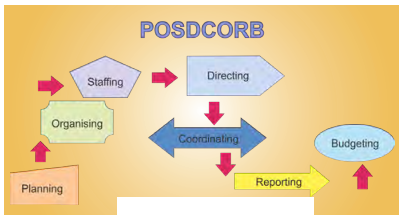
- Planning – working out in broad outline/ blueprint of what is to be done and methods to be adopted for it. e.g., NITI Aayog has adopted the approach of grassroots – national level.
- Organising – establishing the formal structure of authority through which work is delegated, defined, and coordinated e.g. All India services.
- Staffing – recruitment, training, and working conditions of personal e.g., in India this is through UPSC.
- Directing – making decisions and issuing instructions and orders as the administration is a continuous activity.
- Coordinating – interrelating the work of various selections and parts of the organization. eliminate overlapping of work or conflict over responsibility
- Reporting – reporting to superiors/higher authorities any information about ongoing/completed tasks. This ensures responsibility and accountability.
- Budgeting – refers to fiscal planning, control, and accounting.
(b) Broad perspective – This differs from the narrow, managerial view of public administration. It includes activities of all three branches of the government, their interrelationships. Specialized government functions such as defense, finance, health care, etc. as well as collaborations with private groups e.g., NGO’s in providing services to the community. This view is concerned with techniques of administration (POSDCORB) as well as with substantive matters of administration.
According to Woodrow Wilson, ‘Administration is the most obvious part of the government- it is a government inaction, the most visible, operative side of the government.’
Activity (Text Book Page No.63)
Question 1.
Look at the latest Annual Report of the Ministry of Home, Government of India. Make a list of the main activities of the ministry.
Answer:
The main activities of the Ministry of Home, GOI include the maintenance of internal security and domestic policy.
The departments included under this Ministry are-
- Intelligence Bureau (IB)
- Central Reserve Police Force (CRPF)
- Border Security Force (BSF)
- Central Industrial Security Force (CISF)
- Indo-Tibetan Border Police (ITBP)
- National Security Guards (NSG)
- National Investigation Agency (NIA)
- Sashastra Seema Bal (SSB).
Download PDF
Maharashtra Board Solutions Class 11-Political Science: Chapter 7- Public Administration
Chapterwise Maharashtra Board Solutions Class 11 Political Science :
- Chapter 1- The State
- Chapter 2- Liberty and Rights
- Chapter 3- Equality and Justice
- Chapter 4- Constitutional Government
- Chapter 5- Concept of Representation
- Chapter 6- Role of the Judiciary
- Chapter 7- Public Administration
- Chapter 8- Development Administration
- Chapter 9- The World Since 1945 – I
- Chapter 10- The World Since 1945 – II