
Class 9: Biology Chapter 4 solutions. Complete Class 9 Biology Chapter 4 Notes.
Lakhmir Singh Manjit Kaur Solutions for Class 9 Biology: Chapter 4- Diversity In Living Organisms
Lakhmir Singh Manjit Kaur 9th Biology Chapter 4, Class 9 Biology Chapter 4 solutions
Short Answer Type Questions
1. Enlist various types of species diversity.
Answer:
Various types of species diversity are
- Point diversity
- Alpha diversity
- Gamma diversity
- Epsilon diversity
2. By given the example of a tree explains various types of species diversity.
Answer
A single plant may be considered as the unit of alpha diversity, a leaf as an area of point diversity, a group of plants occurring together as an area of gamma diversity and the forest within which the plants are located as an area of epsilon diversity.
3. What is the need for classification?
Answer
It is necessary to classify organisms because it helps in the identification of living organisms as well as in understanding the diversity of living organisms.
4. What is the basis of classification?
Answer
The basis of classification is:
● Type of cell (Eukaryotic or prokaryotic)
● Number of cells present (unicellular or multicellular)
● Mode of nutrition (Autotrophic or heterotrophic)
5. How is the complexity of cell structure and their number used in classification?
Answer
On the basis of the complexity of cell structure, organisms are classified into eukaryotic and prokaryotic organisms. Further eukaryotic organisms are divided into unicellular and multicellular based on the number of cells present in the organisms.
6. Mention seven categories of hierarchical classification.
Answer
Seven categories of hierarchial classification are:
(i) Kingdom
(ii) Phylum (for animals) / Division (for plants)
(iii) Class
(iv) Order
(v) Family
(vi) Genus
(vii) Species
7. Give distinguishing features of plants and animals.
Answer
Plants and animals are put into different categories on the basis of the Mode of nutrition. Plants are autotrophs, while animals are heterotrophs. Cell wall is present in plant cells, while it is absent in animal cells. Also, locomotion, absence of chloroplasts, etc. make them different. Plants do not need to move from one place to another, while most of the animals need to move in search of food.
8. Write down two disadvantages of two-kingdom classification.
Answer
Disadvantages of two-kingdom classification are:
- This system did not distinguish between the eukaryotes and prokaryotes, unicellular and multicellular organisms and photosynthetic (green algae) and non-photosynthetic (fungi) organisms.
- There are some organisms which neither fall into plant nor animal kingdom like Lichens.
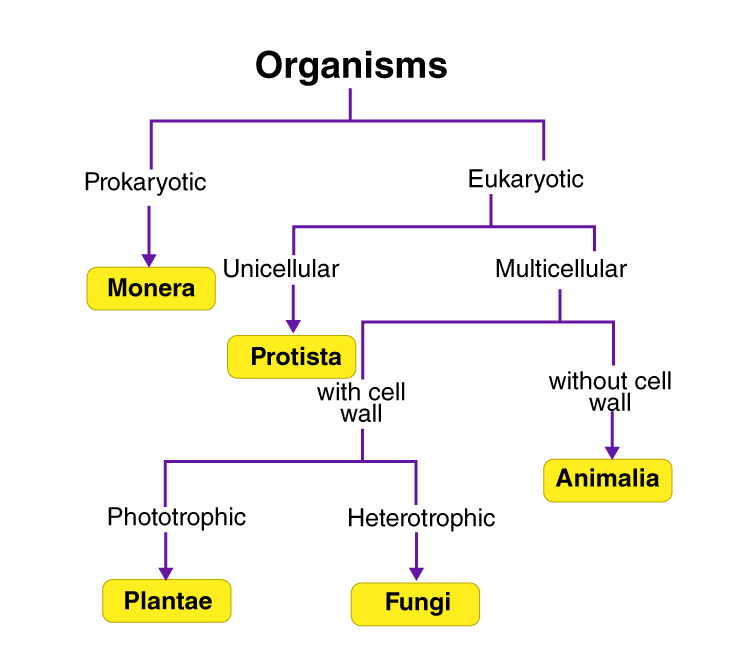
9. With the help of the flow chart depict five kingdoms classification.
Answer
10. Mention two characteristics of the kingdom Protista.
Answer
- They are unicellular and eukaryotic.
- They use appendages such as hair-like cilia or whip-like flagella for moving around.
11. Write a note on lichens.
Answer
A lichen is not a single organism but a symbiosis among different organisms like fungus and a cyanobacterium or algae. Cyanobacteria are also referred to as blue-green algae despite the fact of being distinct from algae. The non-fungal part is known as photobiont that contains chlorophyll.
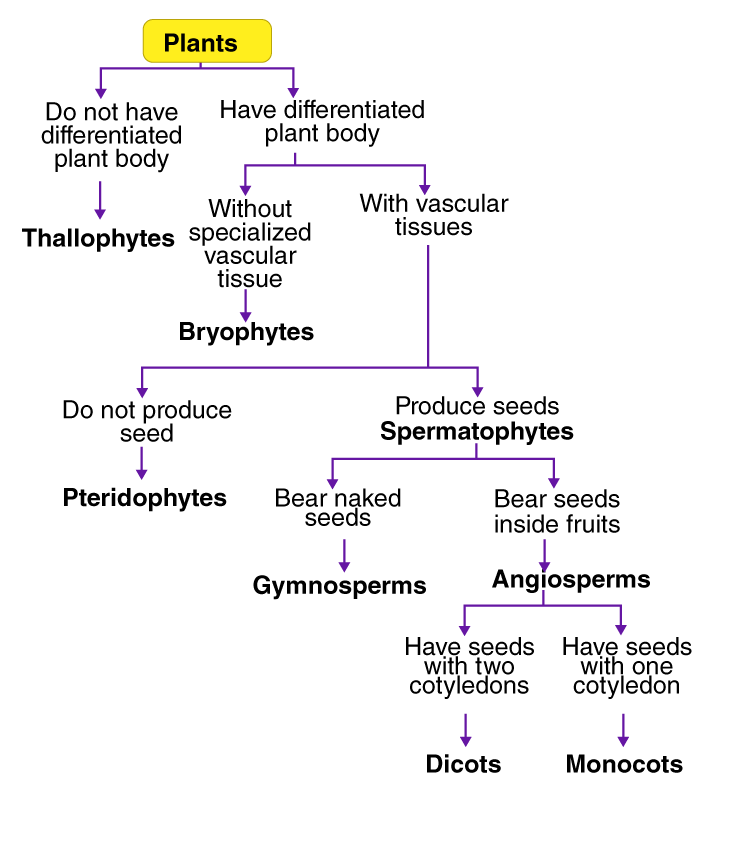
12. Draw a flow chart showing the classification of kingdom Plantae.
Answer
13. Write four general characters of Thallophyta.
Answer
Four general characters of Thallophyta are
- They are aquatic.
- They are autotrophic
- They consist of a cellulose cell wall around their cells.
- Mechanical and conducting elements are absent in Thallophyta.
14. Distinguish between algae and fungi.
Answer
| Algae | Fungi |
| Algae are autotrophic organisms | Fungi are usually heterotrophic. They prefer dead organic matter. |
| Algae are not parasitic | Some fungi members are parasitic |
15. Give the four characteristics of algae.
Answer
- Algae belong to the Kingdom Protista
- Algae are autotrophic organisms
- Algae are not parasitic
- Vascular tissues are absent
16. Write down the differences between dicots and monocots.
Answer
| Dicots | Monocots |
| Shape of Xylem is angular or polygonal | Shape of Xylem is round or oval |
| Vascular tissue has a limited number of Xylem and Phloem | Vascular tissue has a higher number of Xylem and Phloem |
17. Write down the differences between bryophytes and pteridophytes.
Answer
| Bryophytes | Pteridophytes |
| Bryophytes are non-vascular plants. | Pteridophytes are vascular plants. |
| Vascular tissues are absent. | Vascular tissues are present. |
18. Write down four main characters of Bryophyta. Give two examples.
Answer
Characters of Bryophyta:
- These are found on both land and water, therefore they are known as amphibians of the plant kingdom.
- The plant body is commonly differentiated to form stem and leaf-like structures.
- These plants do not have specialized tissue for the conduction of water and other substances from one part of the plant body to another.
- The main plant body of the bryophyte is haploid. It produces gametes, hence it is called a gametophyte.
Examples: Moss (Funaria) and Marchantia.
19. Write down four main characters of Pteridophyta. Give two examples.
Answer
- Characters of Pteriodophyta:
- The plant body is differentiated into roots, stem, and leaves.
- These plants have specialized tissue for the conduction of water and other substances from one part of the plant body to another.
- In pteridophyte, the main plant body is the sporophyte.
- Reproduce through spores.
Example: Marsilea, ferns, etc
20. Write down four main characters of gymnosperms.
Answer
Main characters of gymnosperms are:
- Plants have a well-differentiated plant body.
- Vessels are absent in xylem and companion cells are absent in phloem.
- They are usually perennial, evergreen and woody.
- They bear naked seeds.
Download PDF
Lakhmir Singh Manjit Kaur Solutions for Class 9 Biology: Chapter 4- Diversity In Living Organisms
Chapterwise Lakhmir Singh Manjit Kaur Solutions for Class 9 Biology :
- Chapter 1- Improvement In Food Resources
- Chapter 2- Fundamental Unit Of Life - Cell
- Chapter 3- Tissues
- Chapter 4- Diversity In Living Organisms
- Chapter 5- Why do we fall ill?
- Chapter 6- Natural Resources
About Lakhmir Singh Manjit Kaur
Students studying under the Central Board of Secondary Education find the textbooks of Lakhmir Singh and Manjit Kaur as one of their go-to textbooks for references. These books are designed based on the latest CBSE syllabus. Every concept that is explained in this textbook comes with supporting examples and problems that give students an opportunity to understand the application of formulas and equations.