

Contents
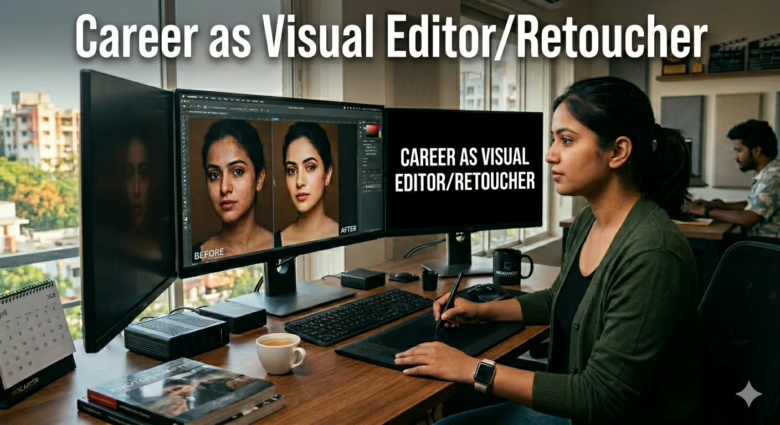
In our visually driven digital age, raw content is just the raw material. The real magic happens in the edit bay. A Visual Editor (or Retoucher in the context of still photography) is the digital craftsman who takes video and images and refines, enhances, and manipulates them to create polished, high-impact final products. Whether it’s removing a blemish from a cover model, creating a fantasy landscape in a film, or pacing a commercial to perfection, this career is at the intersection of technical mastery and artistic vision. In India, the rapid growth of digital media, e-commerce, and the entertainment industry has created an unprecedented demand for skilled visual post-production professionals.
Quick Facts Table
| Feature | Details |
| Course Duration | 6 Months (Certificate) to 3 Years (Degree) |
| Eligibility | 10+2 (any stream) |
| Key Entrance Exams | NID DAT, UCEED, NIFT, CUET, Private Institute Exams |
| Starting Salary (INR) | ₹3 LPA – ₹6 LPA (Entry-level) |
| Top Recruiters | Netflix, Amazon Prime, Advertising Agencies (Ogilvy, JWT), E-commerce (Flipkart, Myntra), Tech Companies, Film Studios (YRF, Dharma) |
| Core Subjects | Adobe Photoshop, Lightroom, Premiere Pro, After Effects, DaVinci Resolve, Color Theory, Narrative Structure, Visual Storytelling |
The Hook: The Digital Alchemist
If you possess a meticulous eye for detail, a strong sense of aesthetic flow, and a love for technological tools, a career as a Visual Editor/Retoucher may be your calling. Every sentence, every commercial, and every film relies on a post-production professional to translate raw footage and photographs into a cohesive, captivating, and flawless narrative. It’s a career where patience meets precision, and where you hold the final brushstroke on the canvas of digital content. With India cementing its place as a global hub for content creation, this is a path full of potential and creativity.
The Roadmap (Step-by-Step)
1. School Level (10+2)
- Stream: You can enter this field from any academic stream—Arts, Commerce, or Science.
- Foundation: Start by experimenting with basic photo and video editing software. Build a rudimentary portfolio by editing family photos, creating short videos for friends, or managing social media content. Developing a strong visual sensibility early is key.
2. Undergraduate & Post-Graduate Options
- Diploma in Editing/Retouching: 6–12 month courses that provide intensive, technical training in specific software.
- B.A. or B.Sc. in Film & Television Production / Multimedia / Visual Communication: 3-year degrees that cover the entire creative process, with specializations in post-production.
- B.Des in Visual Communication: Focuses on the graphic design and visual story element, with editing as a tool.
- M.A. or PG Diploma: Advanced studies for deep specialization, often taken by those looking for leadership roles or to teach.
3. Entrance Exams & Admission
To gain admission to premier design and film institutes, you may need to clear competitive exams:
- NID DAT (National Institute of Design – Design Aptitude Test): A national-level exam testing creative ability and knowledge.
- UCEED (Undergraduate Common Entrance Examination for Design): Accepted by IIT Bombay and other top universities.
- NIFT (National Institute of Fashion Technology Entrance): Required for their communication design courses.
- CUET (Common University Entrance Test): Used by central and some private universities for relevant degree programs.
- AAFT Entrance: Private exams for specific film schools.
4. Top 5 Institutes in India
- National Institute of Design (NID), Ahmedabad/Bengaluru: The premier design school in India.
- Film and Television Institute of India (FTII), Pune: India’s flagship film school with robust post-production programs.
- National Institute of Fashion Technology (NIFT), New Delhi (Visual Communication): Renowned for its connection to the creative industries.
- Whistling Woods International, Mumbai: Offers strong industry connections in the heart of Mumbai.
- Asian Academy of Film and Television (AAFT), Noida: Known for extensive practical training.
Expert Quote
“Post-production has evolved from mere cutting and patching to a powerful storytelling tool. Today, an editor must understand psychology, pacing, and color just as much as the software they use. It’s about creating a language that the viewer understands on an emotional level.”
— Sunil Agrawal, Lead Video Editor, Ogilvy India
Student Interview: A Day in the Life
Interviewee: Priya Sharma, Final Year Student, FTII Pune.
- Q: What is the most demanding aspect of an editor’s job?
- Priya: “Pacing. You have to find the perfect rhythm for a scene. It’s not just about removing the bad takes; it’s about making sure every frame contributes to the emotional arc. You can break a performance or elevate it in the edit.”
- Q: Do you feel your creativity is limited when working for a client?
- Priya: “Not at all. The challenge is to interpret the client’s vision and improve upon it visually. It’s a collaboration. You are the final set of eyes, the one responsible for polish.”
- Q: Your single best piece of advice for aspiring editors?
- Priya: “Organize your workflow. An efficient structure allows you to be creative. If you’re spending all your time looking for files, your artistic energy will suffer. Also, watch everything—films, music videos, and commercials—and analyze how they were put together.”
Skills for Success
- Technical Skills: Proficiency in industry-standard software (Adobe Photoshop, Lightroom, Premiere Pro, After Effects, DaVinci Resolve, Final Cut Pro). Basic knowledge of graphic design, motion graphics, and typography.
- Soft Skills: Problem-solving, sharp attention to detail, strong time management (adhering to strict deadlines), and clear communication skills (working with directors and clients).
Salary & Growth (Indian Market)
- Entry-Level (Junior Editor/Retoucher): ₹25,000 – ₹50,000 per month.
- Mid-Level (Lead Editor/Senior Retoucher): ₹60,000 – ₹1.2 Lakh per month.
- Senior/HOD/Head of Post-Production: ₹1.5 Lakh to ₹5 Lakh+ per month, or very high per-project rates for top freelancers.
Similar Career Options
- Visual Storyteller/Video Content Creator (Social Media)
- Motion Graphics Artist
- Graphic Designer
- Colorist (for video)
- UI/UX Designer
- Documentary Filmmaker (often edits their own work)
- Creative Director
Pros & Cons
Pros:
- Highly creative and satisfying work.
- Constant learning as new software and techniques emerge.
- High demand and excellent earning potential for the skilled.
- Opportunities for freelance and remote work.
Cons:
- Long, unsocial working hours, especially under tight deadlines.
- Physically sedentary (seated in front of screens for long periods).
- Initial years involve financial instability and a relentless search for clients.
FAQ
No, a strong portfolio is more important. However, a degree provides structure, networking, and a deeper theoretical foundation.
A Visual Editor usually works with video (cutting, pacing, and flow). A Retoucher typically works with still photographs (flaw removal, color correction, and composition enhancement).
Initially, any decent laptop will do to learn the basics. To do serious, high-resolution work professionally, you will eventually need a powerful system with a dedicated graphics card and significant RAM.
Start by editing free stock footage, personal projects, or collaborating with filmmakers/photographers who need help. Post your best work online (on Behance, ArtStation, or a personal website).
Yes, India is one of the world’s largest content creators. The explosion of OTT platforms and the growth of e-commerce guarantee that skilled visual editors and retouchers will be in high demand for the foreseeable future.