

Contents
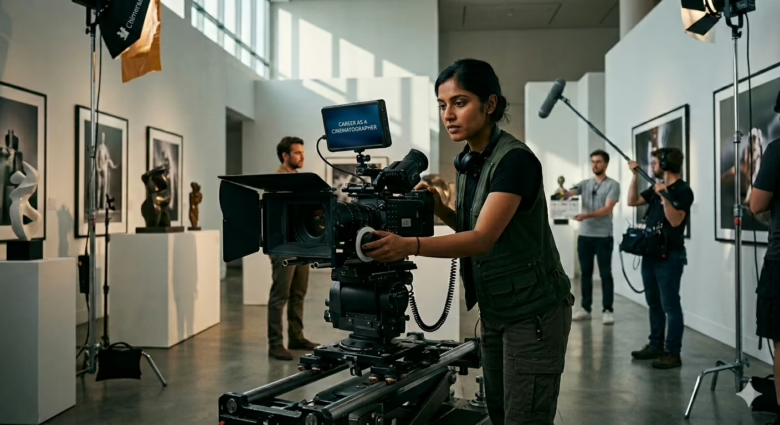
If you have ever been mesmerized by the golden hues of a sunset in a film or the gritty, tense shadows of a thriller, you have witnessed the work of a Cinematographer (also known as the Director of Photography or DoP). In India, with the explosion of OTT platforms like Netflix and Prime Video, alongside the world’s largest film industry, the demand for skilled visual storytellers has never been higher.
This guide provides a comprehensive roadmap for students aiming to turn their passion for the lens into a high-impact professional career.
Quick Facts Table
| Feature | Details |
| Course Duration | 6 Months (Certificate) to 3 Years (Degree/PG Diploma) |
| Eligibility | 10+2 (any stream) for UG; Graduation for PG Diploma |
| Key Entrance Exams | FTII JET, SRFTI Entrance, CUET, AAFT Entrance |
| Starting Salary (INR) | ₹3.5 LPA – ₹6 LPA (Assistant level) |
| Top Recruiters | Red Chillies, Dharma Productions, Netflix, Amazon Prime, Ad Agencies |
| Core Subjects | Lighting, Optics, Digital Imaging, Composition, Visual Narrative |
The Hook: Why Cinematography Matters Today
We live in a “video-first” world. From 30-second viral commercials to 3-hour cinematic epics, the Cinematographer is the person responsible for the “look and feel” of the story. Unlike a photographer who captures a moment, a cinematographer captures the motion of emotion. With India becoming a global content hub, this career offers a unique blend of technical mastery and artistic freedom.
The Roadmap (Step-by-Step)
1. School Level (10+2)
- Stream: You can belong to any stream (Arts, Commerce, or Science). However, a basic understanding of Physics (Optics and Light) and Mathematics is highly beneficial for understanding lens focal lengths and lighting ratios.
- Foundation: Start building a portfolio by practicing still photography. Understanding “The Rule of Thirds” and “Leading Lines” in photos is the first step toward moving images.
2. Undergraduate & Post-Graduate Options
- B.Sc. in Cinema / Cinematography: A 3-year degree focusing on the technicalities of cameras and film history.
- PG Diploma in Cinematography: Offered by premier institutes like FTII. This is considered the “gold standard” in India.
- Short-term Certificates: 6-month intensive courses for those looking to switch careers or gain specific technical skills quickly.
3. Entrance Exams & Admission
To get into the best government-funded film schools, you must clear:
- FTII JET (Joint Entrance Test): A national-level exam for admission to FTII (Pune) and SRFTI (Kolkata). It tests general awareness, cinema history, and specific technical aptitude.
- CUET (Common University Entrance Test): Used by several central and private universities for B.A./B.Sc. Media and Film programs.
- AAFT GEE: The entrance exam for the Asian Academy of Film and Television, a leading private film school.
4. Top 5 Institutes in India
- Film and Television Institute of India (FTII), Pune: The most prestigious film school in Asia.
- Satyajit Ray Film & Television Institute (SRFTI), Kolkata: Known for its artistic and experimental approach.
- Whistling Woods International, Mumbai: Founded by Subhash Ghai, offering great industry networking.
- Asian Academy of Film and Television (AAFT), Noida: One of the oldest private film schools with massive infrastructure.
- LV Prasad Film & TV Academy, Chennai: Excellent for those looking to enter the vibrant South Indian film industry.
Expert Quote
“The future of cinematography in India is shifting from just ‘capturing’ to ‘creating’ through Virtual Production and AI-integrated lighting. Today’s students must balance the classic soul of celluloid with the technical precision of Unreal Engine and high-dynamic-range digital sensors.”
— Vikram Malhotra, Senior Director of Photography & Visual Consultant
Student Interview: A Day in the Life
Interviewee: Rohan Das, Final Year Cinematography Student, SRFTI.
- Q: What is the biggest challenge on a student set?
- Rohan: “Managing light with a limited budget. You learn that cinematography isn’t about expensive cameras; it’s about how you manipulate shadows with what you have.”
- Q: How much ‘math’ is actually involved?
- Rohan: “Quite a bit. Calculating T-stops, depth of field, and data rates for digital storage is a daily task. It’s a very technical craft.”
- Q: Your best advice for beginners?
- Rohan: “Watch movies on mute. Observe how the light tells the story without the dialogue. That’s where your education starts.”
Skills for Success
- Technical Skills: Mastery of DSLR/Mirrorless and Cinema Cameras (ARRI, RED, Sony Venice), Lighting (Key, Fill, Back), and Color Grading software (DaVinci Resolve).
- Soft Skills: Leadership (managing a camera crew), Physical Stamina (long hours on feet), and Collaborative Communication (translating a Director’s vision).
Salary & Growth (Indian Market)
- Entry-Level (2nd/3rd Assistant): ₹15,000 – ₹30,000 per month (freelance or studio-based).
- Mid-Level (Operative Cameraman): ₹80,000 – ₹1.5 Lakh per project.
- Senior/DoP: ₹5 Lakh to ₹50 Lakh+ per film, depending on the scale and experience.
Similar Career Options
- Digital Content Creator (YouTube/Instagram)
- Video Editor
- Lighting Director
- Visual Effects (VFX) Supervisor
- Documentary Filmmaker
- Commercial Photographer
- Gaffer (Chief Lighting Technician)
Pros & Cons
Pros:
- Highly creative and fulfilling work.
- Opportunity to travel to exotic locations.
- No two days are the same; constant variety.
Cons:
- Irregular working hours (14–16 hour shifts are common).
- Physical strain from carrying heavy equipment.
- Initial years involve financial instability as a freelancer.
FAQ
No, many successful DoPs started as assistants. However, a degree from a top school like FTII provides a massive headstart through networking and technical training.
It is not mandatory for most private colleges, but FTII and SRFTI often prefer candidates with a basic understanding of these subjects for technical exams.
While you can work for government bodies like Doordarshan or NFDC, 90% of the industry is private and freelance-based.
Initially, no. Production houses or equipment rental stores provide the gear. Most professionals only invest in their own cameras once they reach a senior level.
Absolutely. India has seen a surge of brilliant female DoPs (like Savita Singh and Deepti Gupta) who are breaking barriers in a traditionally male-dominated field.