

Contents
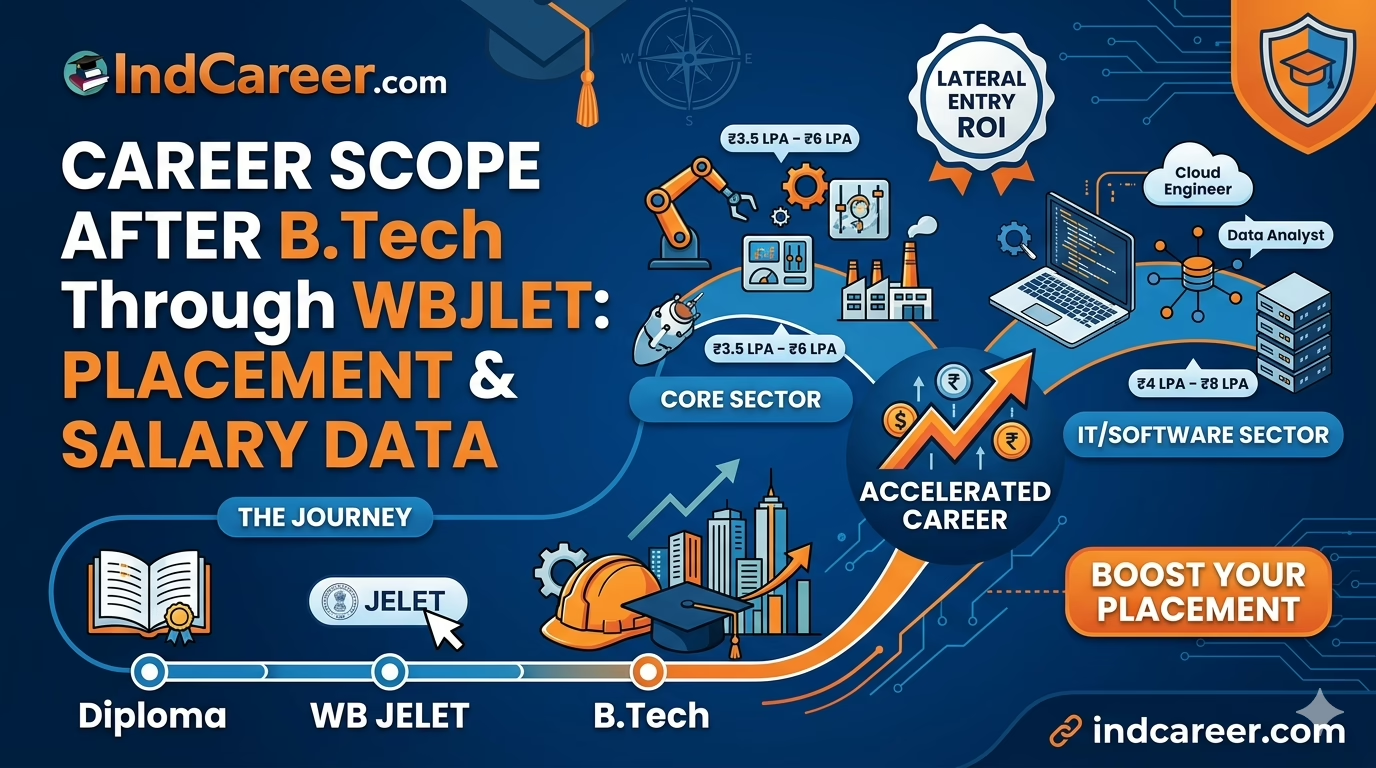
A B.Tech degree via WB JELET holds identical academic and industry value to a regular four-year B.Tech. Lateral entry graduates benefit from earlier entry into the workforce and strong practical foundations, with average starting packages ranging from ₹3.5 LPA to ₹8 LPA, depending on the sector.
Is Lateral Entry (B.Tech) Worth It?
The transition from a Diploma to a B.Tech via lateral entry is a strategic career move. While you skip the first year, the focus shifts to advanced engineering applications. The “worth” of this degree is driven by your ability to bridge the gap between diploma-level practical skills and B.Tech-level theoretical analysis.
- Industry Preference: Core engineering companies (Automotive, Manufacturing, Infrastructure) often prioritize lateral entry students for their hands-on experience in labs and workshops.
- Salary Trajectory: By entering the workforce one year earlier than regular B.Tech peers, you gain an additional year of experience, which compounds into higher salary increments and faster seniority in the long run.
Comparative Salary Table: Core vs. IT/Software Placement
Placement outcomes are determined by technical proficiency, communication skills, and college reputation rather than the mode of entry.
| Sector | Job Roles | Average Fresher Package (LPA) |
| IT / Software | Software Developer, Data Analyst, Cloud Engineer | ₹4.0 – ₹9.0 Lakhs |
| Core Engineering | Site Engineer, Design Engineer, Production Officer | ₹3.0 – ₹6.5 Lakhs |
| Embedded / VLSI | Embedded Systems Dev, Hardware Architect | ₹5.0 – ₹10.0 Lakhs |
| PSUs / Government | Assistant Engineer, Technical Officer | ₹7.0 – ₹12.0 Lakhs |
Note: These figures are indicative averages based on 2025-26 market trends in West Bengal and national hubs. Packages for top-tier institutions (JU, KGEC) may significantly exceed these ranges.
Campus Recruitment Tips for Lateral Entry Students
- Bridge the Math Gap: Engineering Mathematics 3 is a common hurdle for diploma holders. Prioritize clearing these concepts early to maintain a high CGPA, which is often an eligibility filter for mass recruiters.
- Highlight Practical Projects: Use your diploma project experience during interviews. Core companies value the ability to demonstrate “how things work” over just knowing “how things are defined.”
- Bypass Automated Filters: Some companies use automated filters that check for 10+2 scores. If your diploma doesn’t include a standard 10+2 equivalent, contact your college placement cell early to ensure your profile is correctly mapped in their recruitment system.
- Internship ROI: Secure internships during your B.Tech summers. This is the single most effective way to neutralize any perceived “mode of entry” bias.
Higher Education Options (GATE/MBA) After B.Tech
Your B.Tech degree qualifies you for all premium postgraduate opportunities, exactly like a regular four-year graduate.
- GATE (Graduate Aptitude Test in Engineering): The gold standard for PSUs (IOCL, ONGC, BHEL) and M.Tech admissions at IITs and NITs.
- MBA (CAT/XAT/MAT): Combining B.Tech technical expertise with an MBA from an IIM or top-tier private institute leads to high-growth roles in technical consulting and product management.
- Higher Studies Abroad: Your B.Tech is globally recognized. Standardized tests like GRE/IELTS open doors for Masters degrees in the US, Germany, and Canada.
Frequently Asked Questions (FAQ)
No. Once you graduate with a B.Tech degree, the recruitment process focuses on your current skill set, project experience, and performance in technical rounds. The mode of entry is rarely a factor.
It is not harder, provided you build your coding and DSA (Data Structures & Algorithms) skills. Product-based companies (Google, Amazon) assess skills, not your academic history or diploma background.
Absolutely. You are fully eligible to appear for the GATE examination, which is a major gateway for both higher studies and PSU recruitment.
A balance of practical industrial knowledge (from your diploma) and theoretical depth (acquired during B.Tech) is your greatest competitive advantage.
Focus on certifications in emerging fields like AI/ML, Cloud Computing, or IoT alongside your core engineering studies to stand out in a competitive job market.
WB JELET
WBJEE JELET is a state-level Engineering entrance exam. Organized by WBJEEB, WB JELET exam is for admission to Lateral Entry In Bachelor’s Degree Courses in Engineering, Technology, and Pharmacy courses in Universities, Government Colleges as well as Self Financing Engineering & Technological Institutes in the State of West Bengal. West Bengal Joint Entrance Examinations (WBJEE), Kolkata Joint Entrance Examination (JELET) Exam
WBJEE JELET – An Overview
| Aspect of WBJEE JELET | Details |
|---|---|
| Name of exam | WBJEE JELET |
| Full form of exam name | West Bengal Joint Entrance Lateral Engineering Test |
| Official Body for exam and WB JELET Previous Year Question Papers | WBJEEB |
| Full form of organization | West Bengal Joint Entrance Examinations Board |
| Level of exam | State Entrance Exam |
| Type of exam | Engineering Entrance Exam |
| Courses for which WB JELET Solved Papers is useful | Lateral Entry In Bachelor’s Degree Courses in Engineering, Technology, Pharmacy |
| Official website | wbjeeb.nic.in |