

Contents
The energy sector is the backbone of India’s industrial growth. As the nation transitions toward a mix of high-efficiency thermal units and massive renewable energy parks, the role of a Power Plant Engineer has become more critical than ever. Whether it’s managing a 1000MW nuclear reactor or a sprawling 500-acre solar farm, these professionals ensure the lights stay on for 1.4 billion people.
Quick Facts Table: Power Plant Engineering at a Glance
| Feature | Details |
| Duration | 4 Years (B.Tech/B.E.) |
| Eligibility | 10+2 with PCM (Minimum 60-75%) |
| Key Entrance Exams | JEE Main, JEE Advanced, GATE (for PSUs) |
| Starting Salary (INR) | ₹6.5 LPA – ₹12 LPA (Top Tiers) |
| Top Recruiters | NTPC, Tata Power, Adani Power, BHEL, GE |
| Core Branches | Mechanical, Electrical, Instrumentation |
The Roadmap: How to Become a Power Plant Engineer
1. School Level (10+2)
To start, you must choose the Science stream with Physics, Chemistry, and Mathematics (PCM). Aim for a minimum aggregate of 75% if you’re targeting premier institutes like IITs or NITs, as they follow strict eligibility criteria.
2. Undergraduate Degree (B.Tech/B.E.)
Most students enter this field via a degree in Mechanical, Electrical, or Instrumentation Engineering. While some colleges offer a specific “B.Tech in Power Engineering,” a core degree followed by a specialization is often preferred by recruiters for its versatility.
3. Postgraduate & Specialization
If you wish to enter Research & Development (R&D) or Senior Management, an M.Tech in Power Systems or Thermal Engineering is highly recommended. Many engineers also pursue a Post Graduate Diploma in Thermal Power Plant Engineering from NPTI (National Power Training Institute).
Entrance Exams & Admission (2026)
Admission to top-tier engineering programs is strictly merit-based. Here are the 2026 heavy-hitters:
- JEE Main: The gateway to NITs and IIITs. It is conducted twice a year (January and April).
- JEE Advanced: Only the top 2.5 lakh rankers of JEE Main can sit for this, aiming for a seat in the prestigious IITs.
- GATE (Graduate Aptitude Test in Engineering): Crucial for graduates. High GATE scores are the primary criteria for recruitment into PSUs like NTPC, PGCIL, and NHPC.
- BITSAT: An institutional-level exam for admission into BITS Pilani campuses, known for excellent industry tie-ups in the energy sector.
Top 5 Institutes in India for Power Engineering
- IIT Delhi (New Delhi): Consistently ranked #1 for Electrical and Mechanical Engineering in India (QS 2026).
- IIT Bombay (Mumbai): Offers world-class research facilities in Energy Science and Engineering.
- National Power Training Institute (NPTI) (Multiple Locations): A government body specifically dedicated to the power sector.
- NIT Trichy (Tamil Nadu): Known for the highest placement records in core engineering sectors.
- Jadavpur University (Kolkata): Famous for its specialized Power Engineering department and extremely low fee structure.
Expert Quote
“The Power Plant Engineer of 2026 is no longer just a ‘mechanical’ or ‘electrical’ expert. The future belongs to the ‘Hybrid Engineer’ who can integrate AI-driven predictive maintenance with traditional grid stability protocols to manage India’s 500GW renewable target.”
— Dr. Arvind Subramanian, Senior Consultant (Energy Systems)
Student Interview: A Day in the Life
Interview with Rohan M., Final Year Student, NPTI
Q: What is the most challenging part of your curriculum?
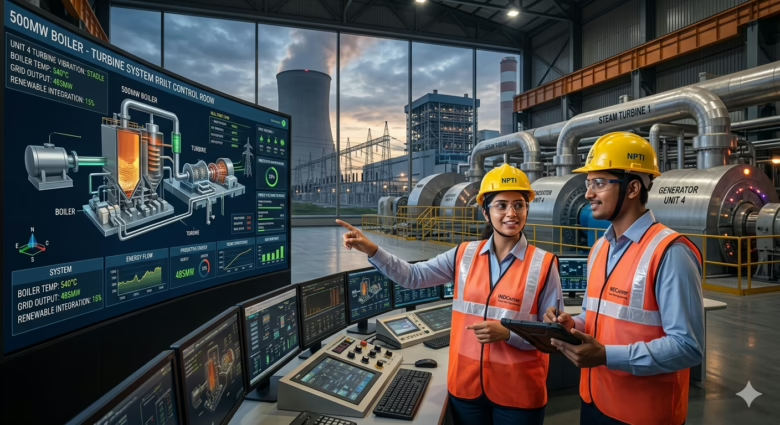
Rohan: “The sheer scale. Moving from textbook circuits to a 500MW boiler simulation is a massive jump. You have to understand how heat, pressure, and electricity interact in real-time.”
Q: Does one need to be a Math wizard?
Rohan: “You don’t need to be a Ramanujan, but you do need to be comfortable with Calculus and Thermodynamics. Most of the heavy lifting is done by software like AutoCAD or MATLAB now.”
Q: What is your advice for 12th-grade aspirants?
Rohan: “Focus on your PCM basics. If you don’t understand ‘Work-Power-Energy’ in Class 11, the turbines in college will make no sense!”
Skills for Success
- Technical Skills: Proficiency in CAD software, Power System Analysis, and SCADA (Supervisory Control and Data Acquisition).
- Soft Skills: High-pressure decision-making, team leadership, and a “Safety-First” mindset.
- Emerging Skills: Knowledge of Green Hydrogen production and Battery Energy Storage Systems (BESS).
Salary & Growth in India (2026)
The Indian power sector offers some of the most stable career paths with significant “dearness allowances” in government roles.
- Entry-Level: ₹4.5 – ₹7 LPA (Private); ₹10 – ₹14 LPA (PSUs via GATE).
- Mid-Level (5-10 years): ₹15 – ₹25 LPA.
- Senior-Level (15+ years): ₹35+ LPA (excluding perks like housing and medical).
Pros & Cons
| Pros | Cons |
| High job security (Power is an essential service) | Often involves remote location postings |
| Lucrative government benefits (in PSUs) | High-stress environment during “tripping” or shutdowns |
| Front-row seat to the “Green Energy” revolution | Requires 24/7 rotational shift work in early years |
Similar Career Options
- Renewable Energy Engineer
- Grid Controller
- Nuclear Engineer
- Energy Auditor
- Electrical Design Engineer
- Sustainability Consultant
FAQ
Not necessarily. While PSUs like NTPC offer government roles, giants like Adani Power and Tata Power are massive private employers.
Yes, Mathematics is a compulsory subject for all B.Tech/B.E. entrance exams in India.
Yes, you can join as a Junior Engineer (JE). However, for career growth into management, a B.Tech (Lateral Entry) is usually required.
No. AI is being used for “Smart Grids,” but the physical maintenance and emergency decision-making still require human engineers.
Both are vital. Mechanical engineers focus on turbines and boilers; Electrical engineers focus on generators and the grid. Choose based on your interest.