

Contents
Imagine designing a robotic limb that restores a veteran’s mobility, or developing an AI-powered sensor that detects heart anomalies before they happen. This is the world of Biomedical Engineering. In 2026, as India’s medical device industry surges toward a $50 billion valuation, Biomedical Engineers have become the essential architects of modern healthcare, blending engineering precision with biological insight.
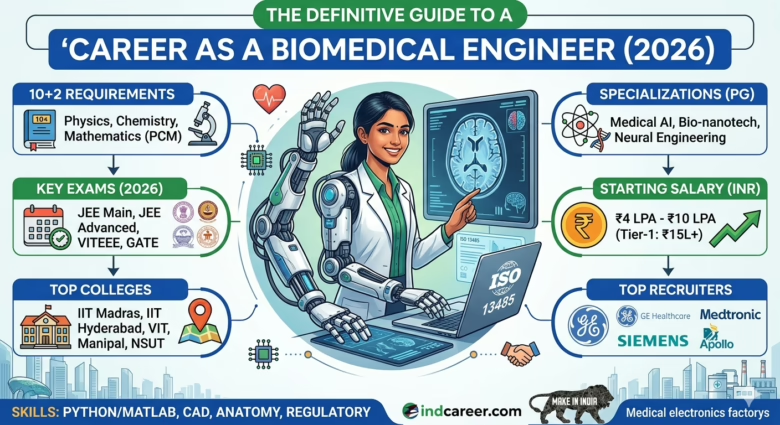
Quick Facts: Biomedical Engineering at a Glance
| Feature | Details |
| Course Duration | 4 Years (B.Tech/B.E.) |
| Eligibility | 10+2 with PCM (Mandatory) or PCB (Accepted by some) |
| Key Entrance Exams | JEE Main, JEE Advanced, VITEEE, GATE (for PG) |
| Starting Salary | ₹4 LPA – ₹10 LPA (Tier-1 institutes see ₹15 LPA+) |
| Top Recruiters | GE Healthcare, Siemens Healthineers, Medtronic, Philips, Apollo Hospitals |
The Hook: Engineering the Pulse of Tomorrow
Healthcare is no longer just about medicine; it is about technology. From the MRI machines in top-tier diagnostic centers to the wearable smartwatches tracking our vitals, every advancement requires a professional who understands both the “circuit” and the “cell.” With the Indian government’s “Make in India” focus on medical electronics, choosing this career in 2026 places you at the intersection of high-growth tech and social impact.
The Roadmap: Step-by-Step to Success
1. School Level (10+2)
- Subjects: Physics, Chemistry, and Mathematics (PCM) are the primary requirements for B.Tech programs.
- Alternative: Many institutions now offer bridge courses for Biology-stream (PCB) students to enter the field.
- Minimum Marks: At least 50%–60% aggregate in your board exams.
2. Undergraduate Degree (UG)
- B.Tech in Biomedical Engineering: A 4-year program covering anatomy, signals & systems, and medical instrumentation.
- B.Tech in Biotechnology: A related path, though less focused on the hardware/electronic side of medical devices.
3. Post-Graduate & Specialization
- M.Tech / MS: Specialize in niche areas like Neural Engineering, Bio-nanotechnology, or Medical AI.
- GATE BM: Clear the specialized GATE (Biomedical Engineering) paper to enter IITs for research.
Entrance Exams & Admission (2026)
- JEE Main: The primary gateway for NITs and government-funded technical institutes.
- JEE Advanced: Required for the prestigious IITs (IIT Bombay, Hyderabad, and Kanpur lead in BME).
- VITEEE: Entrance for VIT Vellore, which houses some of India’s most advanced biomedical labs.
- GATE (BM): Specifically for post-graduate aspirants aiming for R&D roles in PSUs or top universities.
- State CETs: Exams like MHT-CET (Maharashtra) or KCET (Karnataka) for state-level engineering colleges.
Top 5 Institutes in India
| Institute | Location | Key Specialty |
| IIT Madras | Chennai | Rehabilitation & Tissue Engineering |
| IIT Hyderabad | Telangana | Medical Imaging and Bio-Sensors |
| Manipal Institute of Tech | Manipal | Medical Instrumentation & Industry tie-ups |
| VIT University | Vellore | AI in Healthcare & Diagnostics |
| NSUT | Delhi | Clinical Engineering & Device Design |
Expert Quote
“In 2026, the demand has shifted from simple equipment maintenance to complex product design. We need engineers who can integrate machine learning with physiological data to create predictive healthcare tools. It’s no longer just about fixing a machine; it’s about innovating for life.”
— Dr. Sunita Rao, Senior Director of MedTech R&D (Fictional Expert).
Student Interview: A Day in the Life
Interviewee: Ananya K., 4th Year B.Tech Student (IIT Hyderabad).
Q: Is it more ‘Biology’ or ‘Engineering’?
“It’s 70% Engineering. You study circuits, sensors, and coding, but the context is always the human body. You need to know how a heart works to design a pacemaker.”
Q: What is the hardest part of the course?
“Biosignal Processing. Translating the messy electrical signals of the brain or muscles into clean data that a computer can understand is incredibly challenging but rewarding.”
Q: What projects are you working on?
“I’m currently developing a low-cost, portable ECG monitor that can send data to a doctor via a smartphone app for rural clinics.”
Skills for Success
- Technical: MATLAB/Python (for data), CAD (for device design), Circuit Design, and Human Anatomy.
- Regulatory: Understanding ISO 13485 and FDA standards for medical device safety.
- Soft Skills: Empathy, ethics, and the ability to communicate with doctors (who speak ‘medicine’) and engineers (who speak ‘tech’).
Salary & Growth (India)
- Entry-Level (Freshers): ₹4.5 LPA – ₹7 LPA.
- Mid-Level (5+ years): ₹10 LPA – ₹18 LPA.
- Senior/R&D Lead: ₹25 LPA+ (especially in Bangalore or Hyderabad hubs).
Similar Career Options
- Medical Imaging Specialist
- Clinical Engineer (Hospital-based)
- Bioinformatics Scientist
- Prosthetic Engineer
- Regulatory Affairs Specialist
- Healthcare Data Analyst
- Tissue Engineer
Pros & Cons
Pros
- High Purpose: Direct impact on saving lives and improving patient care.
- Recession-Proof: Healthcare is an evergreen industry.
- Global Mobility: Indian BME degrees are highly valued in the US, Germany, and Japan.
Cons
- Strict Regulations: Product development can take years due to clinical trials and safety laws.
- Heavy Workload: You must master two distinct domains: Engineering and Life Sciences.
FAQ
Yes. You will need strong Mathematics for signal processing, biomechanics, and imaging physics.
Yes, as a Clinical Engineer, where you manage and calibrate all high-end life-support and diagnostic machinery.
No. This is an engineering degree. You need to appear for JEE or other engineering entrance exams.
Yes. PSUs like HLL Lifecare and research bodies like DRDO and ISRO (for space medicine) recruit biomedical engineers.
Biotech focuses more on chemical/biological processes (vaccines, drugs), while Biomedical Engineering focuses on devices and hardware (MRI, pacemakers, AI diagnostics).