

Contents
In an era of high-tech manufacturing and stringent healthcare standards, “close enough” is never good enough. A Calibration Specialist is the guardian of accuracy, ensuring that every instrument—from a surgeon’s heart rate monitor to an aerospace pressure gauge—reads correctly. As India becomes a global hub for electronics and pharmaceutical manufacturing, the demand for these “precision experts” is skyrocketing.
Quick Facts Table: Calibration Specialist at a Glance
| Feature | Details |
| Duration | 3-4 Years (Diploma/B.Tech) + Certification |
| Eligibility | 10+2 with PCM (Minimum 50-60%) |
| Key Entrance Exams | JEE Main, GATE, State CETs |
| Starting Salary (INR) | ₹3.5 LPA – ₹7 LPA |
| Top Recruiters | Bosch, ABB, Siemens, Sun Pharma, NABL Labs |
| Core Branches | Instrumentation, Electrical, Mechanical |
The Roadmap: How to Become a Calibration Specialist
1. School Level (10+2)
You must complete your 10+2 with Physics, Chemistry, and Mathematics (PCM). A strong foundation in Physics—specifically units, measurements, and error analysis—is non-negotiable for this career path.
2. Undergraduate Degree or Diploma
- Diploma Route: A 3-year Diploma in Instrumentation & Control or Mechanical Engineering allows for early entry as a Calibration Technician.
- Degree Route: A 4-year B.Tech in Instrumentation & Control Engineering, Electronics & Instrumentation, or Metrology is the gold standard for specialist roles.
3. Specialization & Certifications
To move from a technician to a Specialist, you need to understand ISO/IEC 17025 (the main ISO standard used by testing and calibration laboratories). Short-term courses from NABL (National Accreditation Board for Testing and Calibration Laboratories) or NPL (National Physical Laboratory) add immense value to your resume.
Entrance Exams & Admission (2026)
Most specialists enter the field through core engineering branches. Major exams include:
- JEE Main: For admission into top-tier B.Tech programs in Instrumentation and Electronics.
- GATE (Instrumentation Engineering – IN): Highly recommended for those seeking specialist roles in PSUs like BHEL or ISRO, where precision is a matter of national security.
- CUET (UG): For students opting for B.Sc. in Physics or Metrology from Central Universities.
Top 5 Institutes in India for Calibration & Instrumentation
- Netaji Subhas University of Technology (NSUT), Delhi: Renowned for its dedicated Instrumentation and Control department.
- Madras Institute of Technology (MIT), Chennai: Offers specialized programs in Aerospace and Instrumentation.
- National Institute of Technology (NIT), Trichy: A leader in providing industry-ready instrumentation engineers.
- National Physical Laboratory (NPL), New Delhi: The premier body for measurement standards in India; offers specialized training and workshops.
- College of Engineering (COEP), Pune: Located in India’s manufacturing heartland, offering excellent placement in calibration labs.
Expert Quote:
“Calibration is no longer just about adjusting a dial; it’s about data integrity. With the rise of Industry 4.0, specialists must now understand how digital sensors interact with cloud systems while maintaining traceability to national standards.”
— Mr. Vikram Mehta, Chief Metrologist at a Leading NABL Accredited Lab
Student Interview: A Day in the Life
Interview with Ananya S., Final Year B.Tech (Instrumentation)
Q: Is calibration just a repetitive desk job?
Ananya: “Not at all! One day you are in a sterile ‘Clean Room’ calibrating pharmaceutical scales, and the next you might be at an oil refinery checking massive pressure transmitters. It’s highly mobile and varied.”
Q: What is the hardest part of the job?
Ananya: “The documentation. In calibration, if it isn’t documented with ‘Traceability’ to a national standard, it didn’t happen. You have to be extremely meticulous.”
Q: Any advice for beginners?
Ananya: “Learn the concept of ‘Uncertainty.’ It’s the heart of calibration. If you can calculate uncertainty accurately, you’ll be a top-tier specialist.”
Skills for Success
- Analytical Skills: Understanding error margins and tolerance limits.
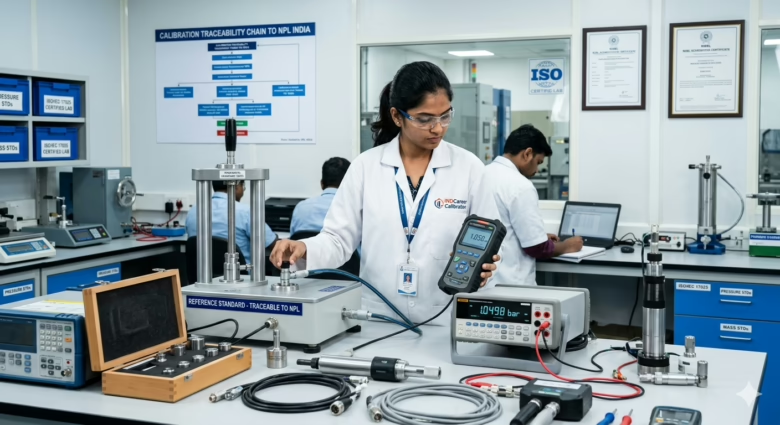
- Technical Proficiency: Mastery over equipment like Oscilloscopes, Deadweight Testers, and Multi-product Calibrators.
- Knowledge of Standards: Familiarity with NABL (India) and NIST (International) guidelines.
- Soft Skills: Extreme attention to detail and ethical reporting (never “fudge” a reading).
Salary & Growth in India (2026)
The salary is heavily dependent on the industry (Pharmaceuticals and Aerospace pay the highest).
- Entry-Level: ₹3.5 – ₹6 LPA (often includes intensive on-the-job training).
- Mid-Level (Lead Auditor/Manager): ₹8 – ₹15 LPA.
- Senior-Level (Quality Manager/Technical Manager): ₹18+ LPA. Specialists with ISO 17025 Lead Auditor certifications are often headhunted for international roles.
Pros & Cons
| Pros | Cons |
| Recession-proof (Quality control is always needed) | Zero margin for error (High responsibility) |
| Opportunities to work in diverse industries (Medical, Aviation, Food) | Can involve standing for long hours in labs or industrial sites |
| High demand for NABL-certified professionals | Requires constant re-certification and keeping up with standards |
Similar Career Options
- Metrologist
- Quality Control (QC) Engineer
- Instrumentation & Control Engineer
- Validation Specialist (Pharma)
- Non-Destructive Testing (NDT) Technician
- Energy Auditor
FAQ
Yes. You need a strong grasp of statistics and algebra to calculate measurement uncertainty and error distributions.
NABL is the body that grants accreditation to labs in India. Being a “NABL Signatory” or having NABL-approved training is a major career boost.
Yes, in organizations like the Bureau of Indian Standards (BIS), ISRO, and various Legal Metrology departments of state governments.
It’s a mix. While the analysis is done at a desk, the actual testing often happens in laboratories or on the factory floor.
Absolutely. Many calibration specialists focus on “Mechanical Calibration” (mass, volume, pressure, and torque).