
Class 7: Maths Chapter 16 solutions. Complete Class 7 Maths Chapter 16 Notes.
Selina Class 7 ICSE Solutions Mathematics : Chapter 16- Pythagoras Theorem
Selina 7th Maths Chapter 16, Class 7 Maths Chapter 16 solutions
Exercise 16 page: 189
1. Triangle ABC is right-angled at vertex A. Calculate the length of BC, if AB = 18 cm and AC = 24 cm.
Solution:
It is given that
Triangle ABC is right-angled at vertex A
AB = 18 cm and AC = 24 cm
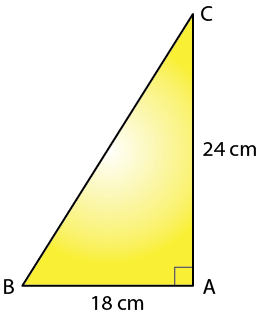
Using Pythagoras Theorem
BC2 = AB2 + AC2
Substituting the values
BC2 = 182 + 242
By further calculation
BC2 = 324 + 576 = 900
BC = √900 = √ (30 × 30)
So we get
BC = 30 cm
2. Triangle XYZ is right-angled at vertex Z. Calculate the length of YZ, if XY = 13 cm and XZ = 12 cm.
Solution:
It is given that
Triangle XYZ is right-angled at vertex Z
XY = 13 cm and XZ = 12 cm
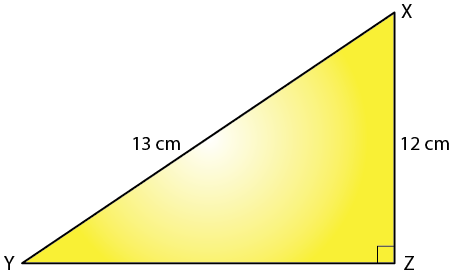
Using Pythagoras Theorem
XY2 = XZ2 + YZ2
Substituting the values
132 = 122 + YZ2
By further calculation
YZ2 = 132 – 122
YZ2 = 169 – 144 = 25
YZ = √25 = √ (5 × 5)
So we get
YZ = 5 cm
3. Triangle PQR is right-angled at vertex R. Calculate the length of PR, if:
PQ = 34 cm and QR = 33.6 cm.
Solution:
It is given that
Triangle PQR is right-angled at vertex R
PQ = 34 cm and QR = 33.6 cm
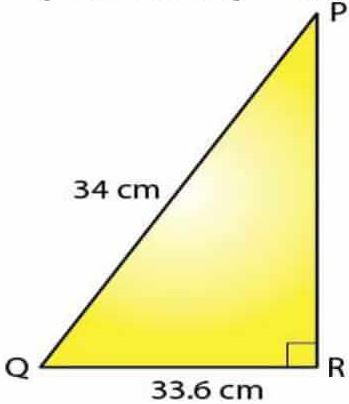
Using Pythagoras Theorem
PQ2 = PR2 + QR2
Substituting the values
342 = PR2 + 33.62
By further calculation
1156 = PR2 + 1128.96
PR2 = 1156 – 1128.96
PR = √27.04
So we get
PR = 5.2 cm
4. The sides of a certain triangle are given below. Find, which of them is right-triangle
(i) 16 cm, 20 cm and 12 cm
(ii) 6 m, 9 m and 13 m
Solution:
(i) 16 cm, 20 cm and 12 cm
The triangle will be right angled if square of the largest side is equal to the sum of the squares of the other two sides.
Here we have 202, 162 and 122
We can write it as
202 = 162 + 122
By further calculation
400 = 256 + 144
So we get
400 = 400
Hence, the given triangle is right angled.
(ii) 6 m, 9 m and 13 m
The triangle will be right angled if square of the largest side is equal to the sum of the squares of the other two sides.
Here 132 = 92 + 62
By further calculation
169 = 81 + 36
So we get
169 ≠ 117
Hence, the given triangle is not right angled.
5. In the given figure, angle BAC = 90°, AC = 400 m and AB = 300 m. Find the length of BC.
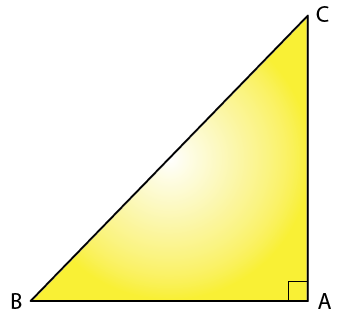
Solution:
It is given that
BAC = 90°, AC = 400 m and AB = 300 m

Using Pythagoras Theorem
BC2 = AB2 + AC2
Substituting the values
BC2 = 3002 + 4002
By further calculation
BC2 = 90000 + 160000 = 250000
BC = √250000
So we get
BC = 500 m
6. In the given figure, angle ACP = ∠BDP = 90°, AC = 12 m, BD = 9 m and PA= PB = 15 m. Find:
(i) CP
(ii) PD
(iii) CD
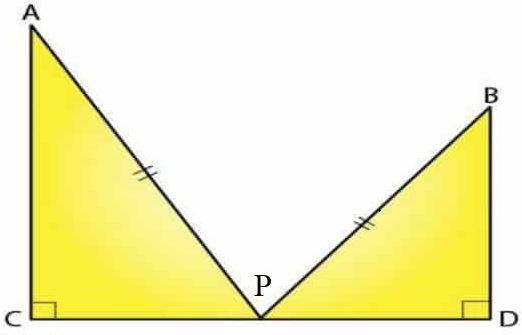
Solution:
It is given that
ACP = ∠BDP = 90°
AC = 12 m
BD = 9 m
PA= PB = 15 m
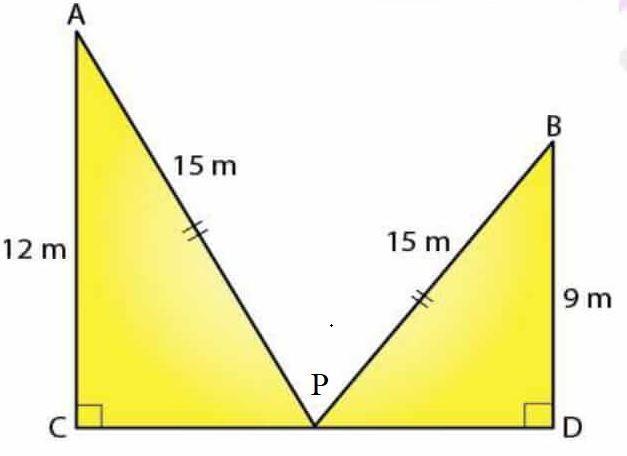
(i) In the right angled triangle ACP
AP2 = AC2 + CP2
Substituting the values
152 = 122 + CP2
By further calculation
225 = 144 + CP2
CP2 = 225 – 144 = 81
So we get
CP = √81 = 9 m
(ii) In the right angled triangle BPD
PB2 = BD2 + PD2
Substituting the values
152 = 92 + PD2
By further calculation
225 = 81 + PD2
PD2 = 225 – 81 = 144
So we get
PD = √144 = 12 m
(iii) We know that
CP = 9 m
PD = 12 m
So we get
CD = CP + PD
Substituting the values
CD = 9 + 12 = 21 m
7. In triangle PQR, angle Q = 90°, find:
(i) PR, if PQ = 8 cm and QR = 6 cm
(ii) PQ, if PR = 34 cm and QR = 30 cm
Solution:
(i) It is given that
PQ = 8 cm and QR = 6 cm
∠PQR = 900
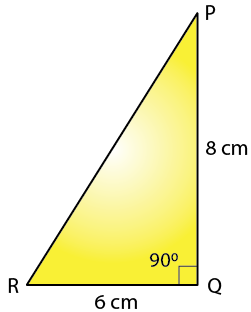
Using Pythagoras Theorem
PR2 = PQ2 + QR2
Substituting the values
PR2 = 82 + 62
By further calculation
PR2 = 64 + 36 = 100
PR = √100
So we get
PR = 10 cm
(ii) It is given that
PR = 34 cm and QR = 30 cm
∠PQR = 900
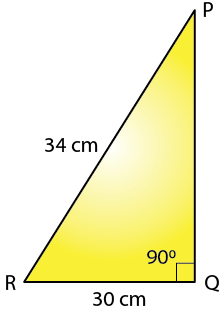
Using Pythagoras Theorem
PR2 = PQ2 + QR2
Substituting the values
342 = PQ2 + 302
By further calculation
1156 = PQ2 + 900
PQ2 = 1156 – 900 = 256
PQ = √256
So we get
PQ = 16 cm
8. Show that the triangle ABC is a right-angled triangle; if:
AB = 9 cm, BC = 40 cm and AC = 41 cm
Solution:
It is given that
AB = 9 cm
BC = 40 cm
AC = 41 cm
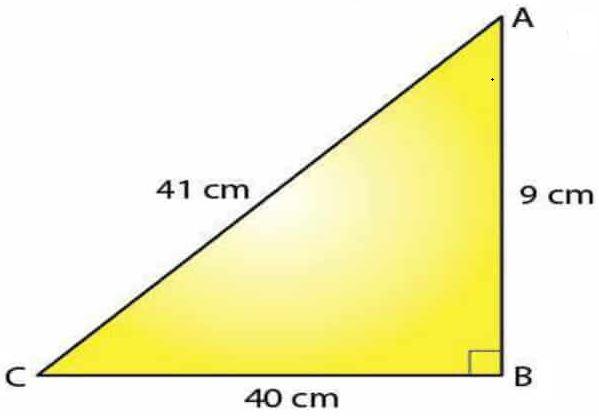
The triangle will be right angled if square of the largest side is equal to the sum of the squares of the other two sides.
Using Pythagoras Theorem
AC2 = BC2 + AB2
Substituting the values
412 = 402 + 92
By further calculation
1681 = 1600 + 81
So we get
1681 = 1681
Therefore, ABC is a right-angled triangle.
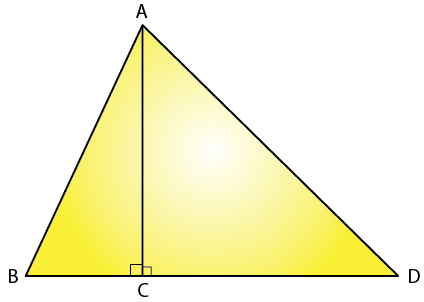
9. In the given figure, angle ACB = 90° = angle ACD. If AB = 10 cm, BC = 6 cm and AD = 17 cm, find:
(i) AC
(ii) CD
Solution:
It is given that
angle ACB = 90° = angle ACD
AB = 10 cm, BC = 6 cm and AD = 17 cm
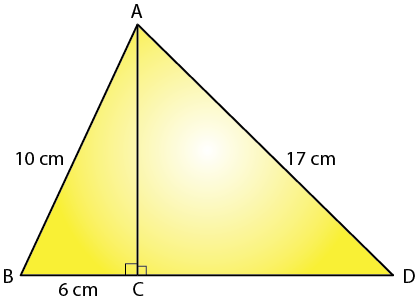
(i) In the right angled triangle ABC
BC = 6 cm and AB = 10cm
Using Pythagoras Theorem
AB2 = AC2 + BC2
Substituting the values
102 = AC2 + 62
By further calculation
100 = AC2 + 36
AC2 = 100 – 36 = 64
AC = √64 = √ (8 × 8)
So we get
AC = 8 cm
(ii) In the right angled triangle ACD
AD = 17 cm and AC = 8cm
Using Pythagoras Theorem
AD2 = AC2 + CD2
Substituting the values
172 = 82 + CD2
By further calculation
289 = 64 + CD2
CD2 = 289 – 64 = 225
CD = √225 = √ (15 × 15)
So we get
CD = 15 cm
10. In the given figure, angle ADB = 90°, AC = AB = 26 cm and BD = DC. If the length of AD = 24 cm; find the length of BC.

Solution:
It is given that
angle ADB = 90°
AC = AB = 26 cm
BD = DC
Using Pythagoras Theorem
AC2 = AD2 + DC2
Substituting the values
262 = 242 + DC2
By further calculation
676 = 576 + DC2
DC2 = 676 – 576 = 100
DC = √100
So we get
DC = 10 cm
Here the length of BC = BD + DC
Substituting the values
Length of BC = 10 + 10 = 20 cm
11. In the given figure, AD = 13 cm, BC = 12 cm, AB = 3 cm and angle ACD = angle ABC = 90°. Find the length of DC.

Solution:
It is given that
AD = 13 cm
BC = 12 cm
AB = 3 cm
angle ACD = angle ABC = 90°
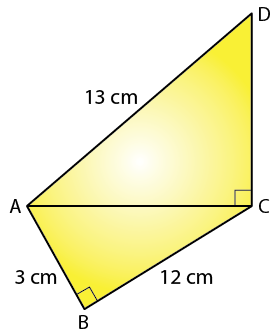
(i) In a right angled triangle ABC
AB = 3 cm and BC = 12 cm
Using Pythagoras Theorem
AC2 = AB2 + BC2
Substituting the values
AC2 = 32 + 122
By further calculation
AC2 = 9 + 144 = 153
So we get
AC = √153 cm
(ii) In a right angled triangle ACD
AD = 13 cm and AC = √153 cm
Using Pythagoras Theorem
DC2 = AD2 – AC2
Substituting the values
DC2 = 132 + √1532
By further calculation
DC2 = 169 – 153 = 16
So we get
DC = √16 = 4 cm
Hence, the length of DC is 4 cm.
12. A ladder, 6.5 m long, rests against a vertical wall. If the foot of the ladder is 2.5 m from the foot of the wall, find upto how much height does the ladder reach?
Solution:
It is given that
Length of ladder = 6.5 m
Length of foot of the wall = 2.5m
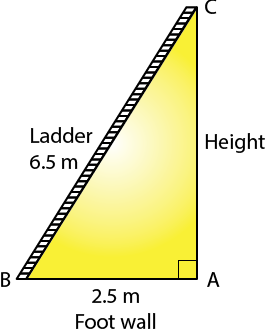
Using Pythagoras Theorem
BC2 = AB2 + AC2
Substituting the values
6.52 = 2.52 + AC2
By further calculation
AC2 = 42.25 – 6.25 = 36
So we get
AC = √36 = 6 m
Hence, the ladder reaches upto 6 m.
13. A boy first goes 5 m due north and then 12 m due east. Find the distance between the initial and the final position of the boy.
Solution:
It is given that
Direction of north AC = 5 m
Direction of east AB = 12 m
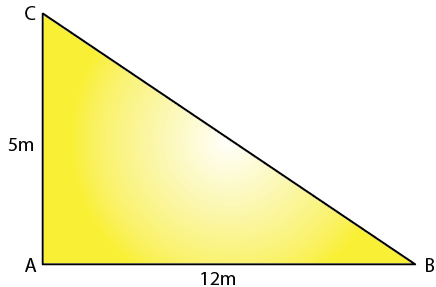
Using Pythagoras Theorem
BC2 = AC2 + AB2
Substituting the values
BC2 = 52 + 122
By further calculation
BC2 = 25 + 144 = 169
BC = √169 = √ (13 × 13)
So we get
BC = 13 m
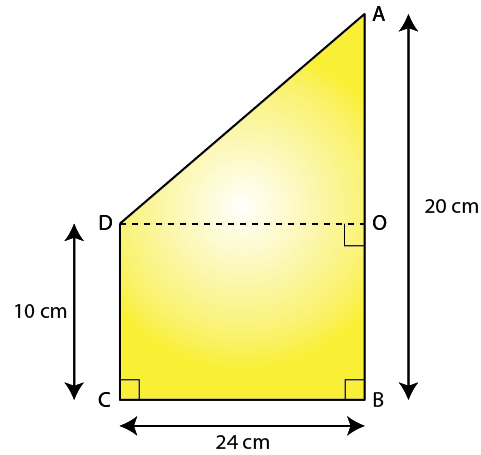
14. Use the information given in the figure to find the length AD.
Solution:
It is given that
AB = 20 cm
AO = AB/2 = 20/2 = 10 cm
BC = OD = 24 cm
Using Pythagoras Theorem
AD2 = AO2 + OD2
Substituting the values
AD2 = 102 + 242
By further calculation
AD2 = 100 + 576 = 676
AD = √676 = √ (26 × 26)
So we get
AD = 26 cm
Download PDF
Selina Class 7 ICSE Solutions Mathematics : Chapter 16- Pythagoras Theorem
Download PDF: Selina Class 7 ICSE Solutions Mathematics : Chapter 16- Pythagoras Theorem PDF
Chapterwise Selina Publishers ICSE Solutions for Class 7 Mathematics :
- Chapter 1- Integers
- Chapter 2- Rational Numbers
- Chapter 3- Fraction (Including Problems)
- Chapter 4- Decimal Fractions (Decimals)
- Chapter 5- Exponents (Including Laws of Exponents)
- Chapter 6- Ratio and Proportion (Including Sharing in a Ratio)
- Chapter 7- Unitary Method (Including Time and Work)
- Chapter 8- Percent and Percentage
- Chapter 9- Profit, Loss and Discount
- Chapter 10- Simple Interest
- Chapter 11- Fundamental Concepts (Including Fundamental Operations)
- Chapter 12- Simple Linear Equations (Including Word Problems)
- Chapter 13- Set Concepts
- Chapter 14- Lines and Angles (Including Construction of Angles)
- Chapter 15- Triangles
- Chapter 16- Pythagoras Theorem
- Chapter 17- Symmetry (Including Reflection and Rotation)
- Chapter 18- Recognition of Solids (Representing 3-D in 2-D)
- Chapter 19- Congruency: Congruent Triangles
- Chapter 20- Mensuration (Perimeter and Area of Plane Figures)
- Chapter 21- Data Handling
- Chapter 22- Probability
About Selina Publishers ICSE
Selina Publishers has been serving the students since 1976 and is one of the quality ICSE school textbooks publication houses. Mathematics and Science books for classes 6-10 form the core of our business, apart from certain English and Hindi literature as well as a few primary books. All these books are based upon the syllabus published by the Council for the I.C.S.E. Examinations, New Delhi. The textbooks are composed by a panel of subject experts and vetted by teachers practising in ICSE schools all over the country. Continuous efforts are made in complying with the standards and ensuring lucidity and clarity in content, which makes them stand tall in the industry.