
Class 10: Maths Chapter 6 solutions. Complete Class 10 Maths Chapter 6 Notes.
RD Sharma Solutions for Class 10 Maths Chapter 6–Trigonometric Identities
Class 10: Maths Chapter 6 solutions. Complete Class 10 Maths Chapter 6 Notes.
Exercise 6.1 Page No: 6.43
Prove the following trigonometric identities:
1. (1 – cos2 A) cosec2 A = 1
Solution:
Taking the L.H.S,
(1 – cos2 A) cosec2 A
= (sin2 A) cosec2 A [∵ sin2 A + cos2 A = 1 ⇒1 – sin2 A = cos2 A]
= 12
= 1 = R.H.S
– Hence Proved
2. (1 + cot2 A) sin2 A = 1
Solution:
By using the identity,
cosec2 A – cot2 A = 1 ⇒ cosec2 A = cot2 A + 1
Taking,
L.H.S = (1 + cot2 A) sin2 A
= cosec2 A sin2 A
= (cosec A sin A)2
= ((1/sin A) × sin A)2
= (1)2
= 1
= R.H.S
– Hence Proved
3. tan2 θ cos2 θ = 1 − cos2 θ
Solution:
We know that,
sin2 θ + cos2 θ = 1
Taking,
L.H.S = tan2 θ cos2 θ
= (tan θ × cos θ)2
= (sin θ)2
= sin2 θ
= 1 – cos2 θ
= R.H.S
– Hence Proved
4. cosec θ √(1 – cos2 θ) = 1
Solution:
Using identity,
sin2 θ + cos2 θ = 1 ⇒ sin2 θ = 1 – cos2 θ
Taking L.H.S,
L.H.S = cosec θ √(1 – cos2 θ)
= cosec θ √( sin2 θ)
= cosec θ x sin θ
= 1
= R.H.S
– Hence Proved
5. (sec2 θ − 1)(cosec2 θ − 1) = 1
Solution:
Using identities,
(sec2 θ − tan2 θ) = 1 and (cosec2 θ − cot2 θ) = 1
We have,
L.H.S = (sec2 θ – 1)(cosec2θ – 1)
= tan2θ × cot2θ
= (tan θ × cot θ)2
= (tan θ × 1/tan θ)2
= 12
= 1
= R.H.S
– Hence Proved
6. tan θ + 1/ tan θ = sec θ cosec θ
Solution:
We have,
L.H.S = tan θ + 1/ tan θ
= (tan2 θ + 1)/ tan θ
= sec2 θ / tan θ [∵ sec2 θ − tan2 θ = 1]
= (1/cos2 θ) x 1/ (sin θ/cos θ) [∵ tan θ = sin θ / cos θ]
= cos θ/ (sin θ x cos2 θ)
= 1/ cos θ x 1/ sin θ
= sec θ x cosec θ
= sec θ cosec θ
= R.H.S
– Hence Proved
7. cos θ/ (1 – sin θ) = (1 + sin θ)/ cos θ
Solution:
We know that,
sin2 θ + cos2 θ = 1
So, by multiplying both the numerator and the denominator by (1+ sin θ), we get

L.H.S =
= R.H.S
– Hence Proved
8. cos θ/ (1 + sin θ) = (1 – sin θ)/ cos θ
Solution:
We know that,
sin2 θ + cos2 θ = 1
So, by multiplying both the numerator and the denominator by (1- sin θ), we get
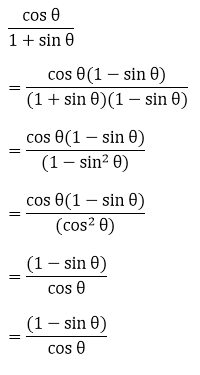
L.H.S =
= R.H.S
– Hence Proved
9. cos2 θ + 1/(1 + cot2 θ) = 1
Solution:
We already know that,
cosec2 θ − cot2 θ = 1 and sin2 θ + cos2 θ = 1
Taking L.H.S,
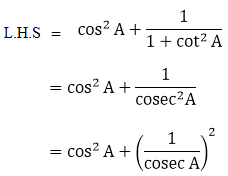
= cos2 A + sin2 A
= 1
= R.H.S
– Hence Proved
10. sin2 A + 1/(1 + tan 2 A) = 1
Solution:
We already know that,
sec2 θ − tan2 θ = 1 and sin2 θ + cos2 θ = 1
Taking L.H.S,
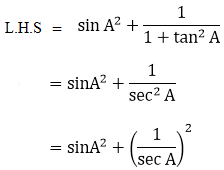
= sin2 A + cos2 A
= 1
= R.H.S
– Hence Proved
11.
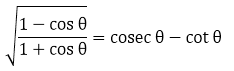
Solution:
We know that, sin2 θ + cos2 θ = 1
Taking the L.H.S,
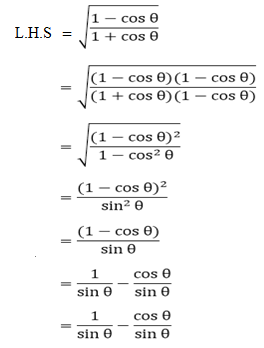
= cosec θ – cot θ
= R.H.S
– Hence Proved
12. 1 – cos θ/ sin θ = sin θ/ 1 + cos θ
Solution:
We know that,
sin2 θ + cos2 θ = 1
So, by multiplying both the numerator and the denominator by (1+ cos θ), we get
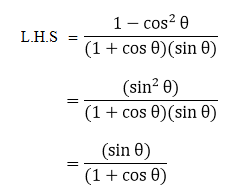
= R.H.S
– Hence Proved
13. sin θ/ (1 – cos θ) = cosec θ + cot θ
Solution:
Taking L.H.S,
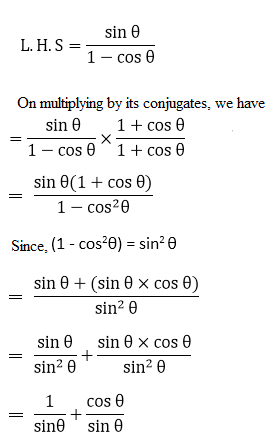
= cosec θ + cot θ
= R.H.S
– Hence Proved
14. (1 – sin θ) / (1 + sin θ) = (sec θ – tan θ)2
Solution:
Taking the L.H.S,
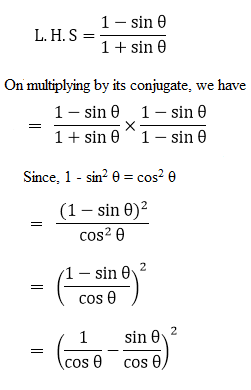
= (sec θ – tan θ)2
= R.H.S
– Hence Proved
15.
Solution:
Taking L.H.S,
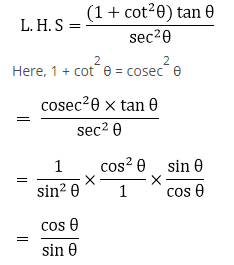
= cot θ
= R.H.S
– Hence Proved
16. tan2 θ − sin2 θ = tan2 θ sin2 θ
Solution:
Taking L.H.S,
L.H.S = tan2 θ − sin2 θ
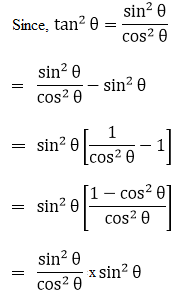
= tan2 θ sin2 θ
= R.H.S
– Hence Proved
17. (cosec θ + sin θ)(cosec θ – sin θ) = cot2θ + cos2θ
Solution:
Taking L.H.S = (cosec θ + sin θ)(cosec θ – sin θ)
On multiplying we get,
= cosec2 θ – sin2 θ
= (1 + cot2 θ) – (1 – cos2 θ) [Using cosec2 θ − cot2 θ = 1 and sin2 θ + cos2 θ = 1]
= 1 + cot2 θ – 1 + cos2 θ
= cot2 θ + cos2 θ
= R.H.S
– Hence Proved
18. (sec θ + cos θ) (sec θ – cos θ) = tan2 θ + sin2 θ
Solution:
Taking L.H.S = (sec θ + cos θ)(sec θ – cos θ)
On multiplying we get,
= sec2 θ – sin2 θ
= (1 + tan2 θ) – (1 – sin2 θ) [Using sec2 θ − tan2 θ = 1 and sin2 θ + cos2 θ = 1]
= 1 + tan2 θ – 1 + sin2 θ
= tan 2 θ + sin 2 θ
= R.H.S
– Hence Proved
19. sec A(1- sin A) (sec A + tan A) = 1
Solution:
Taking L.H.S = sec A(1 – sin A)(sec A + tan A)
Substituting sec A = 1/cos A and tan A =sin A/cos A in the above we have,
L.H.S = 1/cos A (1 – sin A)(1/cos A + sin A/cos A)
= 1 – sin2 A / cos2 A [After taking L.C.M]
= cos2 A / cos2 A [∵ 1 – sin2 A = cos2 A]
= 1
= R.H.S
– Hence Proved
20. (cosec A – sin A)(sec A – cos A)(tan A + cot A) = 1
Solution:
Taking L.H.S = (cosec A – sin A)(sec A – cos A)(tan A + cot A)

= (cos2 A/ sin A) (sin2 A/ cos A) (1/ sin A cos A) [∵ sin2 θ + cos2 θ = 1]
= (sin A cos A) (1/ cos A sin A)
= 1
= R.H.S
– Hence Proved
21. (1 + tan2 θ)(1 – sin θ)(1 + sin θ) = 1
Solution:
Taking L.H.S = (1 + tan2θ)(1 – sin θ)(1 + sin θ)
And, we know sin2 θ + cos2 θ = 1 and sec2 θ – tan2 θ = 1
So,
L.H.S = (1 + tan2 θ)(1 – sin θ)(1 + sin θ)
= (1 + tan2 θ){(1 – sin θ)(1 + sin θ)}
= (1 + tan2 θ)(1 – sin2 θ)
= sec2 θ (cos2 θ)
= (1/ cos2 θ) x cos2 θ
= 1
= R.H.S
– Hence Proved
22. sin2 A cot2 A + cos2 A tan2 A = 1
Solution:
We know that,
cot2 A = cos2 A/ sin2 A and tan2 A = sin2 A/cos2 A
Substituting the above in L.H.S, we get
L.H.S = sin2 A cot2 A + cos2 A tan2 A
= {sin2 A (cos2 A/ sin2 A)} + {cos2 A (sin2 A/cos2 A)}
= cos2 A + sin2 A
= 1 [∵ sin2 θ + cos2 θ = 1]
= R.H.S
– Hence Proved
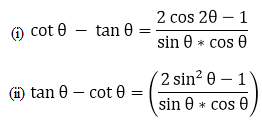
23.
Solution:
(i) Taking the L.H.S and using sin2 θ + cos2 θ = 1, we have
L.H.S = cot θ – tan θ
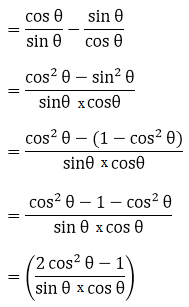
= R.H.S
– Hence Proved
(ii) Taking the L.H.S and using sin2 θ + cos2 θ = 1, we have
L.H.S = tan θ – cot θ
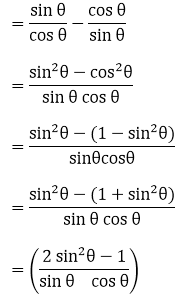
= R.H.S
– Hence Proved
24. (cos2 θ/ sin θ) – cosec θ + sin θ = 0
Solution:
Taking L.H.S and using sin2 θ + cos2 θ = 1, we have
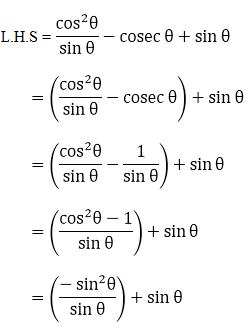
= – sin θ + sin θ
= 0
= R.H.S
- Hence proved
25.
Solution:
Taking L.H.S,
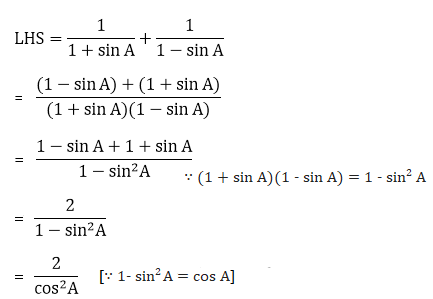
= 2 sec2 A
= R.H.S
- Hence proved
26.
Solution:
Taking the LHS and using sin2 θ + cos2 θ = 1, we have
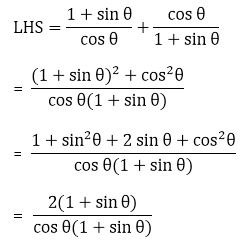
= 2/ cos θ
= 2 sec θ
= R.H.S
- Hence proved

27.
Solution:
Taking the LHS and using sin2 θ + cos2 θ = 1, we have
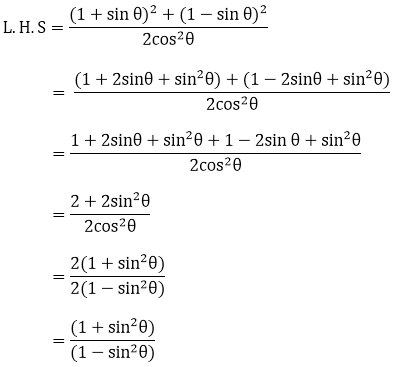
= R.H.S
- Hence proved
28.
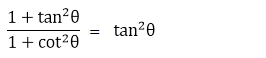
Solution:
Taking L.H.S,

Using sec2 θ − tan2 θ = 1 and cosec2 θ − cot2 θ = 1
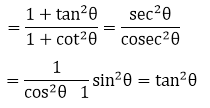
= R.H.S
- Hence proved
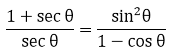
29.
Solution:
Taking L.H.S and using sin2 θ + cos2 θ = 1, we have
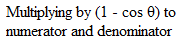
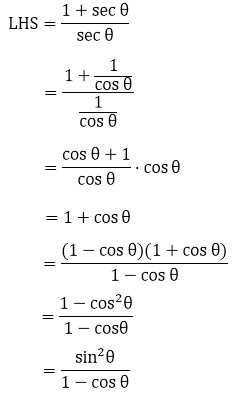
= R.H.S
- Hence proved

30.
Solution:
Taking LHS, we have
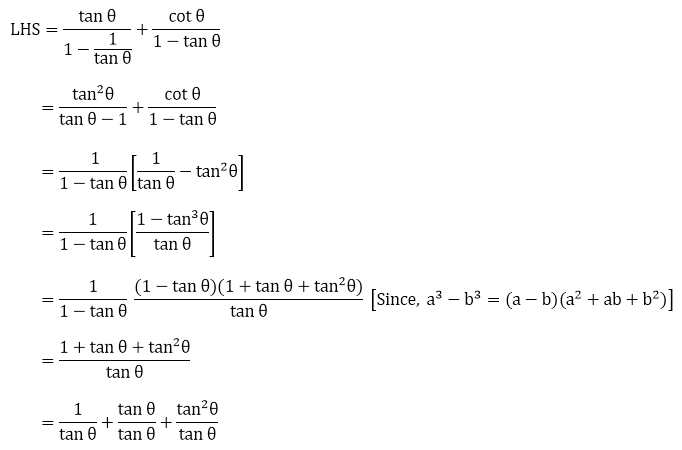
= 1 + tan θ + cot θ
= R.H.S
- Hence proved
31. sec6 θ = tan6 θ + 3 tan2 θ sec2 θ + 1
Solution:
From trig. Identities we have,
sec2 θ − tan2 θ = 1
On cubing both sides,
(sec2θ − tan2θ)3 = 1
sec6 θ − tan6 θ − 3sec2 θ tan2 θ(sec2 θ − tan2 θ) = 1[Since, (a – b)3 = a3 – b3 – 3ab(a – b)]
sec6 θ − tan6 θ − 3sec2 θ tan2 θ = 1
⇒ sec6 θ = tan6 θ + 3sec2 θ tan2 θ + 1
Hence, L.H.S = R.H.S
- Hence proved
32. cosec6 θ = cot6 θ + 3cot2 θ cosec2 θ + 1
Solution:
From trig. Identities we have,
cosec2 θ − cot2 θ = 1
On cubing both sides,
(cosec2 θ − cot2 θ)3 = 1
cosec6 θ − cot6 θ − 3cosec2 θ cot2 θ (cosec2 θ − cot2 θ) = 1[Since, (a – b)3 = a3 – b3 – 3ab(a – b)]
cosec6 θ − cot6 θ − 3cosec2 θ cot2 θ = 1
⇒ cosec6 θ = cot6 θ + 3 cosec2 θ cot2 θ + 1
Hence, L.H.S = R.H.S
- Hence proved
33.
Solution:
Taking L.H.S and using sec2 θ − tan2 θ = 1 ⇒ 1 + tan2 θ = sec2 θ
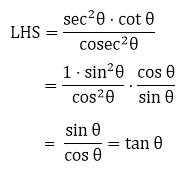
= R.H.S
- Hence proved
34.
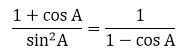
Solution:
Taking L.H.S and using the identity sin2A + cos2A = 1, we get
sin2A = 1 − cos2A
⇒ sin2A = (1 – cos A)(1 + cos A)
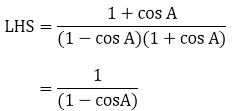
- Hence proved
35.
Solution:
We have,
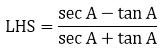
Rationalizing the denominator and numerator with (sec A + tan A) and using sec2 θ − tan2 θ = 1 we get,
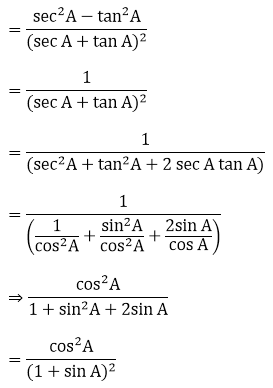
= R.H.S
- Hence proved
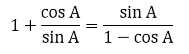
36.
Solution:
We have,
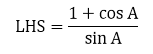
On multiplying numerator and denominator by (1 – cos A), we get
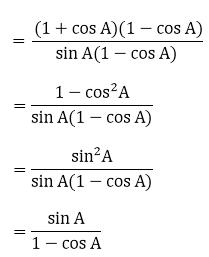
= R.H.S
- Hence proved

37. (i)
Solution:
Taking L.H.S and rationalizing the numerator and denominator with √(1 + sin A), we get
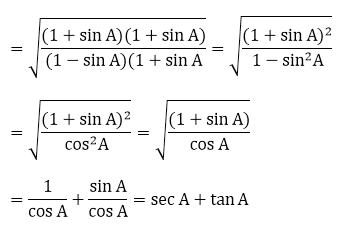
= R.H.S
- Hence proved
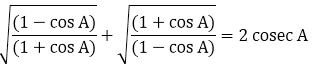
(ii)
Solution:
Taking L.H.S and rationalizing the numerator and denominator with its respective conjugates, we get
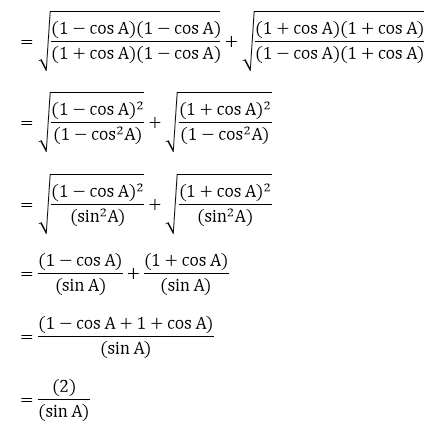
= 2 cosec A
= R.H.S
- Hence proved
38. Prove that:
(i)
Solution:
Taking L.H.S and rationalizing the numerator and denominator with its respective conjugates, we get
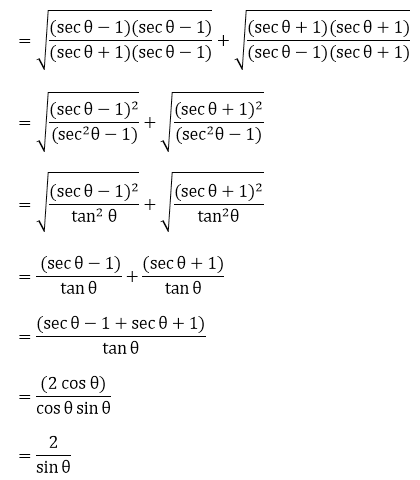
= 2 cosec θ
= R.H.S
- Hence proved
(ii)
Solution:
Taking L.H.S and rationalizing the numerator and denominator with its respective conjugates, we get
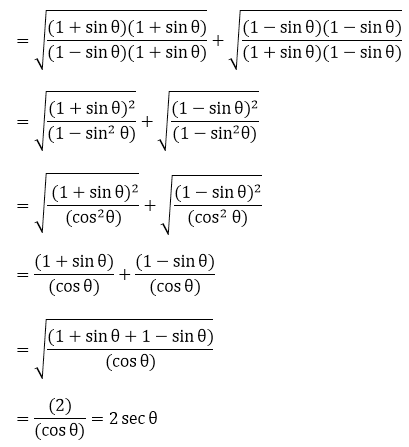
= R.H.S
- Hence proved
(iii)
Solution:
Taking L.H.S and rationalizing the numerator and denominator with its respective conjugates, we get

= 2 cosec θ
= R.H.S
- Hence proved
(iv)
Solution:
Taking L.H.S, we have
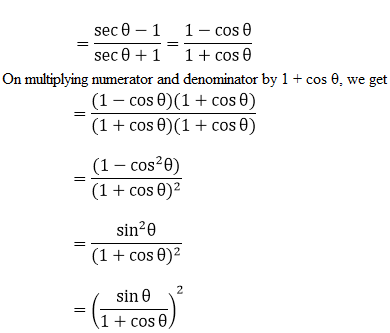
= R.H.S
- Hence proved
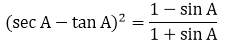
39.
Solution:
Taking LHS = (sec A – tan A)2 , we have
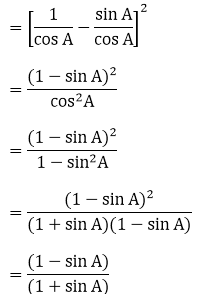
= R.H.S
- Hence proved
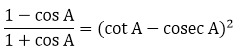
40.
Solution:
Taking L.H.S and rationalizing the numerator and denominator with (1 – cos A), we get
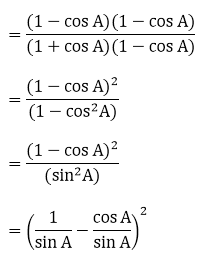
= (cosec A – cot A)2
= (cot A – cosec A)2
= R.H.S
- Hence proved

41.
Solution:
Considering L.H.S and taking L.C.M and on simplifying we have,
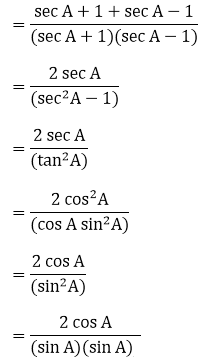
= 2 cosec A cot A = RHS
- Hence proved

42.
Solution:
Taking LHS, we have
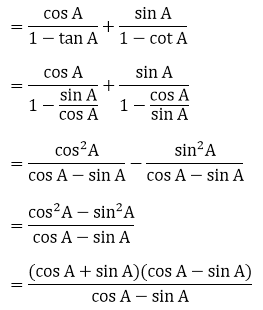
= cos A + sin A
= RHS
- Hence proved
43.
Solution:
Considering L.H.S and taking L.C.M and on simplifying we have,
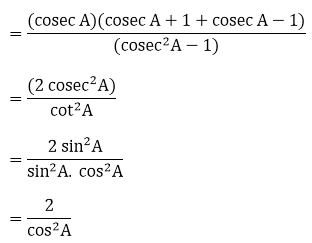
= 2 sec2 A
= RHS
- Hence proved
Exercise 6.2 Page No: 6.54
1. If cos θ = 4/5, find all other trigonometric ratios of angle θ.
Solution:
We have,
cos θ = 4/5
And we know that,
sin θ = √(1 – cos2 θ)
⇒ sin θ = √(1 – (4/5)2)
= √(1 – (16/25))
= √[(25 – 16)/25]
= √(9/25)
= 3/5
∴ sin θ = 3/5
Since, cosec θ = 1/ sin θ
= 1/ (3/5)
⇒ cosec θ = 5/3
And, sec θ = 1/ cos θ
= 1/ (4/5)
⇒ cosec θ = 5/4
Now,
tan θ = sin θ/ cos θ
= (3/5)/ (4/5)
⇒ tan θ = 3/4
And, cot θ = 1/ tan θ
= 1/ (3/4)
⇒ cot θ = 4/3
2. If sin θ = 1/√2, find all other trigonometric ratios of angle θ.
Solution:
We have,
sin θ = 1/√2
And we know that,
cos θ = √(1 – sin2 θ)
⇒ cos θ = √(1 – (1/√2)2)
= √(1 – (1/2))
= √[(2 – 1)/2]
= √(1/2)
= 1/√2
∴ cos θ = 1/√2
Since, cosec θ = 1/ sin θ
= 1/ (1/√2)
⇒ cosec θ = √2
And, sec θ = 1/ cos θ
= 1/ (1/√2)
⇒ sec θ = √2
Now,
tan θ = sin θ/ cos θ
= (1/√2)/ (1/√2)
⇒ tan θ = 1
And, cot θ = 1/ tan θ
= 1/ (1)
⇒ cot θ = 1

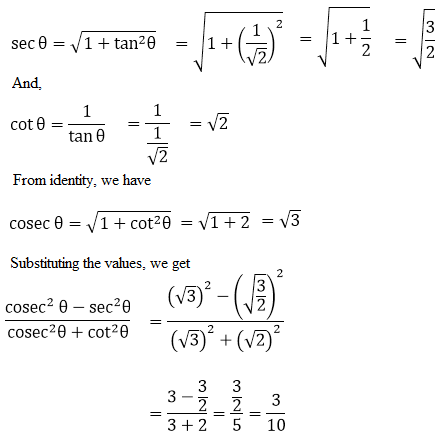
3.
Solution:
Given,
tan θ = 1/√2
By using sec2 θ − tan2 θ = 1,
4.
Solution:
Given,
tan θ = 3/4
By using sec2 θ − tan2 θ = 1,

sec θ = 5/4
Since, sec θ = 1/ cos θ
⇒ cos θ = 1/ sec θ
= 1/ (5/4)
= 4/5
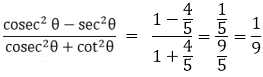
So,

5.
Solution:
Given, tan θ = 12/5
Since, cot θ = 1/ tan θ = 1/ (12/5) = 5/12
Now, by using cosec2 θ − cot2 θ = 1
cosec θ = √(1 + cot2 θ)
= √(1 + (5/12)2 )
= √(1 + 25/144)
= √(169/ 25)
⇒ cosec θ = 13/5
Now, we know that
sin θ = 1/ cosec θ
= 1/ (13/5)
⇒ sin θ = 5/13
Putting value of sin θ in the expression we have,
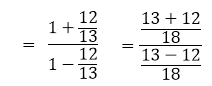
= 25/ 1
= 25

6.
Solution:
Given,
cot θ = 1/√3
Using cosec2 θ − cot2 θ = 1, we can find cosec θ
cosec θ = √(1 + cot2 θ)
= √(1 + (1/√3)2)
= √(1 + (1/3)) = √((3 + 1)/3)
= √(4/3)
⇒ cosec θ = 2/√3
So, sin θ = 1/ cosec θ = 1/ (2/√3)
⇒ sin θ = √3/2
And, we know that
cos θ = √(1 – sin2 θ)
= √(1 – (√3/2)2)
= √(1 – (3/4))
= √((4 – 3)/4)
= √(1/4)
⇒ cos θ = 1/2
Now, using cos θ and sin θ in the expression, we have
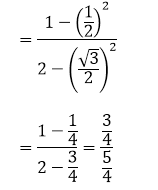
= 3/5

7.
Solution:
Given,
cosec A = √2
Using cosec2 A − cot2 A = 1, we find cot A
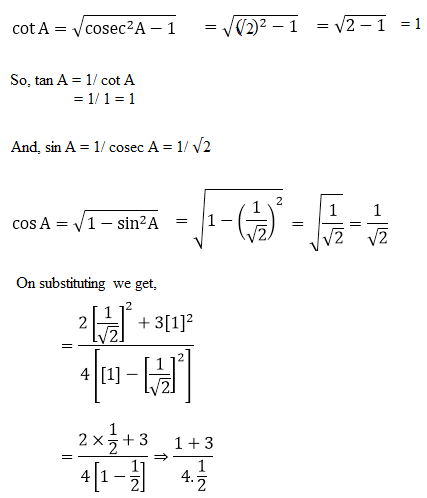
= 4/2
= 2
RD Sharma Solutions for Class 10 Maths Chapter 6: Download PDF
RD Sharma Solutions for Class 10 Maths Chapter 6–Trigonometric Identities
Download PDF: RD Sharma Solutions for Class 10 Maths Chapter 6–Trigonometric Identities PDF
Chapterwise RD Sharma Solutions for Class 10 Maths :
- Chapter 1–Real Numbers
- Chapter 2–Polynomials
- Chapter 3–Pair of Linear Equations In Two Variables
- Chapter 4–Triangles
- Chapter 5–Trigonometric Ratios
- Chapter 6–Trigonometric Identities
- Chapter 7–Statistics
- Chapter 8–Quadratic Equations
- Chapter 9–Arithmetic Progressions
- Chapter 10–Circles
- Chapter 11–Constructions
- Chapter 12–Some Applications of Trigonometry
- Chapter 13–Probability
- Chapter 14–Co-ordinate Geometry
- Chapter 15–Areas Related To Circles
- Chapter 16–Surface Areas And Volumes
About RD Sharma
RD Sharma isn't the kind of author you'd bump into at lit fests. But his bestselling books have helped many CBSE students lose their dread of maths. Sunday Times profiles the tutor turned internet star
He dreams of algorithms that would give most people nightmares. And, spends every waking hour thinking of ways to explain concepts like 'series solution of linear differential equations'. Meet Dr Ravi Dutt Sharma — mathematics teacher and author of 25 reference books — whose name evokes as much awe as the subject he teaches. And though students have used his thick tomes for the last 31 years to ace the dreaded maths exam, it's only recently that a spoof video turned the tutor into a YouTube star.
R D Sharma had a good laugh but said he shared little with his on-screen persona except for the love for maths. "I like to spend all my time thinking and writing about maths problems. I find it relaxing," he says. When he is not writing books explaining mathematical concepts for classes 6 to 12 and engineering students, Sharma is busy dispensing his duty as vice-principal and head of department of science and humanities at Delhi government's Guru Nanak Dev Institute of Technology.