
NCERT Solutions for 8th Class Science: Chapter 13-Sound
Page No: 168
Excercise
1. Choose the correct answer.
Sound can travel through
(a) gases only
(b) solids only
(c) liquids only
(d) solids, liquids and gases.
► (d) solids, liquids and gases.
2. Which of the following voices is likely to have minimum frequency?
(a) Baby girl
(b) Baby boy
(c) A man
(d) A woman
► (c) A man
Page No: 169
3. In the following statements, tick 'T' against those which are true, and 'F' against those which are false.
(a) Sound cannot travel in vacuum. (T / F)
► True
(b) The number of oscillations per second of a vibrating object is called its time period. (T / F)
► False
(c) If the amplitude of vibration is large, sound is feeble. (T / F)
► False
(d) For human ears, the audible range is 20 Hz to 20,000 Hz. (T / F)
► True
(e) The lower the frequency of vibration, the higher is the pitch. (T / F)
► False
(f) Unwanted or unpleasant sound is termed as music. (T / F)
► False
(g) Noise pollution may cause partial hearing impairment. (T/F)
► True
4. Fill in the blanks with suitable words.
(a) Time taken by an object to complete one oscillation is called _________.
(b) Loudness is determined by the________ of vibration.
(c) The unit of frequency is _________.
(d) Unwanted sound is called _________.
(e) Shrillness of a sound is determined by the _________of vibration.
Answer
(a) Time taken by an object to complete one oscillation is called time period.
(b) Loudness is determined by the amplitude of vibration.
(c) The unit of frequency is hertz (Hz).
(d) Unwanted sound is called noise.
(e) Shrillness of a sound is determined by the frequency of vibration.
5. A pendulum oscillates 40 times in 4 seconds. Find its time period and frequency.
Answer
Frequency of oscillations is the number of oscillations of a vibrating object per second. Therefore frequency is = 40 vibrations /4 seconds= 10 Hertz.
Time period is the time required to complete one oscillation. Or it is the inverse of time period. Therefore time period = 1/10 = 0.1 seconds.
6. The sound from a mosquito is produced when it vibrates its wings at an average rate of 500 vibrations per second. What is the time period of the vibration?
Answer
Time Period given by the inverse of the frequency.
Time Period= 1/Frequency of oscillation = 1/500 = 0.002 sec.
7. Identify the part which vibrates to produce sound in the following instruments.
(a) Dholak (b) Sitar (c) Flute
Answer
(a) Diaphragm (stretched membrane)
(b) String
(c) Air column
8. What is the difference between noise and music? Can music become noise sometimes?
Answer
Unwanted sound that is unpleasant to ear is called noise. A pleasant sound is called music.
Music can become noise at many instances. When someone tries to enjoy very loud music, it can be noise for someone else. When loud music is played during religious celebrations or marriages, it can be annoying for many people.
9. List sources of noise pollution in your surroundings.
Answer
Some sources of noise pollution are as follows:
→ Televisions and transistors running at high volumes
→ Loudspeakers and crackers
→ Horns of buses, cars and trucks
→ Home appliances such as mixer, desert cooler, etc.
10. Explain in what way noise pollution is harmful to humans.
Answer
Noise pollution is harmful to humans in many ways. Constant exposure to noise pollution can create many health related problems; like insomnia, hypertension and may even lead to loss of hearing.
11. Your parents are going to buy a house. They have been offered one on the roadside and another three lanes away from the roadside. Which house would you suggest your parents should buy? Explain your answer.
Answer
There will be more noise in the house which is along the roadside due to noise produced by transportation vehicles may cause trouble to the residents. On the other hand, the house which is three lanes away from the roadside would be quieter. Therefore, it is better to take the house that is three lanes away from the roadside.
12. Sketch larynx and explain its function in your own words.
Answer
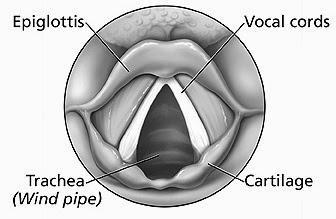
Larynx is a part of the throat. It is responsible for production of sound.
13. Lightning and thunder take place in the sky at the same time and at the same distance from us. Lightning is seen earlier and thunder is heard later. Can you explain?
Answer
The speed of sound is less than the speed of light. Due to this, light reaches to us faster than sound. Hence, during lightning we see the streak of light earlier than hearing the sound of thunder.
Chapterwise NCERT Solutions for 8th Class Science
About
The National Council of Educational Research and Training is an autonomous organization of the Government of India which was established in 1961 as a literary, scientific, and charitable Society under the Societies Registration Act. Its headquarters are located at Sri Aurbindo Marg in New Delhi. Visit the Official NCERT website to learn more.