Curriculum & Exam Preparation Note: Regular practice of NCERT textbook exercises and chapter-end questions establishes strong conceptual clarity for primary and secondary examinations.
NCERT Exemplar Class 9 Science Chapter 13: Why Do We Fall Ill. NCERT Exemplar Solutions for Class 9 Science Chapter 1 Matter In Our Surroundings prepare students for their Class 9 exams thoroughly.
Science problems and solutions for the Class 9 pdf are provided here which are similar to the questions being asked in the previous year's board.
NCERT Exemplar Class 9 Science Chapter 13: Why Do We Fall Ill
Class 9: Science Chapter 13 solutions. Complete Class 9 Science Chapter 13 Notes.
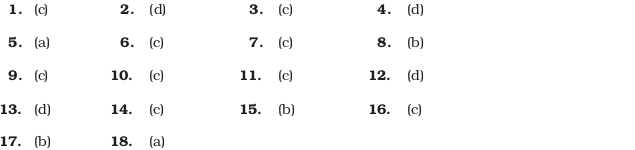
Multiple Choice Questions
- Which one of the following is not a viral disease?
- (a) Dengue
- (b) AIDS
- (c) Typhoid
- (d) Influenza
- Which one of the following is not a bacterial disease?
- (a) Cholera
- (b) Tuberculosis
- (c) Anthrax
- (d) Influenza
- Which one of the following disease is not transmitted by mosquito?
- (a) Brain fever
- (b) Malaria
- (c) Typhoid
- (d) Dengue
- Which one of the following disease is caused by bacteria?
- (a) Typhoid
- (b) Anthrax
- (c) Tuberculosis
- (d) Malaria
- Which one of the following diseases is caused by protozoans?
- (a) Malaria
- (b) Influenza
- (c) AIDS
- (d) Cholera
- Which one of the following has a long term effect on the health of an individual?
- (a) Common cold
- (b) Chicken pox
- (c) Chewing tobacco
- (d) Stress
- Which of the following can make you ill if you come in contact with an infected person?
- (a) High blood pressure
- (b) Genetic abnormalities
- (c) Sneezing
- (d) Blood cancer
- AIDS cannot be transmitted by
- (a) sexual contact
- (b) hugs
- (c) breast feeding
- (d) blood transfusion
- Making anti-viral drugs is more difficult than making anti-bacterial medicines because
- (a) viruses make use of host machinery
- (b) viruses are on the border line of living and non-living
- (c) viruses have very few biochemical mechanisms of their own
- (d) viruses have a protein coat
- Which one of the following causes kala-azar?
- (a) Ascaris
- (b) Trypanosoma
- (c) Leishmania
- (d) Bacteria
- If you live in a overcrowded and poorly ventilated house, it is possible that you may suffer from which of the following diseases
- (a) Cancer
- (b) AIDS
- (c) Air borne diseases
- (d) Cholera
- Which disease is not transmitted by mosquitoes?
- (a) Dengue
- (b) Malaria
- (c) Brain fever or encephalitis
- (d) Pneumonia
- Which one of the following is not important for individual health?
- (a) Living in clean space
- (b) Good economic condition
- (c) Social equality and harmony
- (d) Living in a large and well furnished house
- Choose the wrong statement
- (a) High blood pressure is caused by excessive weight and lack of exercise.
- (b) Cancers can be caused by genetic abnormalities
- (c) Peptic ulcers are caused by eating acidic food
- (d) Acne in not caused by staphylococci
- We should not allow mosquitoes to breed in our surroundings because they
- (a) multiply very fast and cause pollution
- (b) are vectors for many diseases
- (c) bite and cause skin diseases
- (d) are not important insects
- You are aware of Polio Eradication Programme in your city. Children are vaccinated because
- (a) vaccination kills the polio causing microorganisms
- (b) prevents the entry of polio causing organism
- (c) it creates immunity in the body
- (d) all the above
- Viruses, which cause hepatitis, are transmitted through
- (a) air
- (b) water
- (c) food
- (d) personal contact
- Vectors can be defined as
- (a) animals carry the infecting agents from sick person to another healthy person
- (b) microorganisms which cause many diseases
- (c) infected person
- (d) diseased plants
Short Answer Type Questions
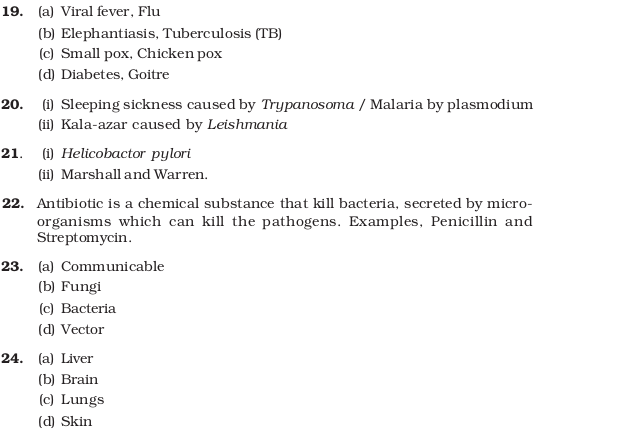
- Give two examples for each of the following
- (a) Acute diseases
- (b) Chronic diseases
- (c) Infectious diseases
- (d) Non-infectious diseases
- Name two diseases caused by Protozoans
What are their causal organisms? - Which bacterium causes peptic ulcers?
Who discovered the above pathogen for the first time? - What is an antibiotic? Give two examples
- Fill in the blanks
- (a) Pneumonia is an example of _____ disease.
- (b) Many skin diseases are caused by _____ .
- (c) Antibiotics commonly block biochemical pathways important for the growth of _____ .
- (d) Living organisms carrying the infecting agents from one person to another are called _____.
- Name the target organs for the following diseases
- (a) Hepatitis targets _____ .
- (b) Fits or unconsciousness targets _____ .
- (c) Pneumonia targets _____ .
- (d) Fungal disease targets _____ .
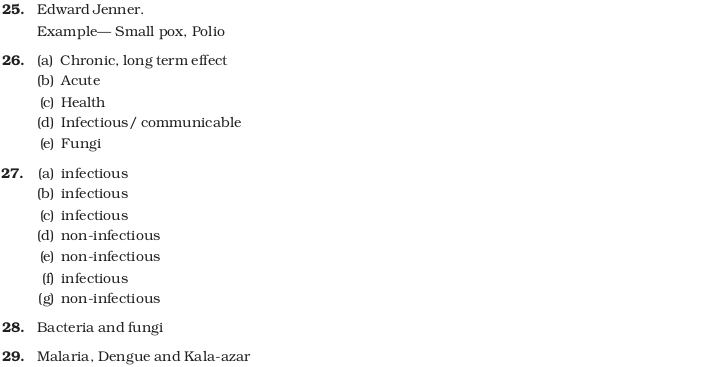
- Who discovered ‘vaccine’ for the first time?
Name two diseases which can be prevented by using vaccines. - Fill in the blanks
- (a) _____ disease continues for many days and causes _____ on body.
- (b) _____ disease continues for a few days and causes no longer term effect on body.
- (c) _____ is defined as physical, mental and social well-being and comfort.
- (d) Common cold is _____ disease.
- (e) Many skin diseases are caused by _____ .
- Classify the following diseases as infectious or non-infectious.
- (a) AIDS
- (b) Tuberculosis
- (c) Cholera
- (d) High blood pressure
- (e) Heart disease
- (f) Pneumonia
- (g) Cancer
- Name any two groups of micro-organisms from which antibiotics could be extracted.
- Name any three diseases transmitted through vectors.
Long Answer Type Questions
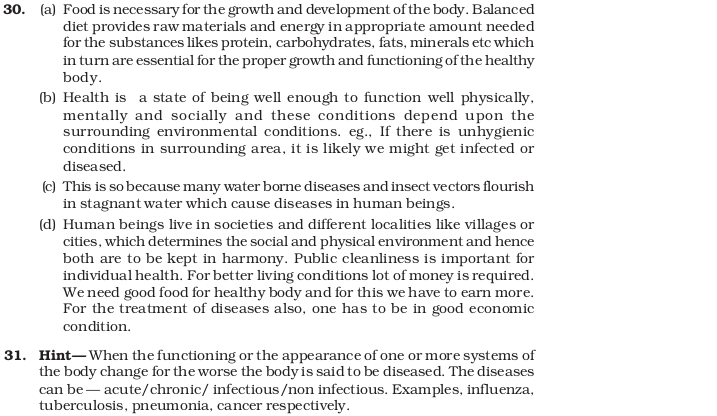
- Explain giving reasons
- (a) Balanced diet is necessary for maintaining healthy body.
- (b) Health of an organism depends upon the surrounding environmental conditions.
- (c) Our surrounding area should be free of stagnant water.
- (d) Social harmony and good economic conditions are necessary for good health.
- What is a disease? How many types of diseases have you studied? Give examples.
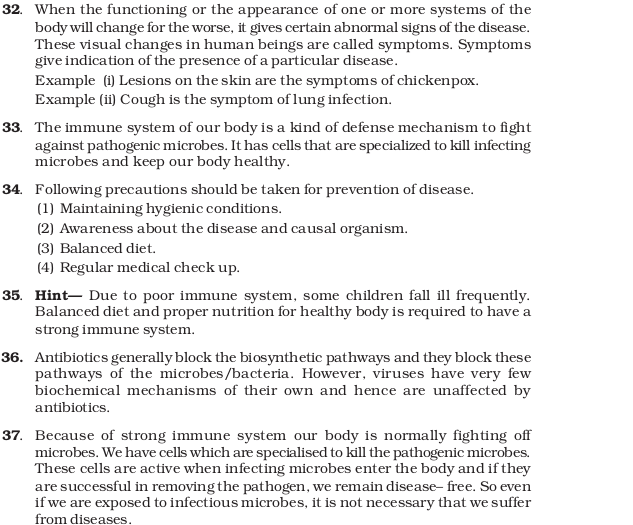
- What do you mean by disease symptoms? Explain giving two examples?
- Why is immune system essential for our health?
- What precautions will you take to justify “prevention is better than cure”.
- Why do some children fall ill more frequently than others living in the same locality?
- Why are antibiotics not effective for viral disease?
- Becoming exposed to or infected with an infectious microbe does not necessarily mean developing noticeable disease. Explain.
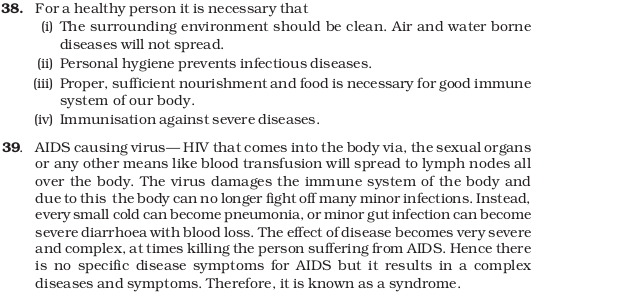
- Give any four factors necessary for a healthy person.
- Why is AIDS considered to be a ‘Syndrome’ and not a disease?
Answers