


NCERT Exemplar Class 9 Science Chapter 12: Sound. NCERT Exemplar Solutions for Class 9 Science Chapter 12 Sound prepare students for their Class 9 exams thoroughly.
Science problems and solutions for the Class 9 pdf are provided here which are similar to the questions being asked in the previous year’s board.
NCERT Exemplar Class 9 Science Chapter 12: Sound
Class 9: Science Chapter 12 solutions. Complete Class 9 Science Chapter 12 Notes.
Multiple Choice Questions
- Note is a sound
- (a) of mixture of several frequencies
- (b) of mixture of two frequencies only
- (c) of a single frequency
- (d) always unpleasant to listen
- A key of a mechanical piano struck gently and then struck again but much harder this time. In the second case
- (a) sound will be louder but pitch will not be different
- (b) sound will be louder and pitch will also be higher
- (c) sound will be louder but pitch will be lower
- (d) both loudness and pitch will remain unaffected
- In SONAR, we use
- (a) ultrasonic waves
- (b) infrasonic waves
- (c) radio waves
- (d) audible sound waves
- Sound travels in air if
- (a) particles of medium travel from one place to another
- (b) there is no moisture in the atmosphere
- (c) disturbance moves
- (d) both particles as well as disturbance travel from one place to another.
- When we change feeble sound to loud sound we increase its
- (a) frequency
- (b) amplitude
- (c) velocity
- (d) wavelength
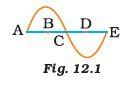
- In the curve (Fig.12.1) half the wavelength is
- Earthquake produces which kind of sound before the main shock wave begins
- (a) ultrasound
- (b) infrasound
- (c) audible sound
- (d) none of the above
- Infrasound can be heard by
- (a) dog
- (b) bat
- (c) rhinoceros
- (d) human beings
- Before playing the orchestra in a musical concert, a sitarist tries to adjust the tension and pluck the string suitably. By doing so, he is adjusting
- (a) intensity of sound only
- (b) amplitude of sound only
- (c) frequency of the sitar string with the frequency of other musical instruments
- (d) loudness of sound
Short Answer Type Questions
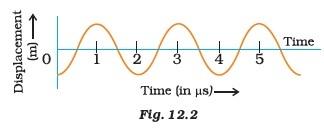
- The given graph (Fig.12.2) shows the displacement versus time relation for a disturbance travelling with velocity of 1500 m s–1. Calculate the wavelength of the disturbance
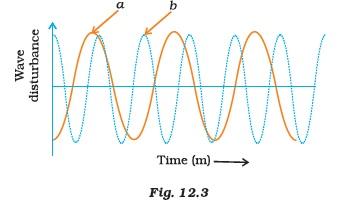
- Which of the above two graphs (a) and (b) (Fig.12.3) representing the human voice is likely to be the male voice? Give reason for your answer.
- A girl is sitting in the middle of a park of dimension 12 m × 12 m. On the left side of it there is a building adjoining the park and on right side of the park, there is a road adjoining the park. A sound is produced on the road by a cracker. Is it possible for the girl to hear the echo of this sound? Explain your answer.
- Why do we hear the sound produced by the humming bees while the sound of vibrations of pendulum is not heard?
- If any explosion takes place at the bottom of a lake, what type of shock waves in water will take place?
- Sound produced by a thunderstorm is heard 10 s after the lightning is seen. Calculate the approximate distance of the thunder cloud. (Given speed of sound = 340 m s–1.)
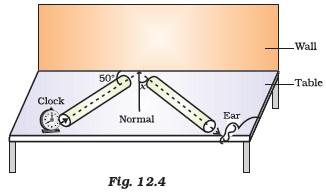
- For hearing the loudest ticking sound heard by the ear, find the angle x in the Fig.12.4.
- Why is the ceiling and wall behind the stage of good conference halls or concert halls made curved?
Long Answer Type Questions
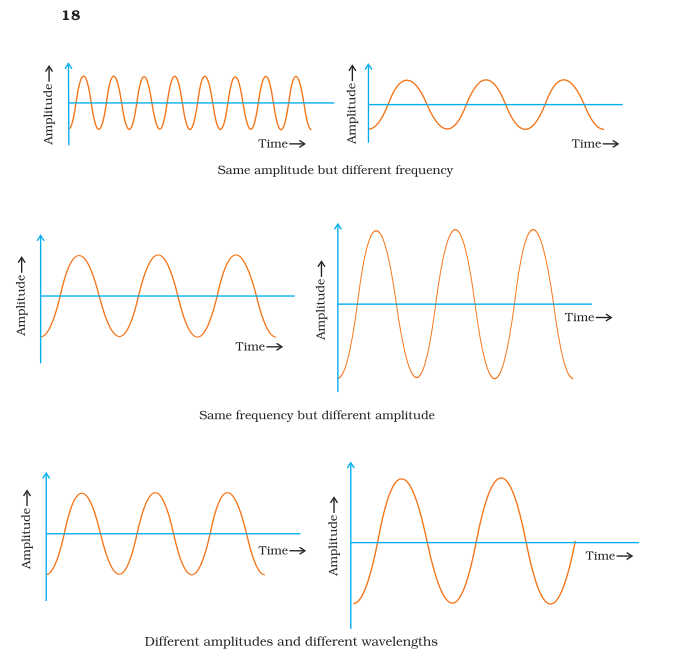
- Represent graphically by two separate diagrams in each case
- (i) Two sound waves having the same amplitude but different frequencies?
- (ii) Two sound waves having the same frequency but different amplitudes.
- (iii) Two sound waves having different amplitudes and also different wavelengths.
- Establish the relationship between speed of sound, its wavelength and frequency. If velocity of sound in air is 340 m s–1, calculate
- (i) wavelength when frequency is 256 Hz.
- (ii) frequency when wavelength is 0.85 m.
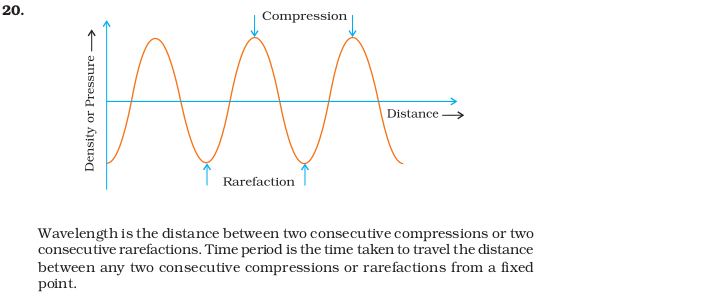
- Draw a curve showing density or pressure variations with respect to distance for a disturbance produced by sound. Mark the position of compression and rarefaction on this curve. Also define wavelengths and time period using this curve.
Answers


| 1. (c) | 2. (a) | 4. (c) | 5. (b) |
| 6. (b) | 7. (b) | 9. (c) |