
Curriculum & Exam Preparation Note: Regular practice of NCERT textbook exercises and chapter-end questions establishes strong conceptual clarity for primary and secondary examinations.
NCERT Exemplar Class 9 Maths Chapter 8: Quadrilaterals. NCERT Exemplar Solutions for Class 9 Maths Chapter 8 Quadrilaterals prepare students for their Class 9 exams thoroughly.
Maths problems and solutions for the Class 9 pdf are provided here which are similar to the questions being asked in the previous year's board.
NCERT Exemplar Class 9 Maths Chapter 8: Quadrilaterals
Class 9: Maths Chapter 8 solutions. Complete Class 9 Maths Chapter 8 Notes.
Main Concepts and Results
Sides, Angles and diagonals of a quadrilateral; Different types of quadrilaterals:
Trapezium, parallelogram, rectangle, rhombus and square.
- Sum of the angles of a quadrilateral is 360 degree.
- A diagonal of a parallelogram divides it into two congruent triangles,
- In a parallelogram
(i) opposite angles are equal
(ii) opposite sides are equal
(iii) diagonals bisect each other. - A quadrilateral is a parallelogram, if
(i) its opposite angles are equal
(ii) its opposite sides are equal
(iii) its diagonals bisect each other
(iv) a pair of opposite sides is equal and parallel. - Diagonals of a rectangle bisect each other and are equal and vice-versa
- Diagonals of a rhombus bisect each other at right angles and vice-versa
- Diagonals of a square bisect each other at right angles and are equal and vice-versa
- The line-segment joining the mid-points of any two sides of a triangle is parallel to the third side and is half of it.
- A line drawn through the mid-point of a side of a triangle parallel to another side bisects
the third side, - The quadrilateral formed by joining the mid-points of the sides of a quadrilateral,
taken in order, is a parallelogram.
Multiple Choice Questions (Solved Examples)

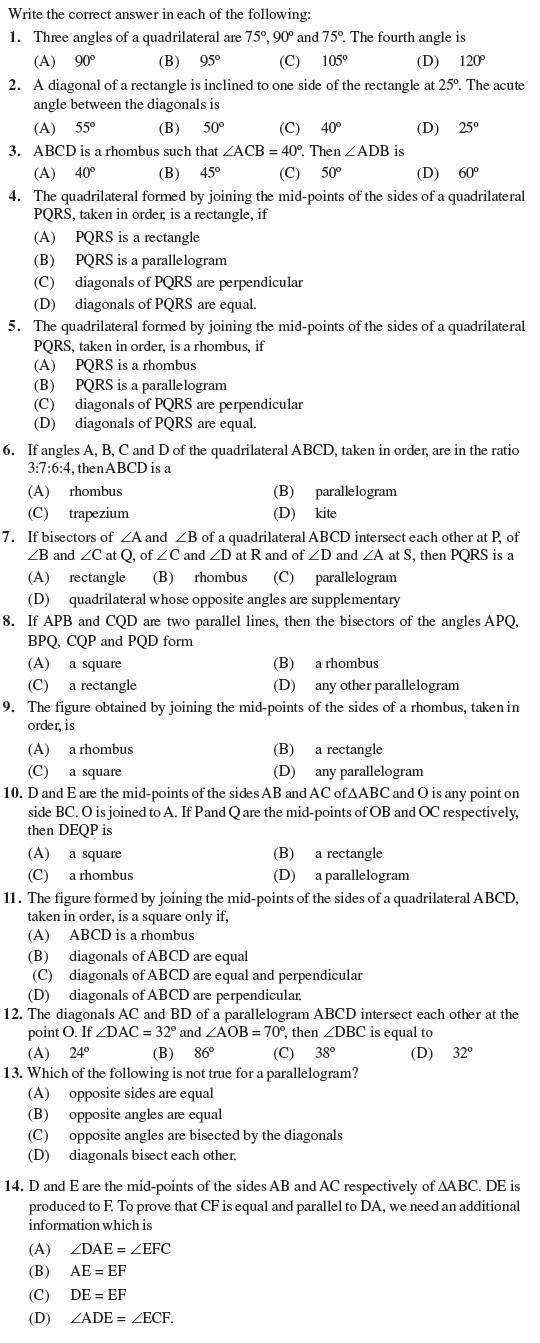
Multiple Choice Questions (Exercise)
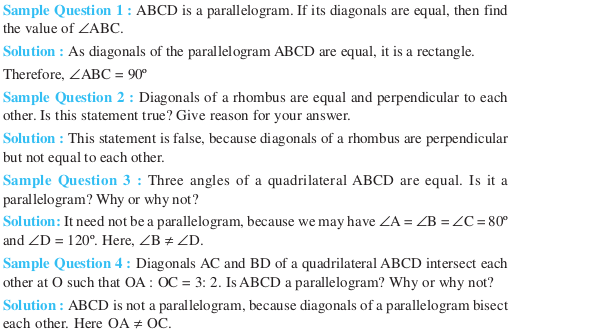
Short Answer Questions with Reasoning (Solved Examples)
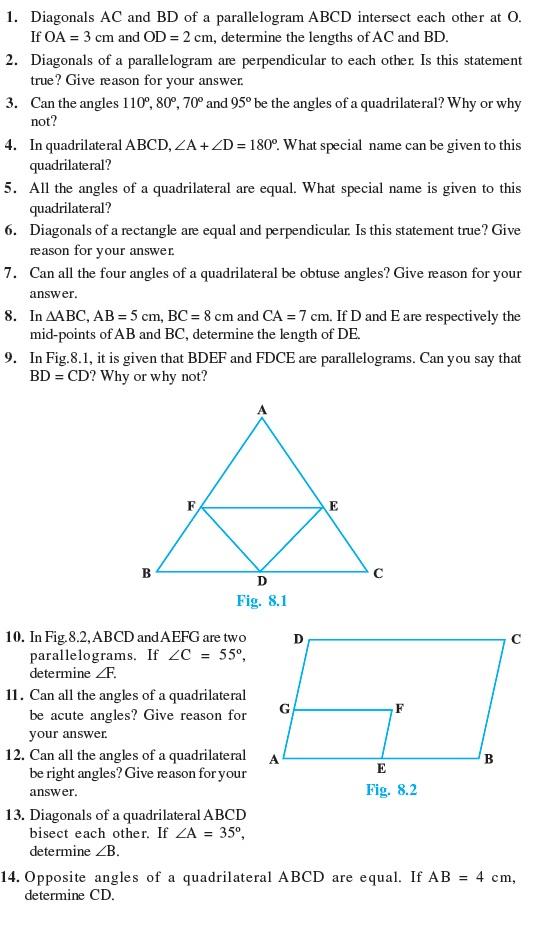
Short Answer Questions with Reasoning (Exercise)
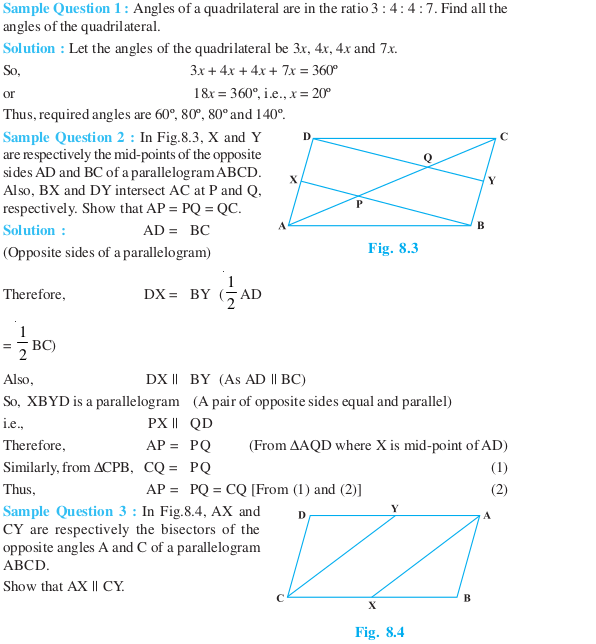
Short Answer Type Questions (Solved Examples)
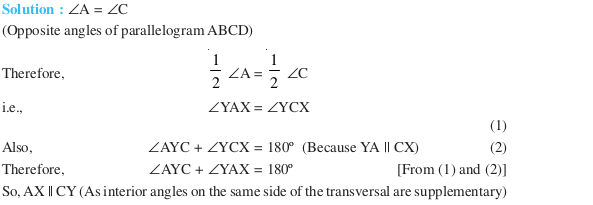
Short Answer Type Questions (Exercise)
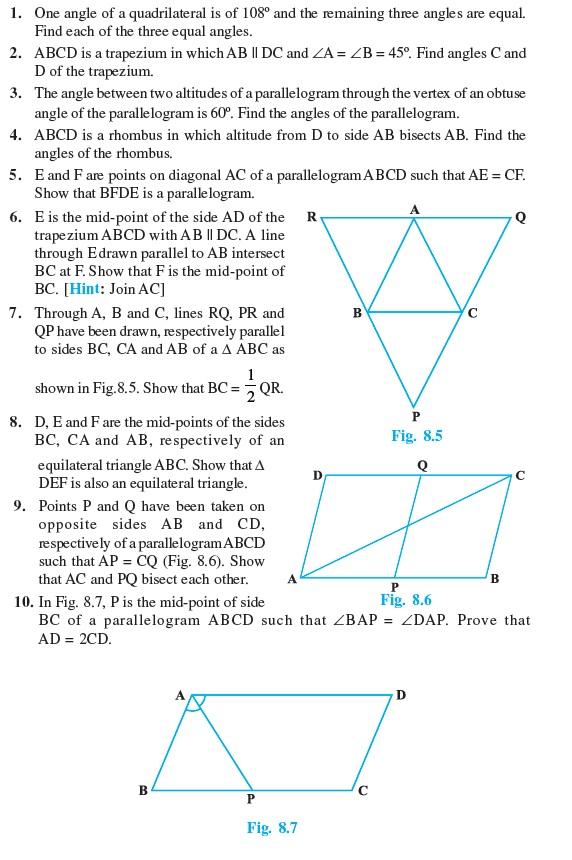
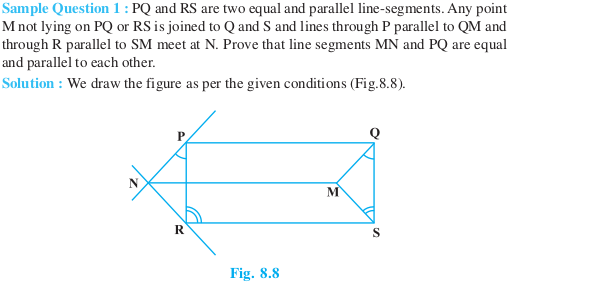
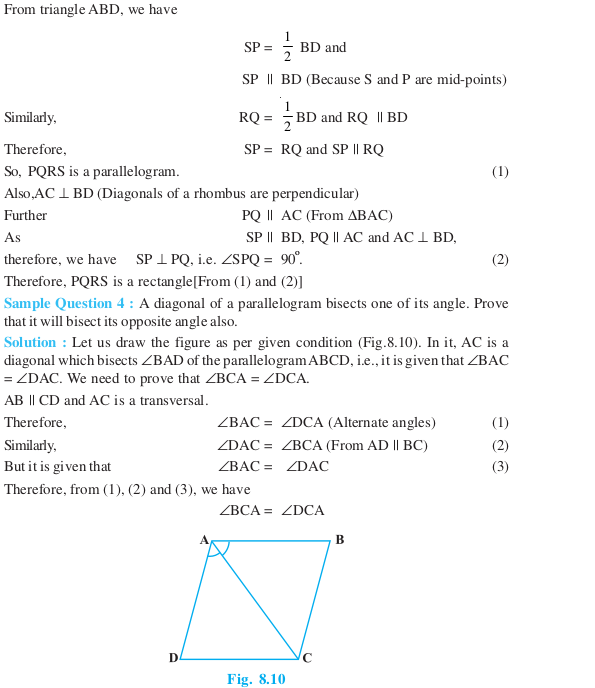
Long Answer Type Questions (Solved Examples)
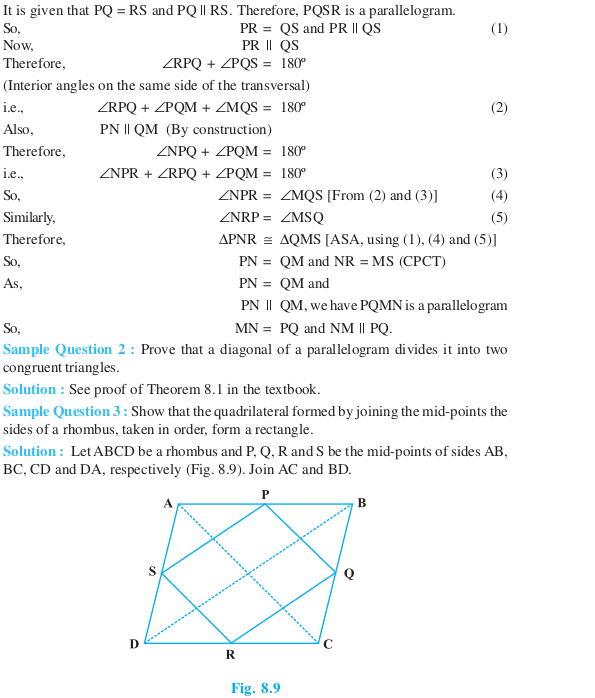
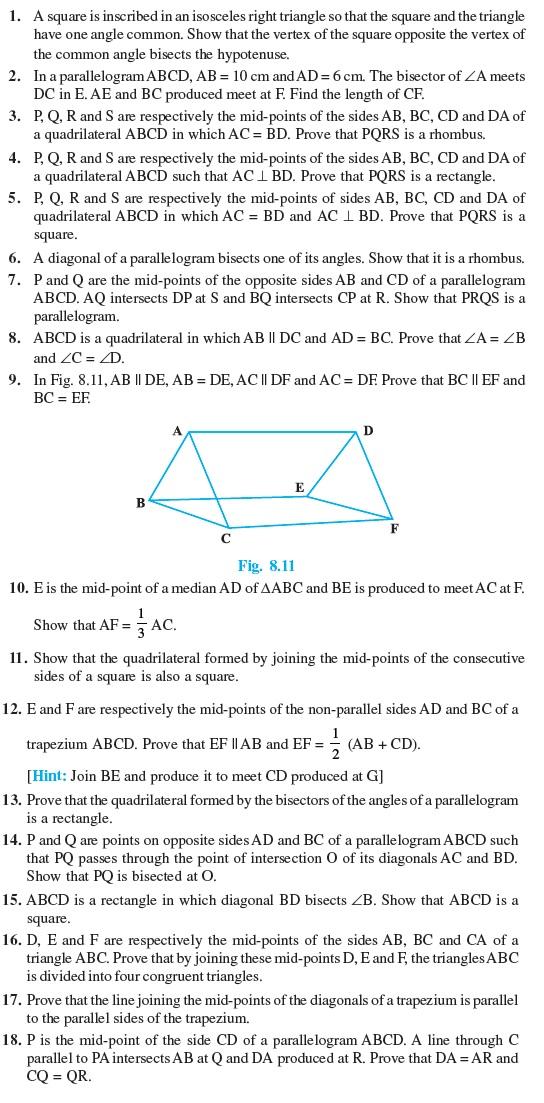
Long Answer Type Questions (Exercise)
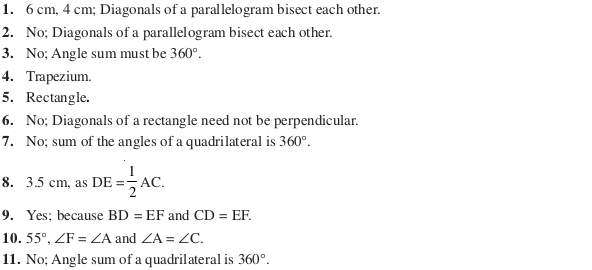
Answers
Multiple Choice Questions (Exercise)

Short Answer Questions with Reasoning (Exercise)

Short Answer Type Questions (Exercise)

Long Answer Type Questions (Exercise)
