Curriculum & Exam Preparation Note: Regular practice of NCERT textbook exercises and chapter-end questions establishes strong conceptual clarity for primary and secondary examinations.
NCERT Exemplar Class 8 Science Chapter 3: Synthetic Fibres and Plastics. NCERT Exemplar Solutions for Class 8 Science Chapter 3 Synthetic Fibres and Plastics prepare students for their Class 8 exams thoroughly.
Science problems and solutions for the Class 8 pdf are provided here which are similar to the questions being asked in the previous year's board.
NCERT Exemplar Class 8 Science Chapter 3: Synthetic Fibres and Plastics
Class 8: Science Chapter 3 solutions. Complete Class 8 Science Chapter 3 Notes.
Multiple Choice Questions
- Pick the synthetic fibre out of the following?
- (a) Cotton
- (b) Nylon
- (c) Jute
- (d) Wool
- Which of the following is a source of rayon?
- (a) Wool
- (b) PET
- (c) Wood pulp
- (d) Silk
- Polycot is obtained by mixing
- (a) nylon and wool
- (b) polyester and wool
- (c) nylon and cotton
- (d) polyester and cotton
- Which is a thermosetting plastic?
- (a) Melamine
- (b) Polythene
- (c) PVC
- (d) Nylon
- The material similar to silk in appearance is
- (a) Nylon
- (b) Rayon
- (c) Polyester
- (d) Terylene
- The most suitable material for the preparation of handles of cooking utensils is
- (a) Polythene
- (b) PVC
- (c) Nylon
- (d) Bakelite
- Which of the following is not a common property of plastics?
- (a) Non-reactive
- (b) Light in weight
- (c) Durable
- (d) Good conductor of electricity
- Which of the following represents the correct match for items in Column A with those in Column B.

- (a) I-(ii), II-(iii), III-(i)
- (b) I-(iii), II-(i), III-(ii)
- (c) I-(ii), II-(i), III-(iii)
- (d) I-(iii), II-(ii), III-(i)
- Which of the following groups contain all synthetic substances?
- (a) Nylon, Terylene, Wool
- (b) Cotton, Polycot, Rayon
- (c) PVC, Polythene, Bakelite
- (d) Acrylic, Silk, Wool
- The material which is commonly used for making kitchen containers is
- (a) PVC
- (b) Acrylic
- (c) Teflon
- (d) PET
Very Short Answer Type Questions
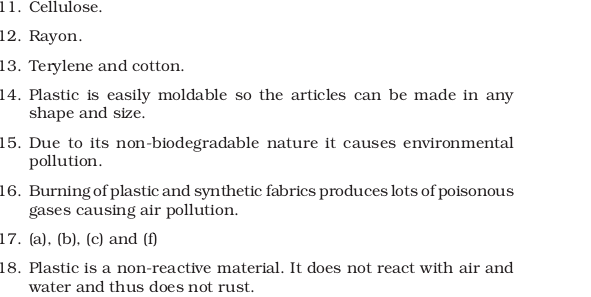
- Cotton is a natural polymer. What is its chemical name?
- A synthetic fiber which looks like silk is obtained by chemical treatment of wood pulp. It is, therefore, known as artificial silk.
What is its common name? - Terrycot is made by mixing two types of fibres. Write the names of the fibres.
- Plastic articles are available in all possible shapes and sizes. Can you tell why?
- Plastic is used for making a large variety of articles of daily use and these articles are very attractive. But it is advised to avoid the use of plastic as far as possible. Why?
- Why is it not advisable to burn plastic and synthetic fabrics?
- Select the articles from the following list which are biodegradable.
- (a) paper
- (b) woolen clothes
- (c) wood
- (d) aluminium can
- (e) plastic bag
- (f) peels of vegetables
- A bucket made of plastic does not rust like a bucket made of iron. Why?
Short Answer Type Questions
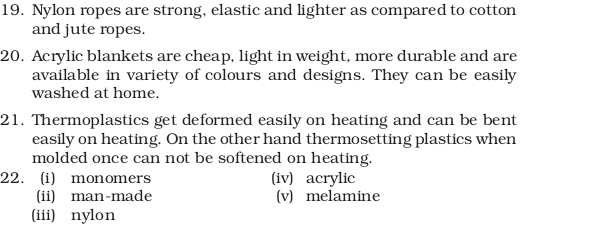
- Rohit took with him some nylon ropes, when he was going for rock climbing. Can you tell why he selected nylon ropes instead of ropes made of cotton or jute?
- A lady went to the market to buy a blanket. The shopkeeper showed her blankets made of acrylic fibres as well as made of wool. She preferred to buy an acrylic blanket. Can you guess why?
- PVC (polyvinyl chloride) is a thermoplastic and is used for making toys, chappals, etc. Bakelite is a thermosetting plastic and is used for making electrical switches, handles of various utensils, etc. Can you write the major difference between these two types of plastics?
- Fill in the blanks.
- (i) A polymer is a chain of many small units joined together which are called ______.
- (ii) The synthetic fibres are also known as ______ fibres.
- (iii) The first fully synthetic fibre was ______.
- (iv) A fibre similar to wool is ______.
- (v) A plastic used for making crockery is ______.
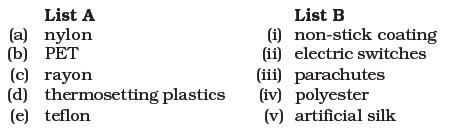
- Match items in List A with the items of list B.
- Unscramble the jumbled words given below, related to synthetic materials.
- (a) anory
- (b) lopmery
- (c) relyteen
- (d) laspict
- (e) yespolter
- (f) felton
Long Answer Type Questions
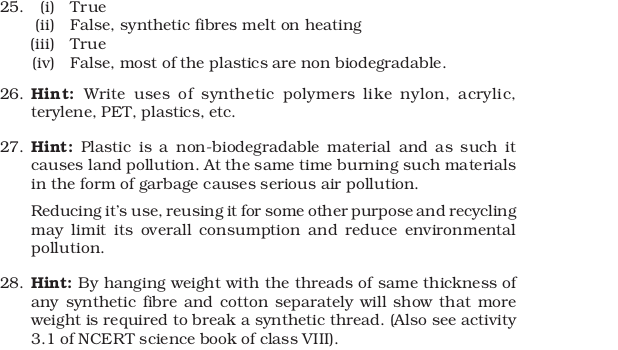
- Indicate whether the following statements are True or False. Also write the false statements in their correct form.
- (i) The fabric terywool is obtained by mixing terylene and wool.
- (ii) Synthetic fibres do not melt on heating.
- (iii) It is risky to wear synthetic clothes while working in the kitchen.
- (iv) Most of the plastics are biodegradable.
- Write the importance of synthetic polymers in our life.
- Despite being very useful it is advised to restrict the use of plastic. Why is it so? Can you suggest some methods to limit its consumption?
- Write an activity to show that synthetic fibres are stronger than the cotton fibres.
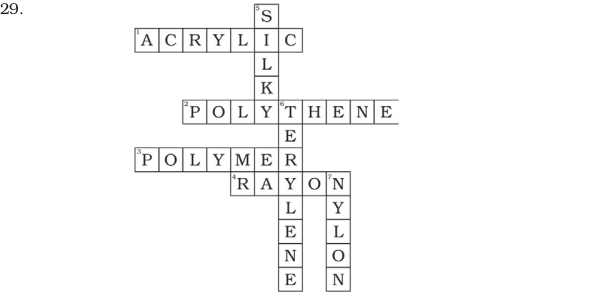
- Complete the crossword given below with the help of clues.
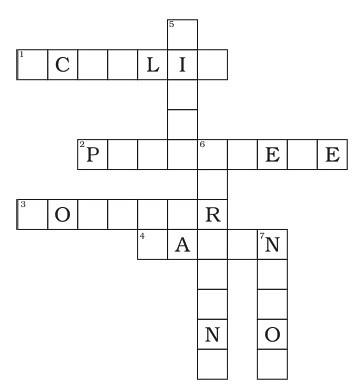
Across- 1. Substance used as synthetic wool (7)
- 2. A plastic used for making containers and carry bags (9)
- 3. Substance made up of large number of smaller molecules (7)
- 4. Another name for this compound is artificial silk (5)
- 5. A type of fibre obtained naturally from cocoon (4)
- 6. A synthetic fibre classified as polyester (8)
- 7. A polymer used for making rope (5)
Answers to Multiple Choice Questions
Multiple Choice Questions

Very Short Questions Questions
Short Answer Questions

Long Answer Questions