Curriculum & Exam Preparation Note: Regular practice of NCERT textbook exercises and chapter-end questions establishes strong conceptual clarity for primary and secondary examinations.
NCERT Exemplar Class 7 Science Chapter 10: Respiration in Organisms. NCERT Exemplar Solutions for Class 7 Science Chapter 10 Respiration in Organisms prepare students for their Class 7 exams thoroughly.
Science problems and solutions for the Class 7 pdf are provided here which are similar to the questions being asked in the previous year's board.
NCERT Exemplar Class 7 Science Chapter 10: Respiration in Organisms
Class 7: Science Chapter 10 solutions. Complete Class 7 Science Chapter 10 Notes.
Multiple Choice Questions
- Sometimes when we do heavy exercise, anaerobic respiration takes place in our muscle cells. What is produced during this process?
- (a) alcohol and lactic acid
- (b) alcohol and CO2
- (c) lactic acid and CO2
- (d) lactic acid only
- Yeast is used in wine and beer industries because it respires
- (a) aerobically producing oxygen.
- (b) aerobically producing alcohol.
- (c) anaerobically producing alcohol.
- (d) anaerobically producing CO2.
- During the process of exhalation, the ribs move
- (a) down and inwards.
- (b) up and inwards.
- (c) down and outwards.
- (d) up and outward.
- Breathing is a process that
(i) provides O2 to the body.
(ii) breaks down food to release energy.
(iii) helps the body to get rid of CO2.
(iv) produces water in the cells.
Which of the following gives the correct combination of functions of breathing?- (a) (i) and (ii)
- (b) (ii) and (iii)
- (c) (i) and (iii)
- (d) (ii) and (iv)
- Fish breathe with the help of gills which are richly supplied with blood vessels. The gills help the fish to
- (a) take in oxygen from air.
- (b) take in oxygen dissolved in water.
- (c) absorb nutrients present in water.
- (d) release waste substances in water.
- Earthworms and frogs breathe through their skin because of which the skin of both the organisms is
- (a) moist and rough.
- (b) dry and rough.
- (c) dry and slimy.
- (d) moist and slimy.
Very Short Answer Type Questions
- Mark the following statements as True or False. Correct the false statements.
- (a) Oxygen breaks down glucose outside the cells of organisms.
- (b) Frogs can breathe through their skin as well as lungs.
- (c) Insects have spiracles on the lower surface of the body.
- (d) Exhaled air has more percentage of CO2 than inhaled air.
- Fill in the blanks with suitable words.
- (a) The roots of a plant take up oxygen from the ______ trapped between the ________ particles.
- (b) Diaphragm forms the ___________ of the chest cavity.
- (c) Exchange of gases in the leaves take place with the help of __________.
- (d) Cockroaches breathe with the help of air tubes called ___________.
Short Answer Type Questions
- Pick the odd-one-out from each of the groups given below on the basis of respiratory organs. Give reason for your answer.
- (a) cockroach, grasshopper, snail, ant
- (b) lizard, cow, earthworm, snake
- (c) crocodile, whale, dolphin, fish
- (d) snake, tadpole, crow, goat
- Which gas present in air is essential for aerobic respiration? What is the role of oxygen during respiration?
- On an average, an adult human being at rest breathes 15–18 times per minute. The breathing rate, however, may differ under different conditions. Arrange the following activities given in the box in order of increasing breathing rates and give reason for your answer.
sleeping, cycling, brisk walk, watching T.V. - On a very cold morning, Boojho and Paheli were talking with each other as they walked down to their school. They observed that the air coming out of their mouth looked like smoke. They were amused and wondered how it happened. Help them find the answer.
- Whenever we feel drowsy or sleepy, we start yawning. Does yawning help us in anyway?
- Insects and leaves of a plant have pores through which they exchange gases with the atmosphere. Can you write two points of differences between these pores with respect to their position, number and extension into the body.
Long Answer Type Questions
- Paheli participated in a 400 m race competition held at her school and won the race. When she came home she had mixed feelings of joy and pain as she had cramps in her leg muscles. After a massage she was relieved of the pain. Answer the following questions related to the situation.
- (a) What can be the possible reasons for the pain in her legs?
- (b) Why did she feel comfortable after a massage?
- Observe Figure 10.1 carefully and answer the following questions.
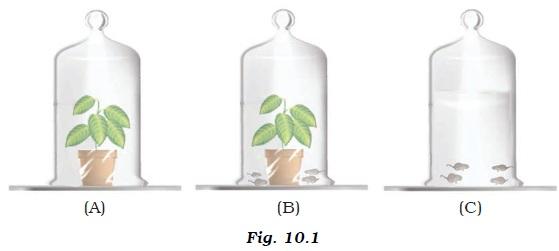
- (a) In which jar, will the amount of CO2 be the highest and why?
- (b) In which jar, will the amount of CO2 be the lowest and why?
- Observe Figure 10.2 carefully and answer the following questions.
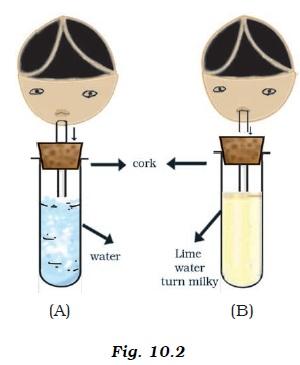
- (a) Which process is being tested in the activity?
- (b) What is the result of the activity? Give reasons.
- A food stall owner was preparing dough for making bhaturas. He added a pinch of yeast and sugar to the dough and left it in a warm place. After few hours, the dough had risen. There was a sour smell too.
- (a) Why did the dough rise?
- (b) Why did the dough smell sour?
- (c) Why was sugar added to the dough?
- (d) What would have happened if the dough was kept in the refrigerator, soon after it was prepared?
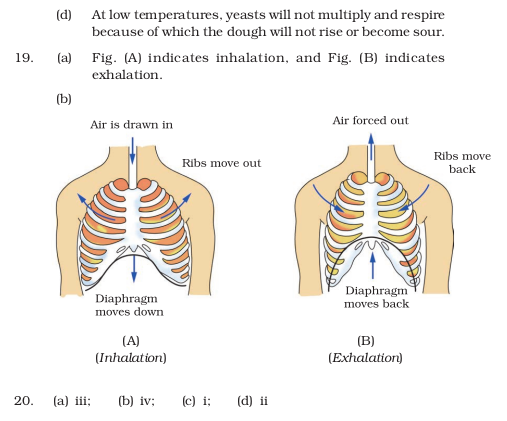
- Observe the figures given as Figure 10.3 (A) and (B) and answer the following.
- (a) Which of the figures A or B indicates the process of inhalation and which the process of exhalation?
- (b) In the figure label the arrows and indicate the direction of
(i) movement of air
(ii) movement of diaphragm
(iii) movement of ribs
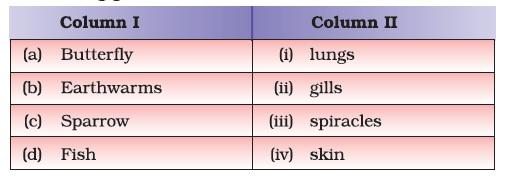
- Match the names of organisms in Column I with their organs of breathing given in Column II.
Answers