Curriculum & Exam Preparation Note: Regular practice of NCERT textbook exercises and chapter-end questions establishes strong conceptual clarity for primary and secondary examinations.
NCERT Exemplar Class 6 Science Chapter 9: The Living Organisms and their Surroundings. NCERT Exemplar Solutions for Class 6 Science Chapter 1 Food : Where Does it Come From ? prepare students for their Class 6 exams thoroughly.
Science problems and solutions for the Class 6 pdf are provided here which are similar to the questions being asked in the previous year's board.
NCERT Exemplar Class 6 Science Chapter 9: The Living Organisms and their Surroundings
Class 6: Science Chapter 9 solutions. Complete Class 6 Science Chapter 9 Notes.
Multiple Choice Questions
- Which of the following cannot be called a habitat?
- (a) A desert with camels.
- (b) A pond with fishes.
- (c) A jungle with wild animals.
- (d) Cultivated land with grazing cattle.
- Following are some features of plants
(i) They lose a lot of water through transpiration.
(ii) Their leaves are always broad and flat.
(iii) They lose very little water through transpiration.
(iv) Their roots grow very deep into the soil.
Which of the combination of above features are typical of desert plants?- (a) (i) and (ii)
- (b) (ii) and (iv)
- (c) (ii) and (iii)
- (d) (iii) and (iv)
- Boojho comes across an animal having a stream-lined and slippery body. What is the habitat of the animal?
- (a) Water
- (b) Desert
- (c) Grassland
- (d) Mountain
- Which of the following are characteristics of living beings ?
(i) Respiration
(ii) Reproduction
(iii) Adaptation
(iv) Excretion
Choose the correct answer from the options below:- (a) (i), (ii) and (iv) only
- (b) (i) and (ii) only
- (c) (ii) and (iv) only
- (d) (i), (ii), (iii) and (iv)
- Earthworms breathe through their
- (a) skin
- (b) gills
- (c) lungs
- (d) stomata
- Which of the following is not an example of response to stimulus?
- (a) Watering in mouth when we see delicious food items.
- (b) Closing of leaves of mimosa plant when touched.
- (c) Shutting our eyes when an object is suddenly thrown in our direction.
- (d) A chick hatching out of an egg.
- Which of the following is correct for respiration in plants?
- (a) Respiration takes place only during day time.
- (b) Respiration takes place only during night.
- (c) Respiration takes place both during day and night.
- (d) Respiration takes place only when plants are not making food.
- Which of the following is an incorrect statement about excretion?
- (a) Excretion takes place in plants.
- (b) Excretion takes place both in plants and animals.
- (c) Excretion is the process of getting rid of excess water only.
- (d) Secretion is one method of excretion.
- Choose the set that represents only the biotic components of a habitat.
- (a) Tiger, Deer, Grass, Soil
- (b) Rocks, Soil, Plants, Air
- (c) Sand, Turtle, Crab, Rocks
- (d) Aquatic plant, Fish, Frog, Insect
- Which one of the following is not associated with reproduction?
- (a) A new leaf coming out of a tree branch.
- (b) A dog giving birth to puppy.
- (c) A seed growing into a plant.
- (d) Chick hatching from an egg.
- Choose the odd one out from below with respect to reproduction.
- (a) Eggs of hen
- (b) Seeds of plants
- (c) Buds of potato
- (d) Roots of mango tree
- Although organisms die, their kind continue to live on earth. Which characteristic of living organisms makes this possible?
- (a) Respiration.
- (b) Reproduction.
- (c) Excretion.
- (d) Movement.
- If you happen to go to a desert, what changes do you expect to observe in the urine you excrete? You would
(i) excrete small amount of urine.
(ii) excrete large amount of urine.
(iii) excrete concentrated urine.
(iv) excrete very dilute urine.
Which of the above would hold true?- (a) (i) and (iii)
- (b) (ii) and (iv)
- (c) (i) and (iv)
- (d) (i) and (ii)
Very Short Answer Type Questions
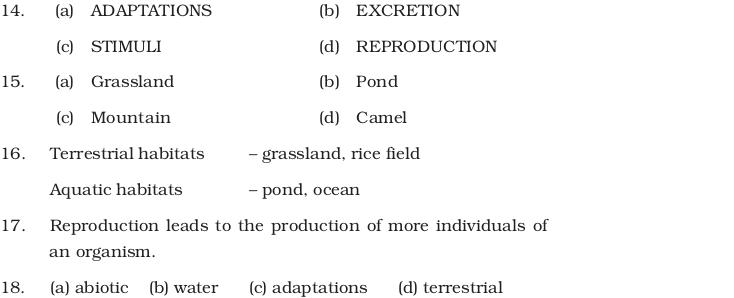
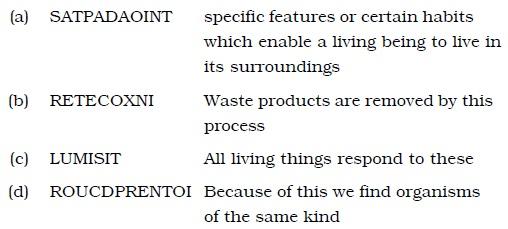
- Unscramble the given words below to get the correct word using the clues given against them.
- Using the following words, write the habitat of each animal given in Fig. 9.1 (a to d).
Grassland, Mountain, Desert, Pond, River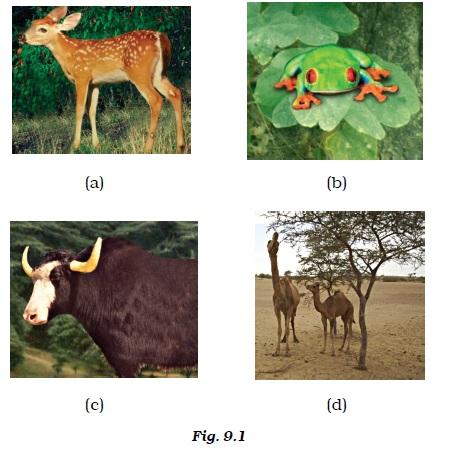
- Classify the following habitats into terrestrial and aquatic types.
Grassland, Pond, Ocean, Rice Field - Why is reproduction important for organisms?
- Fill in the blanks:
- (a) Saline water, hot air and sand are ……………. components of a habitat.
- (b) The habitat of plants and animals that live in ……………. is called the aquatic habitat.
- (c) ……………. enable a plant or an animal to live in its surroundings.
- (d) Plants and animals that live on land are said to live in ……………. habitats.
Short Answer Type Questions
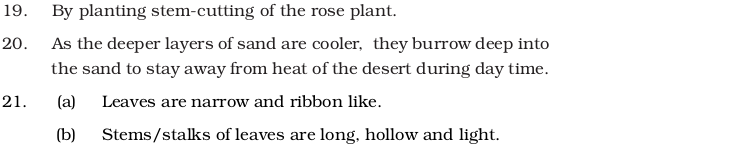
- Paheli has a rose plant in her garden. How can she increase the number of rose plants in the garden?
- Why do desert snakes burrow deep into the sand during the day?
- Write the adaptation in aquatic plants due to which
- (a) submerged leaves can bend in the flowing water.
- (b) leaves can float on the surface of water.
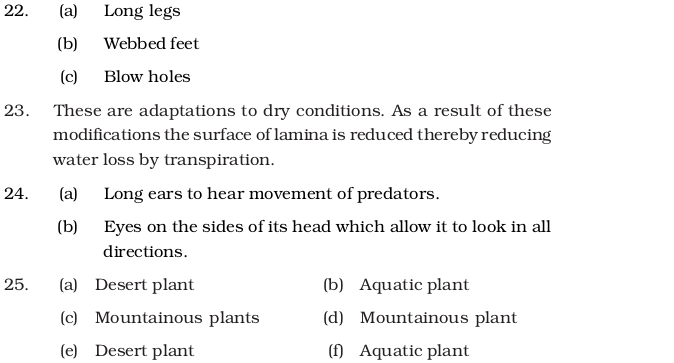
- Mention one adaptation present in the following animals:
- (a) In camels to keep their bodies away from the heat of sand.
- (b) In frogs to enable them to swim.
- (c) In dolphins and whales to breathe in air when they swim near the surface of water.
- Some desert plants have very small leaves whereas some others have only spines. How does this benefit the plants?
- What are the specific features present in a deer that helps it to detect the presence of predators like lion?
- Read the features of plants given below:
- (a) Thick waxy stem
- (b) Short roots
- (c) Cone shaped plants
- (d) Sloping branches
- (e) Small or spine-like leaves
- (f) Hollow stem
- Choose the type of plant for every feature given in a, b, c, d, e and f from the list given below:
- Aquatic plant, Desert plant, Mountainous plant
Long Answer Type Questions
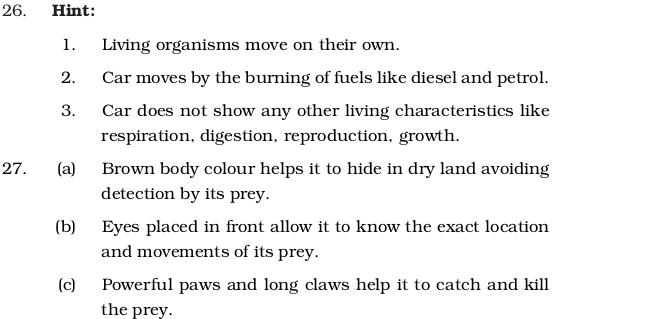
- Like many animals although a car also moves it is not considered as a living organism. Give 2-3 reasons.
- What are the adaptive features of a lion that helps it in hunting?
Answers