Curriculum & Exam Preparation Note: Regular practice of NCERT textbook exercises and chapter-end questions establishes strong conceptual clarity for primary and secondary examinations.
NCERT Exemplar Class 6 Science Chapter 8: Body Movement. NCERT Exemplar Solutions for Class 6 Science Chapter 8 Body Movement prepare students for their Class 6 exams thoroughly.
Science problems and solutions for the Class 6 pdf are provided here which are similar to the questions being asked in the previous year's board.
NCERT Exemplar Class 6 Science Chapter 8: Body Movement
Class 6: Science Chapter 8 solutions. Complete Class 6 Science Chapter 8 Notes.
Multiple Choice Questions
- Which of the following parts of our body help us in movement?
(i) Bones
(ii) Skin
(iii) Muscles
(iv) Organs
Choose the correct answer from the option below.- (a) (i) and (iii)
- (b) (ii) and (iv)
- (c) (i) and (iv)
- (d) (iii) and (ii)
- Which of the following joints is immovable?
- (a) Shoulder and arm
- (b) Knee and joint
- (c) Upper jaw and skull
- (d) Lower jaw and upper jaw
- Which of the following organisms does not have both muscles and skeleton for movement?
- (a) dog
- (b) snail
- (c) earthworm
- (d) human being
- Underwater divers wear fin-like flippers on their feet to
- (a) swim easily in water.
- (b) look like a fish.
- (c) walk on water surface.
- (d) walk over the bottom of the sea (sea bed).
- Snail moves with the help of its
- (a) shell
- (b) bone
- (c) muscular foot
- (d) whole body
- How many muscles work together to move a bone?
- (a) One
- (b) Two
- (c) Three
- (d) Four
Very Short Answer Type Questions
- Name the type of joint of your hand which help you to grasp a badminton racquet.
- What would have happened if our backbone was made of one single bone?
- Provide one word answers to the statements given below.
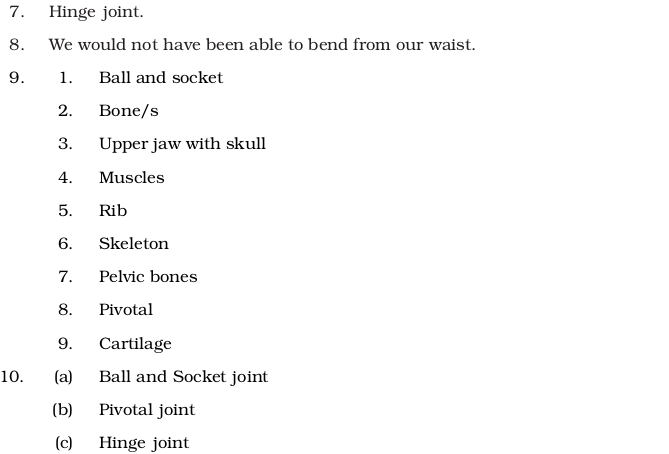
- 1. Joint which allows movement in all directions.
- 2. Hard structure that forms the skeleton.
- 3. Part of the body with a fixed joint.
- 4. Help in the movement of body by contraction and relaxation.
- 5. Bones that join with chest bone at one end and to the backbone at the other end.
- 6. Framework of bones which gives shape to our body.
- 7. Bones which enclose the organs of our body that lie below the abdomen.
- 8. Joint where our neck joins the head.
- 9. Part of the skeleton that forms the earlobe.
- Write the type of joint which is used for each of the following movements:
- (a) A cricket bowler bowls the ball.
- (b) A girl moves her head in right and left direction.
- (c) A person lifts weights to build up his biceps.
Short Answer Type Questions
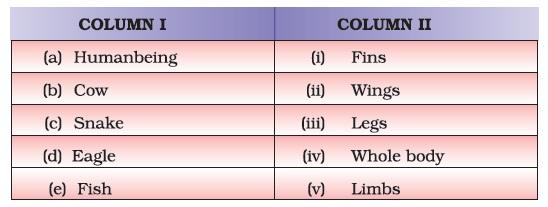
- Match the name of the animals given in Column I with its body parts used for movement given in Column II.
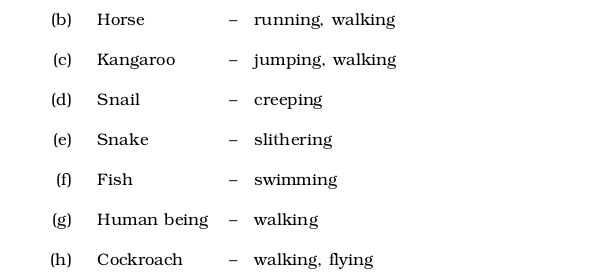
- Given below is a list of different types of movements in animals.

Write the types of movements seen in each animal.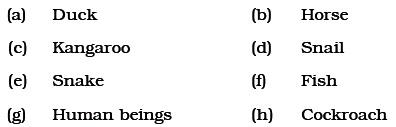
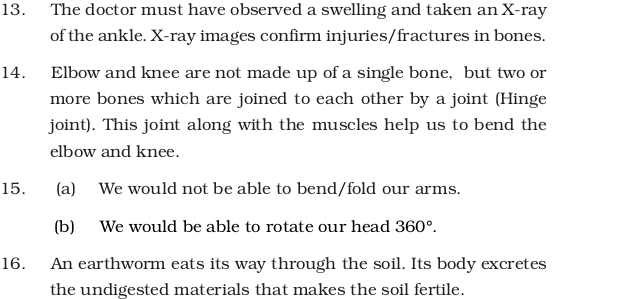
- Boojho fell off a tree and hurt his ankle. On examination the doctor confirmed that the ankle was fractured. How was it detected?
- Bones are hard structures and cannot be bent. But, we can still bend our elbow, knee, etc. How is this possible?
- Which type of movement would have been possible if
- (a) our elbow had a fixed joint.
- (b) we were to have a ball and socket joint between our neck and head.
- Earthworms are known as ‘farmer’s friends’. Why?
Long Answer Type Questions
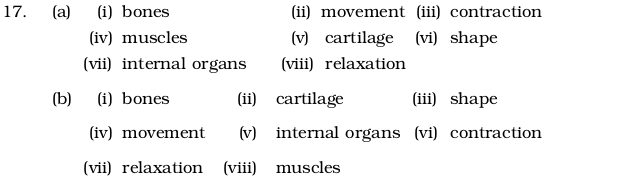
- (a) Unscramble the jumbled words and write them in the blank spaces provided.
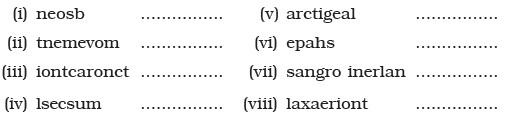
(b) Read the following paragraph and fill in the blanks using the words you unscrambled.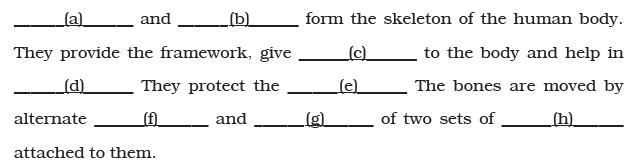
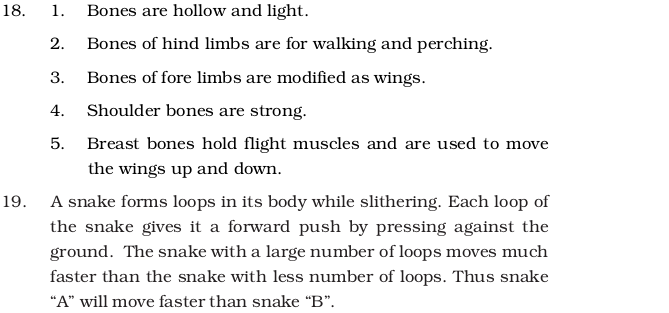
- How is the skeleton of a bird well-suited for flying?
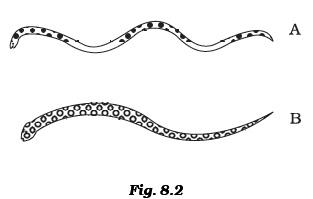
- In Fig. 8.2 there are two snakes of the same size slithering on sand. Can you identify which of them would move faster and why?
Answers