Curriculum & Exam Preparation Note: Regular practice of NCERT textbook exercises and chapter-end questions establishes strong conceptual clarity for primary and secondary examinations.
NCERT Exemplar Class 6 Science Chapter 10: Motion and Measurement of Distances. NCERT Exemplar Solutions for Class 6 Science Chapter 10 Motion and Measurement of Distances prepare students for their Class 6 exams thoroughly.
Science problems and solutions for the Class 6 pdf are provided here which are similar to the questions being asked in the previous year's board.
NCERT Exemplar Class 6 Science Chapter 10: Motion and Measurement of Distances
Class 6: Science Chapter 10 solutions. Complete Class 6 Science Chapter 10 Notes.
Multiple Choice Questions
- The distance between Delhi and Mumbai is usually expressed in units of
- (a) decametre
- (b) metre
- (c) centimetre
- (d) kilometre
- Which of the following does not express a time interval?
- (a) A day
- (b) A second
- (c) A school period
- (d) Time of the first bell in the school
- Fig. 10.1 shows a measuring scale which is usually supplied with a geometry box. Which of the following distance cannot be measured with this scale by using it only once?

- (a) 0.1 m
- (b) 0.15 m
- (c) 0.2 m
- (d) 0.05 m
- A piece of ribbon folded five times is placed along a 30 cm long measuring scale as shown in Fig. 10.2.
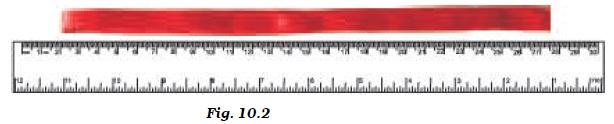
The length of the ribbon is between- (a) 1.15 m – 1.25 m
- (b) 1.25 m – 1.35 m
- (c) 1.50 m – 1.60 m
- (d) 1.60 m – 1.70 m
- Paheli moves on a straight road from point A to point C. She takes 20 minutes to cover a certain distance AB and 30 minutes to cover the rest of distance BC. She then turns back and takes 30 minutes to cover the distance CB and 20 minutes to cover the rest of the distance to her starting point. She makes 5 rounds on the road the same way. Paheli concludes that her motion is
- (a) only rectilinear motion.
- (b) only periodic motion.
- (c) rectilinear and periodic both.
- (d) neither rectilinear nor periodic.
- Bholu and Golu are playing in a ground. They start running from the same point A in the ground and reach point B at the same time by following the paths marked 1 and 2 respectively as shown in Fig. 10.3. Which of the following is/are true for the given situation.
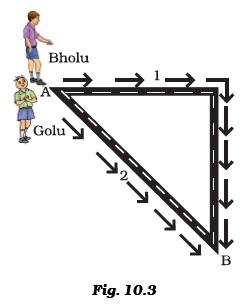
As compared to Golu, Bholu covers a- (a) longer distance but with a lower speed.
- (b) longer distance with a higher speed.
- (c) shorter distance with a lower speed.
- (d) shorter distance with a higher speed.
- Four pieces of wooden sticks A,B,C and D are placed along the length of 30 cm long scale as shown in Fig. 10.4. Which one of them is 3.4 cm in length?
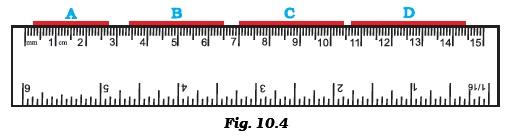
- (a) A
- (b) B
- (c) C
- (d) D
- Which of the following figure shows the correct placement of a block along a scale for measuring its length?

- You are provided three scales A, B and C as shown in Fig. 10.6 to measure a length of 10 cm.
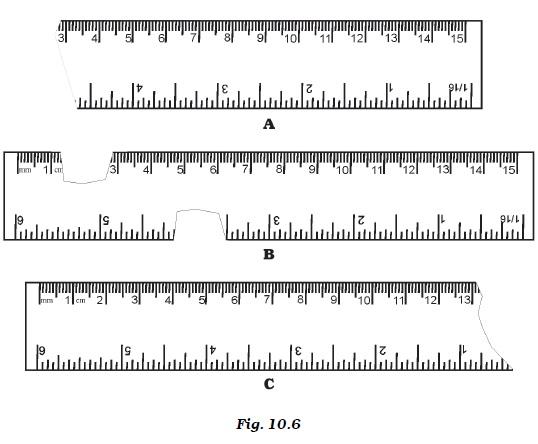
For the correct measurement of the length you will use the scale- (a) A only
- (b) B only.
- (c) C only.
- (d) Any of the three scales.
Very Short Answer Type Questions
- Correct the following.
- (i) The motion of a swing is an example of rectilinear motion.
- (ii) 1m = 1000 cm
- Fill in the blanks
- (i) Motion of an object or a part of it around a fixed point is known as ……………. motion.
- (ii) A body repeating its motion after certain interval of time is in ……….. motion.
- (iii) In rectilinear motion, object moves……….. a ………… line.
- (iv) SI unit of length is …………
- Write one example for each of the following type of motion.
- (i) Rectilinear
- (ii) Circular
- (iii) Periodic
- (iv) Circular and periodic
Short Answer Type Questions
-

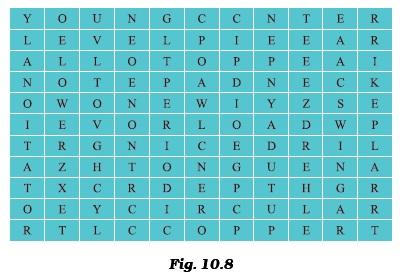
The photograph given as Fig. 10.7 shows a section of a grille made up of straight and curved iron bars. How would you measure the length of the bars of this section, so that the payment could be made to the contractor? - Identify the different types of motion in the following word diagram given as Fig. 10.8.
- Four children measure the length of a table which was about 2 m. Each of them used different ways to measure it.
- (i) Sam measured it with a half metre long thread.
- (ii) Gurmeet measured it with a 15 cm scale from her geometry box.
- (iii) Reena measured it using her hand span.
- (iv) Salim measured it using a 5 m long measuring tape.
Which one of them would get the most accurate length? Give reason for your answer.
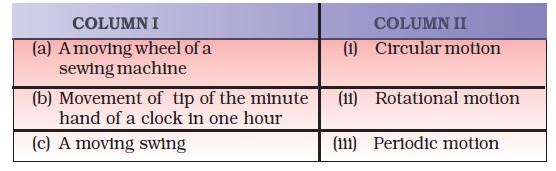
- Match the events related to motion in Column I with the types of motions given in Column II.
Long Answer Type Questions
- While travelling in a train, it appears that the trees near the track are moving whereas co-passengers appear to be stationary. Explain the reason.
- How are the motions of a wheel of a moving bicycle and a mark on the blade of a moving electric fan different? Explain.
- Three students measured the length of a corridor and reported their measurements. The values of their measurements were different. What could be the reason for difference in their measurements? (Mention any three)
- Boojho was riding in his bicycle along a straight road. He classified the motion of various parts of the bicycle as (i) rectilinear motion, (ii) circular motion and (iii) both rectilinear as well as circular motion. Can you list one part of the bicycle for each type of motion? Support your answer with reason.
Answers