NCERT Exemplar Class 11 Maths Chapter 7: Permutations and Combinations. NCERT Exemplar Solutions for Class 11 Maths Chapter 7 Permutations and Combinations prepare students for their Class 11 exams thoroughly.
Maths problems and solutions for the Class 11 pdf are provided here which are similar to the questions being asked in the previous year's board.
NCERT Exemplar Class 11 Maths Chapter 7: Permutations and Combinations
Class 11: Maths Chapter 7 solutions. Complete Class 11 Maths Chapter 7 Notes.
7.1 Overview
The study of permutations and combinations is concerned with determining the number
of different ways of arranging and selecting objects out of a given number of objects,
without actually listing them. There are some basic counting techniques which will be
useful in determining the number of different ways of arranging or selecting objects.
The two basic counting principles are given below:
Fundamental principle of counting
7.1.1 Multiplication principle (Fundamental Principle of Counting)
Suppose an event E can occur in m different ways and associated with each way of
occurring of E, another event F can occur in n different ways, then the total number of
occurrence of the two events in the given order is m × n .
7.1.2 Addition principle
If an event E can occur in m ways and another event F can occur in n ways, and
suppose that both can not occur together, then E or F can occur in m + n ways.
7.1.3 Permutations A permutation is an arrangement of objects in a definite order.
7.1.4 Permutation of n different objects The number of permutations of n objects
taken all at a time, denoted by the symbol ⁿPn , is given by

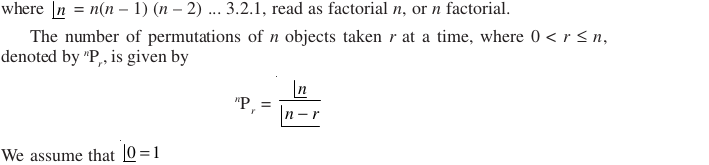



7.1.5 When repetition of objects is allowed The number of permutations of n things
taken all at a time, when repetion of objects is allowed is nⁿ .
Solved Examples
Example 1: In a class, there are 27 boys and 14 girls. The teacher wants to select 1
boy and 1 girl to represent the class for a function. In how many ways can the teacher
make this selection?
Solutions: Here the teacher is to perform two operations:
(i) Selecting a boy from among the 27 boys and
(ii) Selecting a girl from among 14 girls.
The first of these can be done in 27 ways and second can be performed in 14 ways. By the fundamental principle of counting, the required number of ways is 27 × 14 = 378.

Example 2:
(i) How many numbers are there between 99 and 1000 having 7 in the units place?
(ii) How many numbers are there between 99 and 1000 having atleast one of their
digits 7?
Solution:
(i) First note that all these numbers have three digits. 7 is in the unit’s place. The
middle digit can be any one of the 10 digits from 0 to 9. The digit in hundred’s
place can be any one of the 9 digits from 1 to 9. Therefore, by the fundamental
principle of counting, there are 10 × 9 = 90 numbers between 99 and 1000 having 7 in the unit’s place.
(ii) Total number of 3 digit numbers having atleast one of their digits as 7 = (Total
numbers of three digit numbers) – (Total number of 3 digit numbers in which 7 does not appear at all).
= (9 × 10 × 10) – (8 × 9 × 9)
= 900 – 648 = 252.
Example 3: In how many ways can this diagram be coloured subject to the following
two conditions?
(i) Each of the smaller triangle is to be painted with one of three colours: red, blue or green.
(ii) No two adjacent regions have the same colour.
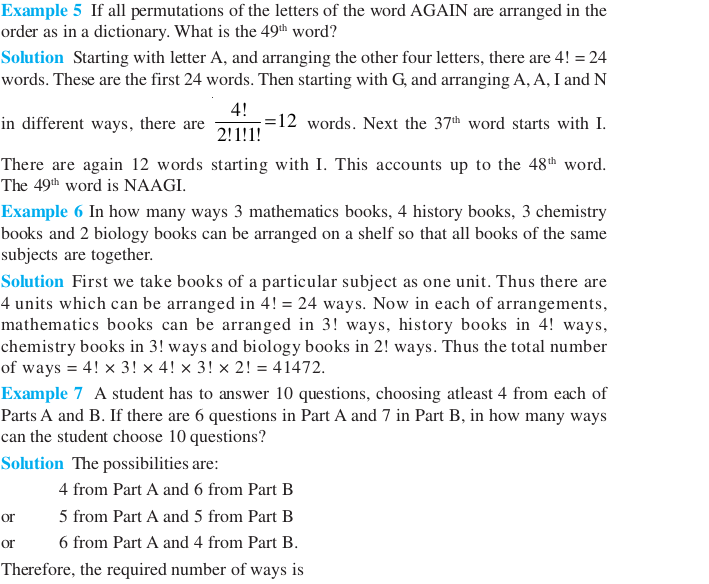
Solution: These conditions are satisfied exactly when we do as follows: First paint the
central triangle in any one of the three colours. Next paint the remaining 3 triangles,
with any one of the remaining two colours.
By the fundamental principle of counting, this can be done in 3 × 2 × 2 × 2 = 24 ways.

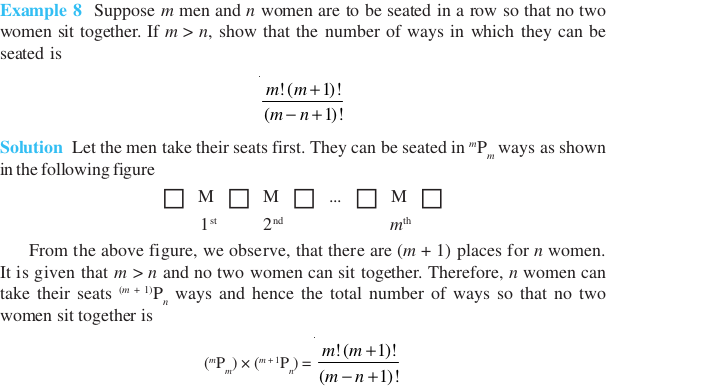
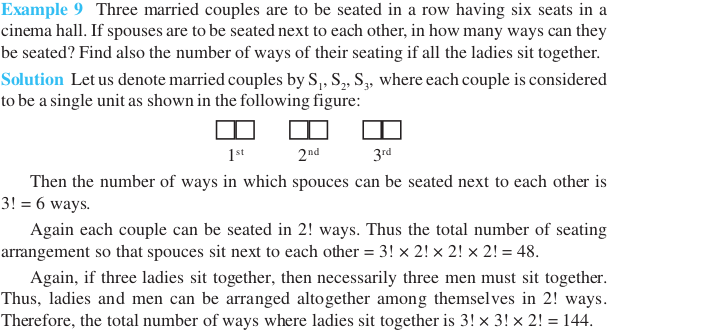
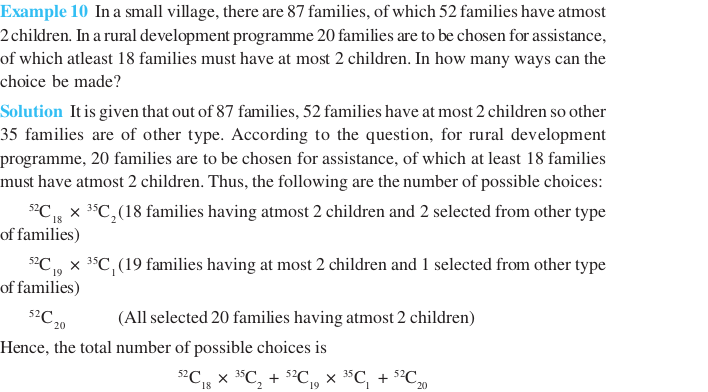
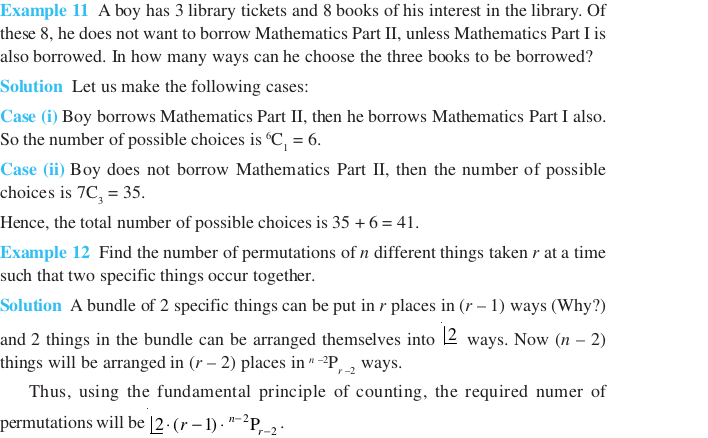
Example 4: In how many ways can 5 children be arranged in a line such that (i) two particular children of them are always together (ii) two particular children of them are never together.
Solution:
(i) We consider the arrangements by taking 2 particular children together as one
and hence the remaining 4 can be arranged in 4! = 24 ways. Again two particular
children taken together can be arranged in two ways. Therefore, there are
24 × 2 = 48 total ways of arrangement.
(ii) Among the 5! = 120 permutations of 5 children, there are 48 in which two children
are together. In the remaining 120 – 48 = 72 permutations, two particular children
are never together.
Long Answer Type
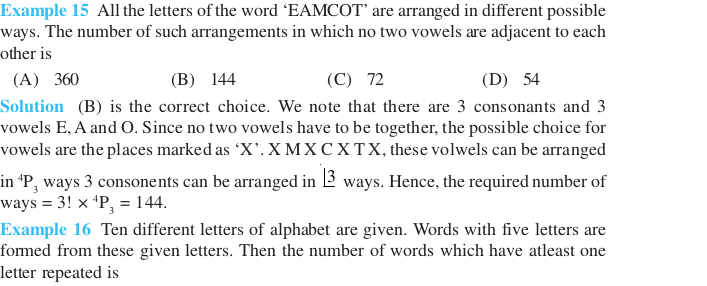
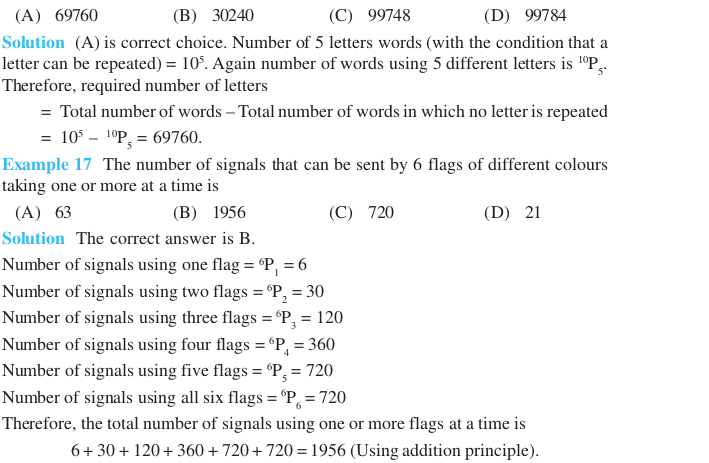
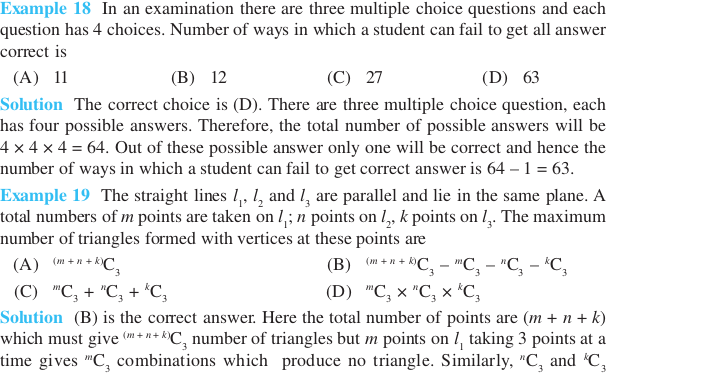

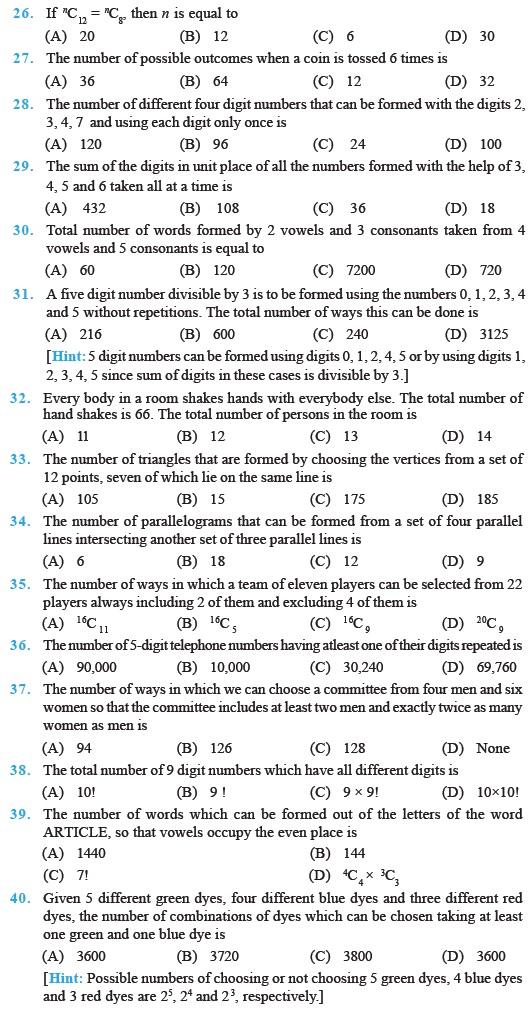
Objective Type Questions
Choose the correct answer out of four options given against each of the following
Examples (M.C.Q.).
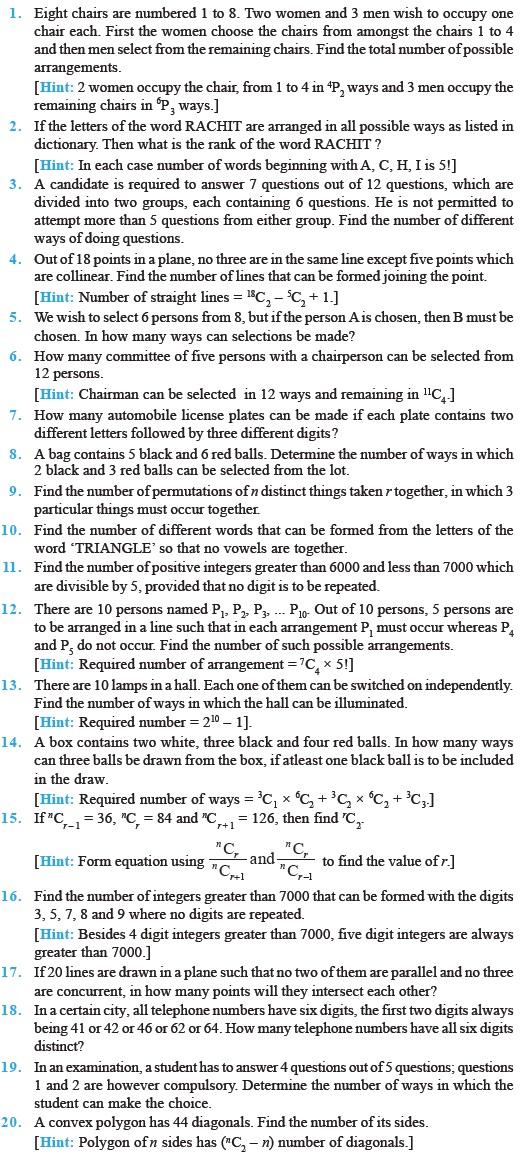
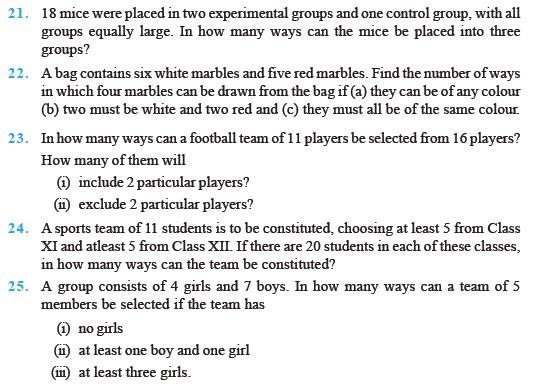
Short Type Questions
Long Type Questions
Objective Type Questions
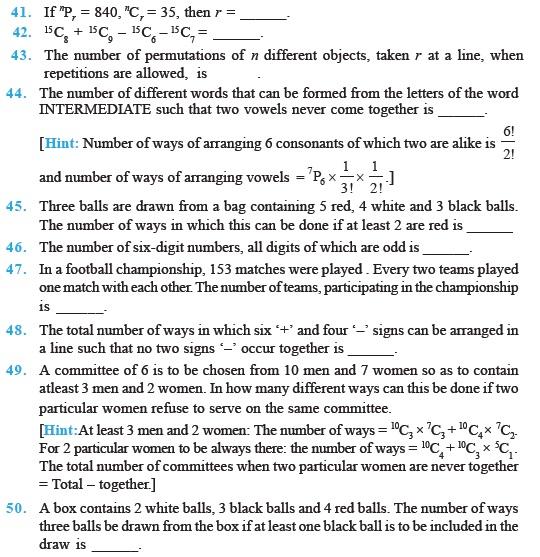
Fill in the Blanks Type Questions
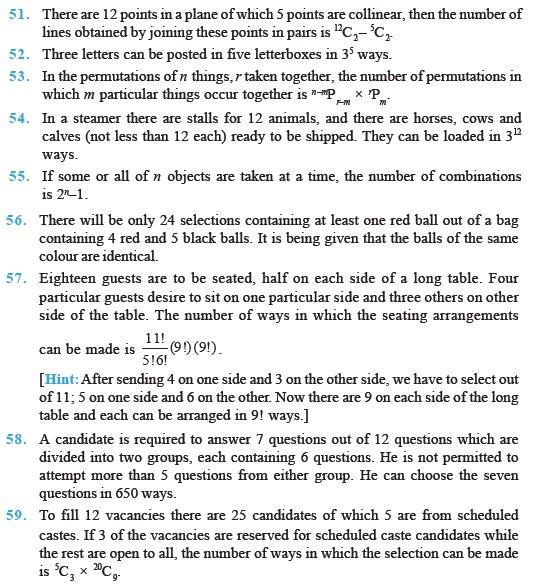
True or False Type Questions
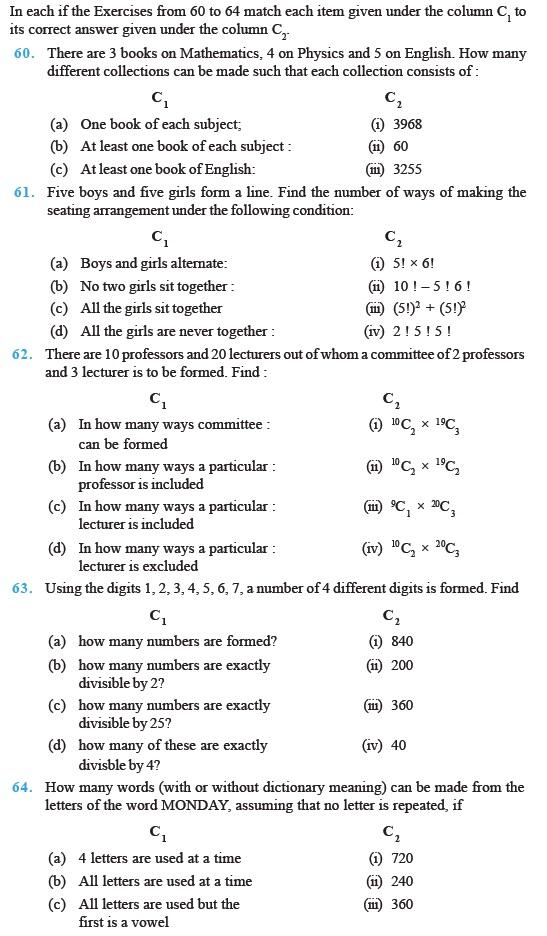
Match Type Questions
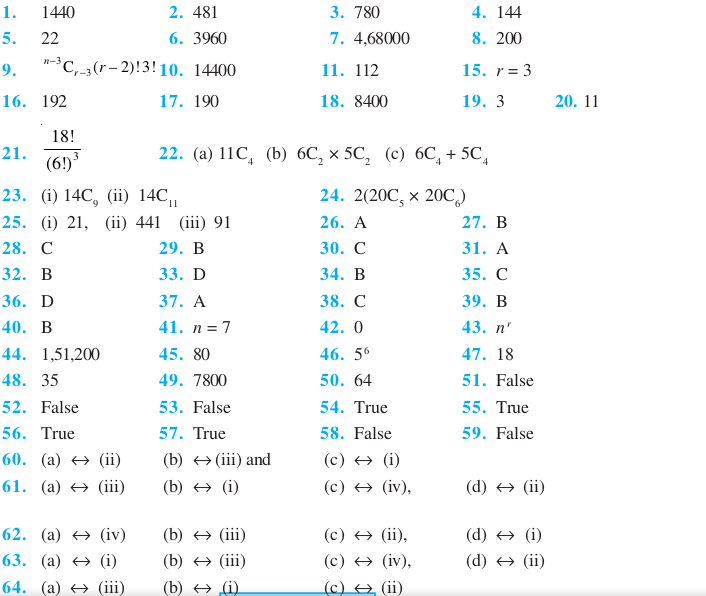
Answers to Objective Type Questions