Curriculum & Exam Preparation Note: Regular practice of NCERT textbook exercises and chapter-end questions establishes strong conceptual clarity for primary and secondary examinations.
NCERT Exemplar Class 10 Science Chapter 11: Human Eye and Colourful World. NCERT Exemplar Solutions for Class 10 Science Chapter 11 Human Eye and Colourful World prepare students for their Class 10 exams thoroughly.
Science problems and solutions for the Class 10 pdf are provided here which are similar to the questions being asked in the previous year's board.
NCERT Exemplar Class 10 Science Chapter 11: Human Eye and Colourful World
Class 10 : Science Chapter 11 solutions. Complete Class 10 Science Chapter 11 Notes.
Multiple Choice Questions
- A person cannot see distinctly objects kept beyond 2 m. This defect can be corrected by using a lens of power
(a) + 0.5 D
(b) – 0.5 D
(c) + 0.2 D
(d) – 0.2 D - A student sitting on the last bench can read the letters written on he blackboard but is not able to read the letters written in his text book. Which of the following statements is correct?
(a) The near point of his eyes has receded away
(b) The near point of his eyes has come closer to him
(c) The far point of his eyes has come closer to him
(d) The far point of his eyes has receded away - A prism ABC (with BC as base) is placed in different orientations. A narrow beam of white light is incident on the prism as shown in Figure 11.1. In which of the following cases, after dispersion, the third colour from the top corresponds to the colour of the sky?
(a) (i)
(b) (ii)
(c) (iii)
(d) (iv)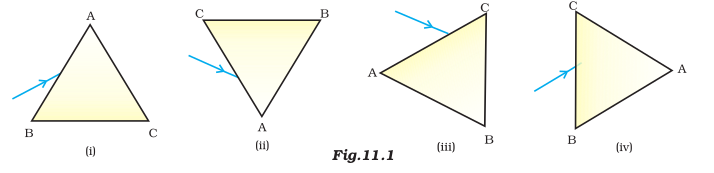
- At noon the sun appears white as
(a) light is least scattered
(b) all the colours of the white light are scattered away
(c) blue colour is scattered the most
(d) red colour is scattered the most - Which of the following phenomena of light are involved in the formation of a rainbow?
(a) Reflection, refraction and dispersion
(b) Refraction, dispersion and total internal reflection
(c) Refraction, dispersion and internal reflection
(d) Dispersion, scattering and total internal reflection - Twinkling of stars is due to atmospheric
(a) dispersion of light by water droplets
(b) refraction of light by different layers of varying refractive indices
(c) scattering of light by dust particles
(d) internal reflection of light by clouds - The clear sky appears blue because
(a) blue light gets absorbed in the atmosphere
(b) ultraviolet radiations are absorbed in the atmosphere
(c) violet and blue lights get scattered more than lights of all other colours by the atmosphere
(d) light of all other colours is scattered more than the violet and blue colour lights by the atmosphere - Which of the following statements is correct regarding the propagation of light of different colours of white light in air?
(a) Red light moves fastest
(b) Blue light moves faster than green light
(c) All the colours of the white light move with the same speed
(d) Yellow light moves with the mean speed as that of the red and the violet light - The danger signals installed at the top of tall buildings are red in colour. These can be easily seen from a distance because among all other colours, the red light
(a) is scattered the most by smoke or fog
(b) is scattered the least by smoke or fog
(c) is absorbed the most by smoke or fog
(d) moves fastest in air - Which of the following phenomena contributes significantly to the reddish appearance of the sun at sunrise or sunset?
(a) Dispersion of light
(b) Scattering of light
(c) Total internal reflection of light
(d) Reflection of light from the earth - The bluish colour of water in deep sea is due to
(a) the presence of algae and other plants found in water
(b) reflection of sky in water
(c) scattering of light
(d) absorption of light by the sea - When light rays enter the eye, most of the refraction occurs at the
(a) crystalline lens
(b) outer surface of the cornea
(c) iris
(d) pupil - The focal length of the eye lens increases when eye muscles
(a) are relaxed and lens becomes thinner
(b) contract and lens becomes thicker
(c) are relaxed and lens becomes thicker
(d) contract and lens becomes thinner - Which of the following statement is correct?
(a) A person with myopia can see distant objects clearly
(b) A person with hypermetropia can see nearby objects clearly
(c) A person with myopia can see nearby objects clearly
(d) A person with hypermetropia cannot see distant objects clearly
Short Answer Type Questions
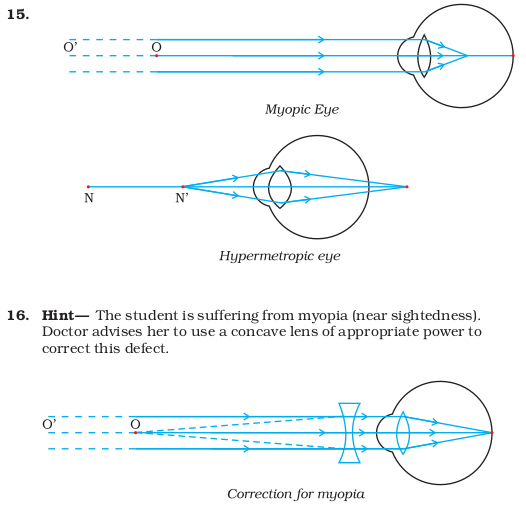
- Draw ray diagrams each showing
(i) myopic eye and
(ii) hypermetropic eye. - A student sitting at the back of the classroom cannot read clearly the letters written on the blackboard. What advice will a doctor give to her? Draw ray diagram for the correction of this defect.
- How are we able to see nearby and also the distant objects clearly?
- A person needs a lens of power –4.5 D for correction of her vision.
(a) What kind of defect in vision is she suffering from?
(b) What is the focal length of the corrective lens?
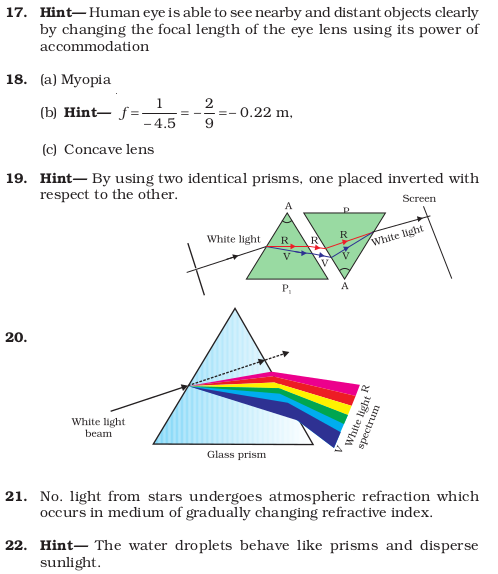
(c) What is the nature of the corrective lens? - How will you use two identical prisms so that a narrow beam of white light incident on one prism emerges out of the second prism as white light? Draw the diagram.
- Draw a ray diagram showing the dispersion through a prism when a narrow beam of white light is incident on one of its refracting surfaces. Also indicate the order of the colours of the spectrum obtained.
- Is the position of a star as seen by us its true position? Justify your answer.
- Why do we see a rainbow in the sky only after rainfall?
- Why is the colour of the clear sky blue?
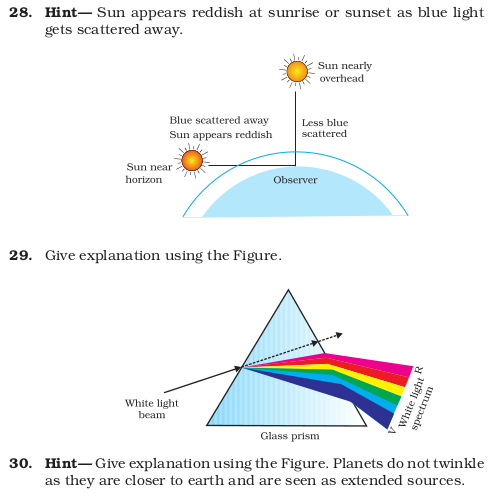
- What is the difference in colours of the Sun observed during sunrise/sunset and noon? Give explanation for each.
Long Answer Type Questions
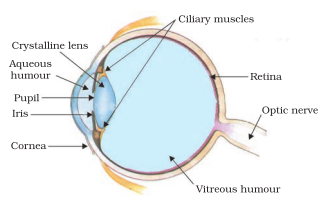
- Explain the structure and functioning of Human eye. How are we able to see nearby as well as distant objects?
- When do we consider a person to be myopic or hypermetropic? Explain using diagrams how the defects associated with myopic and hypermetropic eye can be corrected?
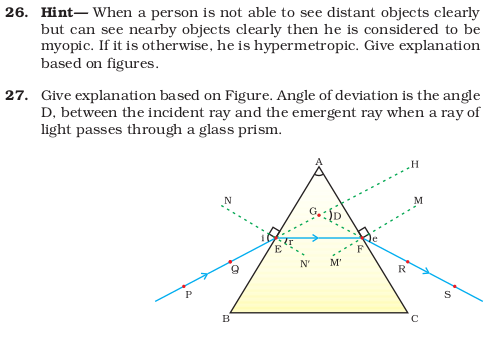
- Explain the refraction of light through a triangular glass prism using a labelled ray diagram. Hence define the angle of deviation.
- How can we explain the reddish appearance of sun at sunrise or sunset? Why does it not appear red at noon?
- Explain the phenomenon of dispersion of white light through a glass prism, using suitable ray diagram.
- How does refraction take place in the atmosphere? Why do stars twinkle but not the planets ?
Click here to download NCERT Exemplar Class 10 Science for Unit 11 Human Eye and Colourful World.
Answers
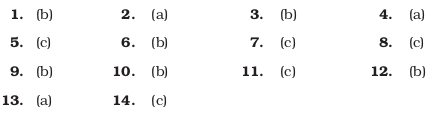
Multiple Choice Questions
Short Answer Questions


Long Answer Questions