
Class 9: Maths Chapter 8 solutions. Complete Class 9 Maths Chapter 8 Notes.
ML Aggarwal Solutions for Class 9 Maths Chapter 8- Indices
ML Aggarwal 9th Maths Chapter 8, Class 9 Maths Chapter 8 solutions
Exercise 8
Simplify the following (1 to 20):
1. (i) (81/16)-3/4
Solution:
(81/16)-3/4
= [(34/24)]-3/4
= [(3/2)4]-3/4
= (3/2)-3/4 x 4
= (3/2)-3
= (2/3)3
= 23/33
= (2 x 2 x 2)/(3 x 3 x 3)
= 8/27
(ii) 
Solution:
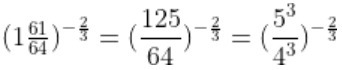
= (5/4)3 x -2/3
= (5/4)-2
= (4/5)2
= 16/25
2. (i) (2a-3b2)3
Solution:
(2a-3b2)3
= 23 a -3×3 b 2×3
= 8a-1b6
(ii) (a-1 + b-1)/(ab)-1
Solution:

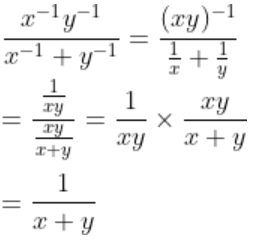
3. (i) (x-1 y-1)/(x-1 + y-1)
Solution:
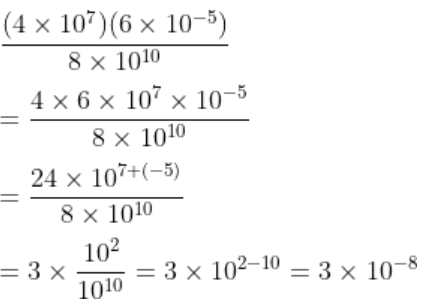
(ii) (4 x 10⁷) (6 x 10⁻⁵)/(8 x 1010)
Solution:
4. (i) 3a/b-1 + 2b/a-1
Solution:
3a/b-1 + 2b/a-1
= 3a/(1/b) + 2b/(1/a)
= (3a x b)/1 + (2b x a)/1
= 3ab + 2ab = 5ab
(ii) 50 x 4-1 + 81/3
Solution:
50 x 4-1 + 81/3
= 1 x (1/4) + (2)3 x 1/3
= ¼ + 2
= (1 + 8)/4
= 9/4 = 2¼
5. (i) (8/125)-1/3
Solution:
(8/125)-1/3
= [(2 x 2 x 2)/(5 x 5 x 5)]-1/3
= (23/53)-1/3
= (2/5)3 x -1/3
= (2/5)-1
= 5/2 = 2½
(ii) (0.027)-1/3
Solution:
(0.027)-1/3
= (27/1000)-1/3
= [(3 x 3 x 3)/(10 x 10 x 10)]-1/3
= (33/103)-1/3
= (3/10)3 x -1/3
= (3/10)-1
= 10/3
6. (i) (-1/27)-2/3
Solution:
(-1/27)-2/3
= (-1/33)-2/3
= (-1/3)3 x -2/3
= (-1/3)-2
= (-3)2
= 9
(ii) (64)-2/3 ÷ 9-3/2
Solution:
(64)-2/3 ÷ 9-3/2
We can write it as
= (43)-2/3 ÷ (32)-3/2
By further calculation
= 4 3 ×- 2/3 ÷ 3 2 × -3/2
So we get
= 4-2 ÷ 3-3
= 4-2/ 3-3
It can be written as
= 1/42 / 1/33
= 33/42
We get
= 27/16
= 1 11/16
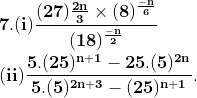
Solution:
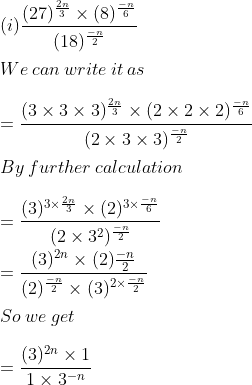
It can be written as
= (3)2n × (3)n
= 3 2n + n
= 33n
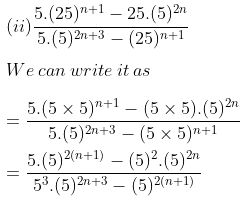
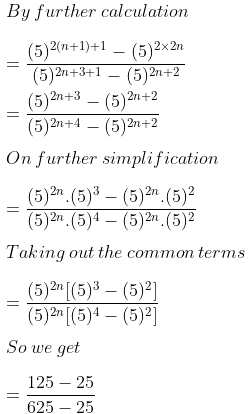
= 100/600
= 1/6
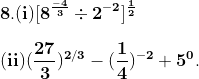
Solution:
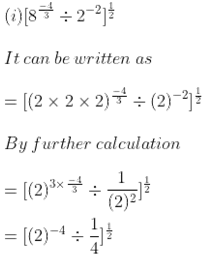
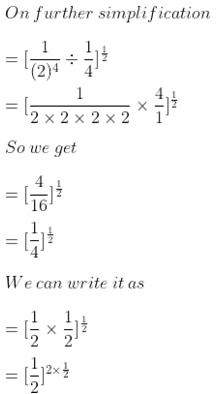
= (1/2)1
= ½

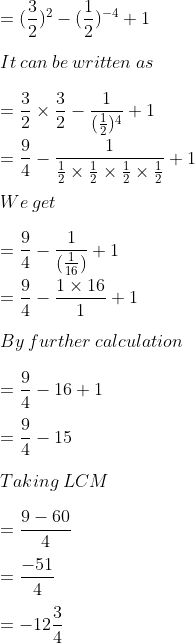
9. (i) (3x2)-3 × (x9)2/3
(ii) (8x4)1/3 ÷ x1/3.
Solution:
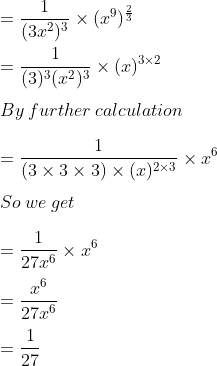
(i) (3x2)-3 × (x9)2/3
We can write it as
(ii) (8x4)1/3 ÷ x1/3
We can write it as

= 2 × x3/3
So we get
= 2 × x1
= 2 × x
= 2x
10. (i) (32)0 + 3-4 × 36 + (1/3)-2
(ii) 95/2 – 3.(5)0 – (1/81)-1/2
Solution:
(i) (32)0 + 3-4 × 36 + (1/3)-2
We can write it as
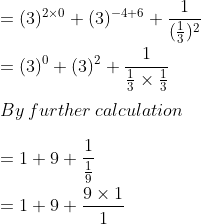
So we get
= 1 + 9 + 9
= 19
(ii) 95/2 – 3.(5)0 – (1/81)-1/2
We can write it as
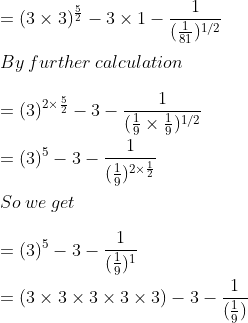
Here
= 243 – 3 – (9 × 1)/1
= 240 – 9
= 231
11. (i) 163/4 + 2 (1/2)-1 (3)0
(ii) (81)3/4 – (1/32)-2/5 + (8)1/3 (1/2)-1 (2)0.
Solution:
(i) 163/4 + 2 (1/2)-1 (3)0
We can write it as
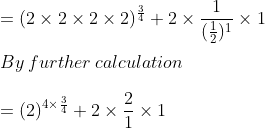
So we get
= (2)3 + 4
= 2 × 2 × 2 + 4
= 8 + 4
= 12
(ii) (81)3/4 – (1/32)-2/5 + (8)1/3 (1/2)-1 (2)0
We can write it as
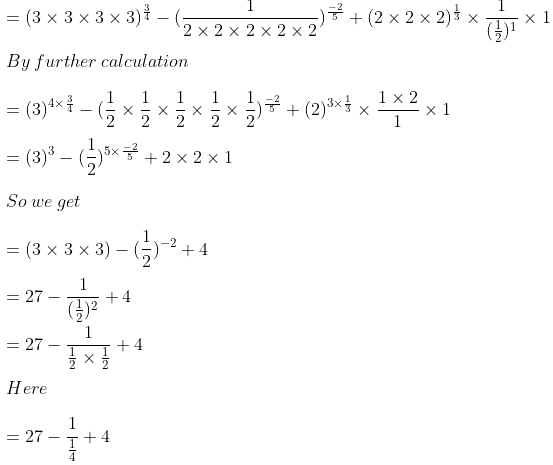
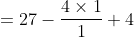
= 27 – 4 + 4
= 27
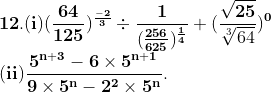
Solution:

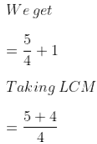
= 9/4
= 2 ¼
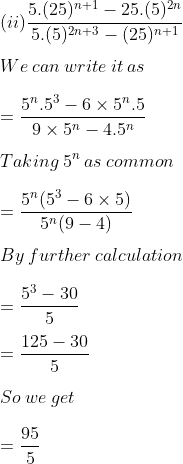
= 19
13. (i) [(64)-2/3 2-2 + 80]-1/2
(ii) 3n × 9n + 1 ÷ (3n – 1 × 9n – 1).
Solution:
(i) [(64)-2/3 2-2 + 80]-1/2
We can write it as

= [4 × 1 × 1]-1/2
= (4)-1/2
Here
= (2 × 2)-1/2
= (2)2 × -1/2
= (2)-1
= 1/(2)1
= ½
(ii) 3n × 9n + 1 ÷ (3n – 1 × 9n – 1)
We can write it as
= 3n × (3 × 3)n + 1 ÷ (3n – 1 × (3 × 3)n – 1)
By further calculation
= 3n × (3)2 × (n + 1) ÷ (3n – 1 × (3)2(n-1)])
= 3n × (3)2n + 2 ÷ (3n – 1 × (3)2n – 2)
So we get
= (3)n + 2n + 2 ÷ (3)n – 1 + 2n – 2
= (3)3n + 2 ÷ (3)3n – 3
Here
= (3)3n + 2 – 3n + 3
= (3)5
We get
= 3 × 3 × 3 × 3 × 3
= 243
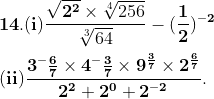
Solution:
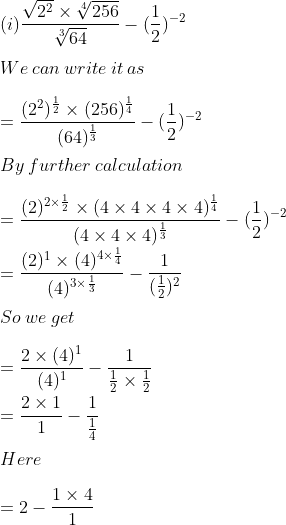
= 2 – 4
= – 2
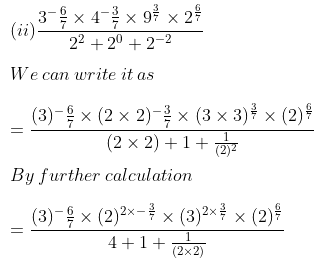
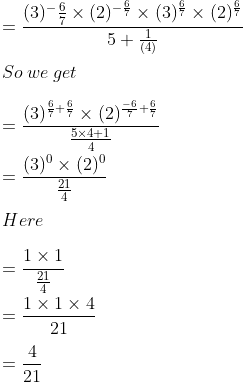
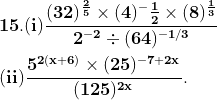
Solution:
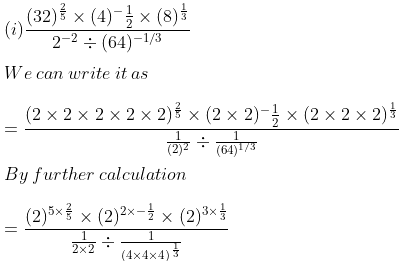
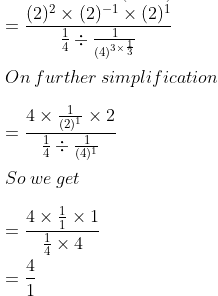
= 4
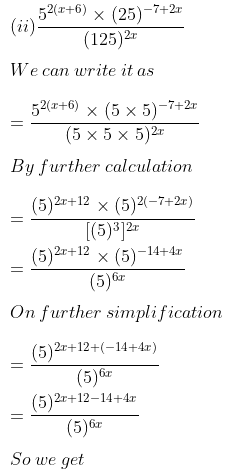

= 56x – 2 – 6x
= 5-2
= 1/(5)2
= 1/25
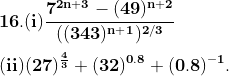
Solution:
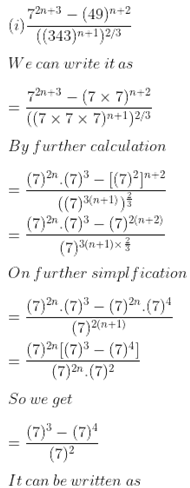
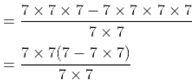
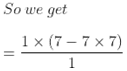
= 7 – 7 × 7
= 7 – 49
= – 42
(ii) (27)4/3 + (32)0.8 + (0.8)-1
We can write it as
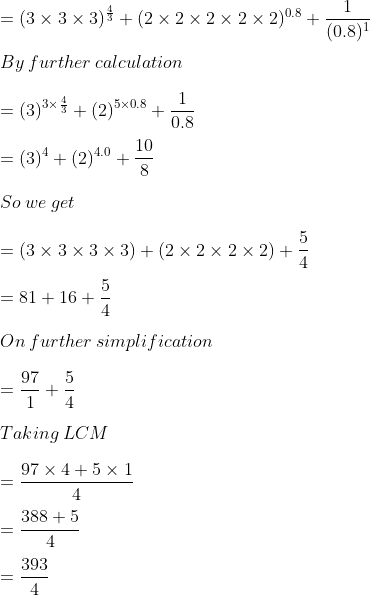
= 98.25
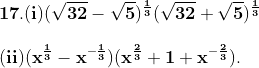
Solution:
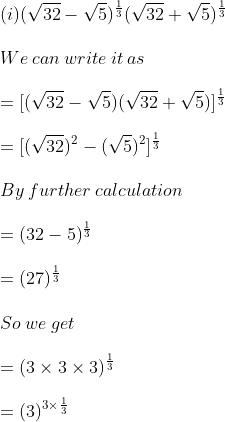
= (3)1
= 3
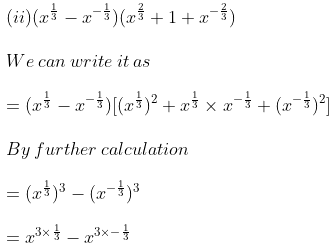
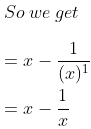
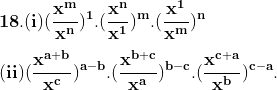
Solution:
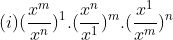
We can write it as
= (xm – n)l. (xn – 1)m. (x1-m)n
By further calculation
= (x)(m – n)l. (x)(n – 1)m. (x)(l – m)n
= xml – nl. xnm – lm. xln – mn
So we get
= xml – nl + nm – lm + ln – mn
= x0
= 1

We can write it as
= (xa + b – c)a – b. (xb + c – a)b – c. (xc + a – b)c – a
By further calculation
= x(a + b – c) (a – b). x(b + c – a) (b – c). x(c + a – b) (c – a)
So we get
= x0
= 1
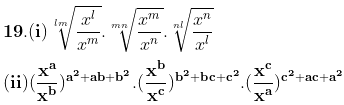

Solution:
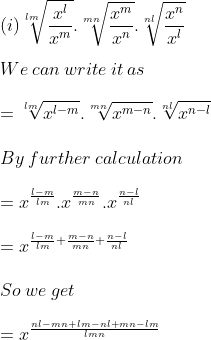
= x0
= 1
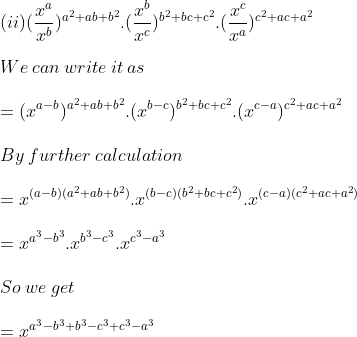
= x0
= 1
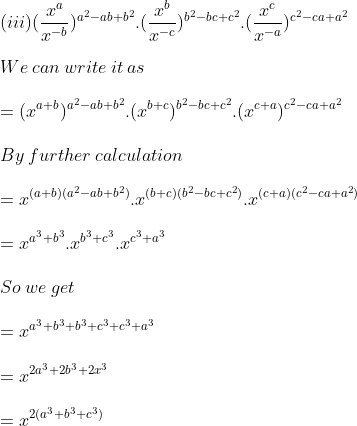
20. (i) (a-1 + b-1) ÷ (a-2 – b-2)

Solution:
(i) (a-1 + b-1) ÷ (a-2 – b-2)
We can write it as
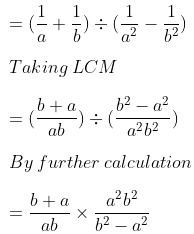
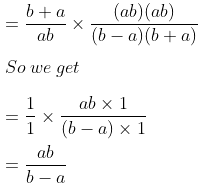
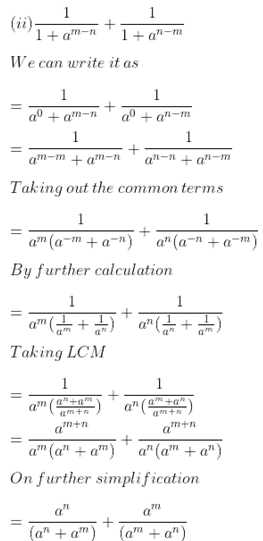


= 1
21. Prove the following:
(i) (a + b)-1 (a-1 + b-1) = 1/ab

Solution:
(i) (a + b)-1 (a-1 + b-1) = 1/ab
Here
LHS = (a + b)-1 (a-1 + b-1)
We can write it as
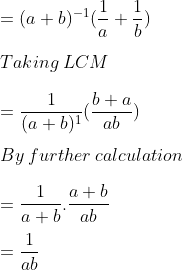
= RHS
Hence, proved.
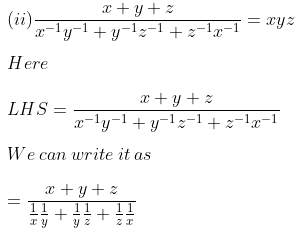
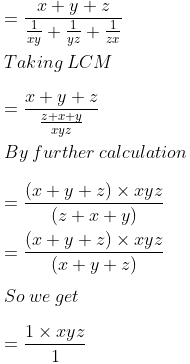
= xyz
= RHS
Hence, proved.
22. If a = cz, b = ax and c = by, prove that xyz = 1.
Solution:
It is given that
a = cz, b = ax and c = by
We can write it as
a = (by)z where c = by
So we get
a = byz
Here
a = (ax)yz
a1 = axyz
By comparing both
xyz = 1
Therefore, it is proved.
23. If a = xyp – 1, b = xyq – 1 and c = xyr – 1, prove that
aq – r. br – p. cp – q = 1.
Solution:
It is given that
a = xyp – 1
Here
aq – r = (xyb – 1)q – r = xq – r. y(q – r) (p – 1)
b = xyq – 1
Here
br – p = (xyq – 1)r – p = xr – p. y(q – 1) (r – p)
c = xyr – 1
Here
cp – q = (xyr – 1)p – q = xp – q. y(r – 1) (p – q)
Consider
LHS = aq – r. br – p. cp – q
Substituting the values
= xq – r. y(q – r) (p – 1). xr – p. y(q – 1) (r – p). xp – q. y(r – 1) (p – q)
By further calculation
= xq – r + r – p – q. y(p – 1) (q – r) + (q – 1) (r – p) + (r – 1) (p – q)
So we get
= x0. ypq – pr – q + r + qr – pr – r + p + rp – qr – p + q
= x0. y0
= 1 × 1
= 1
= RHS
24. If 2x = 3y = 6-z, prove that 1/x + 1/y + 1/z = 0.
Solution:
Consider
2x = 3y = 6-z = k
Here
2x = k
We can write it as
2 = (k)1/x
3y = k
We can write it as
3 = (k)1/y
6-z = k
We can write it as
6 = (k)-1/z
So we get
2 × 3 = 6
(k)1/x × (k)1/y = (k)-1/z
By further calculation
(k)1/x + 1/y = (k)-1/z
We get
1/x + 1/y = – 1/z
1/x + 1/y + 1/z = 0
Therefore, it is proved.
25. If 2x = 3y = 12z, prove that x = 2yz/y – z.
Solution:
It is given that
2x = 3y = 12z
Consider
2x = 3y = 12z = k
Here
2x = k where 2 = (k)1/x
3y = k where 3 = (k)1/y
12z = k where 12 = (k)-1/z
We know that
12 = 2 × 2 × 3
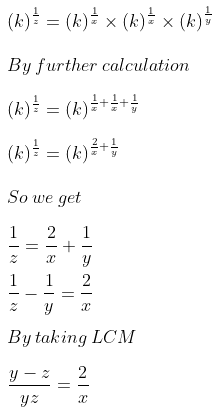
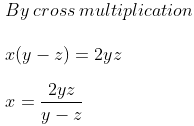
Therefore, it is proved.
26. Simplify and express with positive exponents:
(3x2)0, (xy)-2, (-27a9)2/3.
Solution:
We know that
(3x2)0 = 1

27. If a = 3 and b = – 2, find the values of:
(i) aa + bb
(ii) ab + ba.
Solution:
It is given that
a = 3 and b = – 2
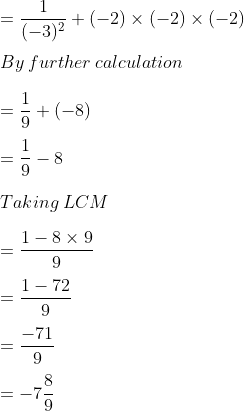
(i) aa + bb = (3)3 + (-2)-2
We can write it as
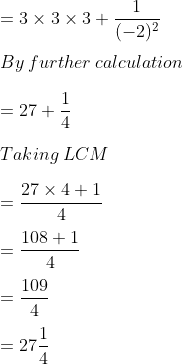
(ii) ab + ba = (3)-2 + (-2)3
We can write it as
28. If x = 103 × 0.0099, y = 10-2 × 110, find the value of
Solution:
It is given that
x = 103 × 0.0099, y = 10-2 × 110
We know that

= √9
= √(3 × 3)
= 3
29. Evaluate x1/2. y-1. z2/3 when x = 9, y = 2 and z = 8.
Solution:
It is given that
x = 9, y = 2 and z = 8
We know that
x1/2. y-1. z2/3 = (9)1/2. (2)-1. (8)2/3
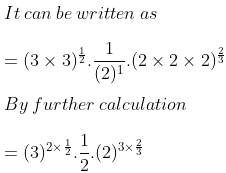
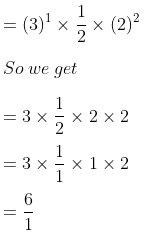
= 6
30. If x4y2z3 = 49392, find the values of x, y and z, where x, y and z are different positive primes.
Solution:
It is given that
x4y2z3 = 49392
We can write it as
x4y2z3 = 2 × 2 × 2 × 2 × 3 × 3 × 7 × 7 × 7
x4y2z3 = (2)4 (3)2 (7)3 ……. (1)
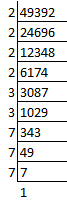
Now compare the powers of 4, 2 and 3 on both sides of equation (1)
x = 2, y = 3 and z = 7
31. If , find x and y, where a, b are different positive primes.
Solution:
It is given that
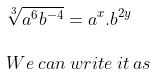
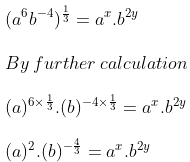
By comparing the base on both sides
2 = x
x = 2
– 4/3 = 2y
2y = – 4/3
By further calculation
y = – 4/3 × ½ = – 2/3
32. If (p + q)-1 (p-1 + q-1) = paqb, prove that a + b + 2 = 0, where p and q are different positive primes.
Solution:
It is given that
(p + q)-1 (p-1 + q-1) = paqb
We can write it as

By cross multiplication
p-1q-1 = paqb
By comparing the powers
a = – 1 and b = – 1
Here
LHS = a + b + 2
Substituting the values
= – 1 – 1 + 2
= 0
= RHS
Download PDF
ML Aggarwal Solutions for Class 9 Maths Chapter 8- Indices
Download PDF: ML Aggarwal Solutions for Class 9 Maths Chapter 8- Indices PDF
Chapterwise ML Aggarwal Solutions for Class 9 Maths :
- Chapter 1- Rational and Irrational Numbers
- Chapter 2- Compound Interest
- Chapter 3- Expansions
- Chapter 4- Factorization
- Chapter 5- Simultaneous Linear Equations
- Chapter 6- Problems on Simultaneous Linear Equations
- Chapter 7- Quadratic Equations
- Chapter 8- Indices
- Chapter 9- Logarithms
- Chapter 10- Triangles
- Chapter 11- Mid Point Theorem
- Chapter 12- Pythagoras Theorem
- Chapter 13- Rectilinear Figures
- Chapter 14- Theorems on Area
- Chapter 15- Circle
- Chapter 16- Mensuration
- Chapter 17- Trigonometric Ratios
- Chapter 18- Trigonometric Ratios and Standard Angles
- Chapter 19- Coordinate Geometry
- Chapter 20- Statistics
About ML Aggarwal
M. L. Aggarwal, is an Indian mechanical engineer, educator. His achievements include research in solutions of industrial problems related to fatigue design. Recipient Best Paper award, Manipal Institute of Technology, 2004. Member of TSTE.