
Class 10: Maths Chapter 4 solutions. Complete Class 10 Maths Chapter 4 Notes.
ML Aggarwal Solutions for Class 10 Maths Chapter 4- Linear Inequations
ML Aggarwal 10th Maths Chapter 4, Class 10 Maths Chapter 4 solutions
Exercise 4
1. Solve the inequation, 3x – 11 < 3 where x ∈ {1, 2, 3, ……, 10}. Also, represent its solution on a number line.
Solution:
Given inequation, 3x – 11 < 3
3x < 3 + 11
3x < 14
⇒ x < 14/3
But, x ∈ {1, 2, 3,……, 10}
Hence, the solution set is {1, 2, 3, 4}.
Representing the solution on a number line:

2. Solve 2(x – 3) < 1, x ∈ {1, 2, 3, …. 10}
Solution:
Given inequation, 2(x – 3) < 1
2x – 6 < 1
2x < 7
⇒ x < 7/2
But, x ∈ {1, 2, 3, …. 10}
Hence, the solution set is {1, 2, 3}
3. Solve 5 – 4x > 2 – 3x, x ∈ W. Also represent its solution on the number line.
Solution:
Given inequation, 5 – 4x > 2 – 3x
– 4x + 3x > 2 – 5
-x > -3
On multiplying both sides by -1, the inequality reverses
⇒ x < 3
Since, x ∈ W
The solution set is {0, 1, 2}
Representing the solution on a number line:

4. List the solution set of 30 – 4 (2x – 1) < 30, given that x is a positive integer.
Solution:
Given inequation, 30 – 4 (2x – 1) < 30
30 – 8x + 4 < 30
34 – 8x < 30
-8x < 30 – 34
-8x < -4 [On multiplying both sides by -1, the inequality reverses]
8x > 4
x > 4/8
⇒ x > 1/2
As x is a positive integer
The solution set is {1, 2, 3, … }
5. Solve: 2 (x – 2) < 3x – 2, x ∈ {– 3, – 2, – 1, 0, 1, 2, 3}.
Solution:
Given inequation, 2 (x – 2) < 3x – 2
2x – 4 < 3x – 2
2x – 3x < -2 + 4
-x < 2
⇒ x > -2
But, x ∈ {– 3, – 2, – 1, 0, 1, 2, 3}
Hence, the solution set is {– 1, 0, 1, 2, 3}.
6. If x is a negative integer, find the solution set of 2/3 + 1/3 (x + 1) > 0.
Solution:
Given inequation, 2/3 + 1/3 (x + 1) > 0.
2/3 + x/3 + 1/3 > 0
x/3 + 1 > 0
x/3 > -1
⇒ x > -3
As x is a negative integer
The solution set is {-1, -2}.
7. Solve x – 3 (2 + x) > 2 (3x – 1), x ∈ { – 3, – 2, – 1, 0, 1, 2, 3}. Also represent its solution on the number line.
Solution:
Given inequation, x – 3 (2 + x) > 2 (3x – 1)
x – 6 – 3x > 6x – 2
-2x – 6 > 6x – 2
-6x – 2x > -2 + 6
-8x > 4
x < -4/8
⇒ x < -1/2
But, x ∈ { – 3, – 2, – 1, 0, 1, 2, 3}
Hence, the solution set is {-3, -2, -1}
8. Given x ∈ {1, 2, 3, 4, 5, 6, 7, 9} solve x – 3 < 2x – 1.
Solution:
Given inequation, x – 3 < 2x – 1
x – 2x < – 1 + 3
-x < 2
⇒ x > -2
But, x ∈ {1, 2, 3, 4, 5, 6, 7, 9}
Hence, the solution set is {1, 2, 3, 4, 5, 6, 7, 9}.
9. List the solution set of the inequation ½ + 8x > 5x – 3/2, x ∈ Z
Solution:
Given inequation, ½ + 8x > 5x – 3/2
8x – 5x > -3/2 – ½
3x > -4/2
⇒ x > -2/3
As x ∈ Z
The solution set is {0, 1, 2, 3, 4, 5, …}
10. List the solution set of (11 – 2x)/5 ≥ (9 – 3x)/8 + 3/4, x ∈ N
Solution:
Given inequation, (11 – 2x)/5 ≥ (9 – 3x)/8 + ¾
(11 – 2x)/5 ≥ (9 – 3x + 6)/8
8 (11 – 2x) ≥ 5 (15 – 3x)
88 – 16x ≥ 75 – 15x
15x – 16x ≥ 75 – 88
-x ≥ -13
⇒ x ≤ 13
As x ∈ N
Hence, the solution set is {1, 2, 3, 4, …, 13}.
11. Find the values of x, which satisfy the inequation : , x ∈ N. Graph the solution set on the number line.
Solution:
Given inequation,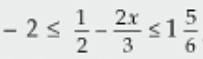
-2 ≤ (3 – 4x)/ 6 ≤ 11/6
-12 ≤ 3 – 4x ≤ 11
-12 – 3 ≤ -4x ≤ 11 – 3
-15 ≤ -4x ≤ 8
-15/4 ≤ -x ≤ 8/4
⇒ 15/4 ≥ x ≥ -2
As x ∈ N,
The solution set is {1, 2, 3}.
Representing the solution on a number line:

12. If x ∈ W, find the solution set of 3/5 x – (2x – 1)/3 > 1. Also graph the solution set on the number line, if possible.
Solution:
Given inequation, 3/5 x – (2x – 1)/3 > 1
9/15 x – 5(2x – 1)/15 > 1 [Taking L.C.M]
9x – 5(2x – 1) > 15 [Multiplying by 15 on both sides]
9x – 10x + 5 > 15
-x > 15 – 5
-x > 10
⇒ x < -10
But, x ∈ W
Hence, the solution set is a null set.
Thus, it can’t be represented on number line.
13. Solve:
(i) x/2 + 5 ≤ x/3 + 6, where x is a positive odd integer.
(ii) (2x + 3)/3 ≥ (3x – 1)/4, where x is positive even integer.
Solution:
(i) Given inequation, x/2 + 5 ≤ x/3 + 6
(x + 10)/2 ≤ (x + 18)/3 [Taking L.C.M on both sides]
3 (x + 10) ≤ 2 (x + 18) [On cross-multiplying]
3x + 30 ≤ 2x + 36
3x – 2x ≤ 36 – 30
⇒ x ≤ 6
As x is a positive odd integer.
Hence, the solution set is {1, 3, 5}.
(ii) Given inequation, (2x + 3)/3 ≥ (3x – 1)/4
4 (2x + 3) ≥ 3 (3x – 1) [On cross-multiplying]
8x + 12 ≥ 9x – 3
-9x + 8x ≥ -12 – 3
-x ≥ -15
⇒ x ≤ 15
As x is positive even integer.
Hence, the solution set is {2, 4, 6, 8, 10, 12, 14}.
14. Given that x ∈ I, solve the inequation and graph the solution on the number line:
3 ≥ (x – 4)/2 + x/3 ≥ 2
Solution:
Given inequation, 3 ≥ (x – 4)/2 + x/3 ≥ 2
Now, let’s take
3 ≥ (x – 4)/2 + x/3, we have
3 ≥ (3x – 12 + 2x)/6 [Taking L.C.M]
18 ≥ 5x – 12
30 ≥ 5x
⇒ x ≤ 6 …. (i)
Next,
(x – 4)/2 + x/3 ≥ 2
(3x – 12 + 2x)/6 ≥ 2
5x – 12 ≥ 12
5x ≥ 24
x ≥ 24/5 ⇒ x ≥ 4.8 … (ii)
Hence, from (i) and (ii) we have
Solution of x = {5, 6}
Representing the solution on a number line:

15. Solve: 1 ≥ 15 – 7x > 2x – 27, x ∈ N
Solution:
Given inequation, 1 ≥ 15 – 7x > 2x – 27,
So, we have
1 ≥ 15 – 7x and 15 – 7x > 2x – 27
7x ≥ 15 – 1 and -2x – 7x > -27 – 15
7x ≥ 14 and -9x > -42
x ≥ 2 and -x > -42/9
x ≥ 2 and x < 14/3
⇒ 2 ≤ x < 14/3
But as x ∈ N
The solution set is {2, 3, 4}.
16. If x ∈ Z, solve 2 + 4x < 2x – 5 ≤ 3x. Also represent its solution on the number line.
Solution
Given inequation, 2 + 4x < 2x – 5 ≤ 3x
So, we have
2 + 4x < 2x – 5 and 2x – 5 ≤ 3x
4x – 2x < -5 – 2 and 2x – 3x ≤ 5
2x < -7 and -x ≤ 5
x < -7/2 and x ≥ -5
⇒ -5 ≤ x < -7/2
As x ∈ Z
The solution set is {-5, -4}.
Representing the solution on a number line:

17. Solve: (4x – 10)/3 ≤ (5x – 7)/2, x ∈ R and represent the solution set on the number line.
Solution:
Given inequation, (4x – 10)/3 ≤ (5x – 7)/2
2 (4x – 10) ≤ 3 (5x – 7) [On cross-multiplying]
8x – 20 ≤ 15x – 21
8x – 15x ≤ -21 + 20
-7x ≤ -1
-x ≤ -1/7
x ≥ 1/7
As x ∈ R
Hence, the solution set is {x: x ∈ R, x ≥ 1/7}
Representing the solution on a number line:

18. Solve 3x/5 – (2x – 1)/3 > 1, x ∈ R and represent the solution set on the number line.
Solution:
Given inequation, 3x/5 – (2x – 1)/3 > 1
(9x – 10x + 5)/15 > 1 [Taking L.C.M]
-x + 5 > 15
-x > 15 – 5
-x > 10
x < -10
As x ∈ R
Hence, the solution set is {x: x ∈ R, x < -10}
Representing the solution on a number line:

19. Given that x ∈ R, solve the following inequation and graph the solution on the number line: -1 ≤ 3 + 4x < 23.
Solution:
Given inequation, -1 ≤ 3 + 4x < 23
-1 – 3 ≤ 4x < 23 – 3
-4 ≤ 4x < 20
-4/4 ≤ x < 20/4
-1 ≤ x < 5
Hence, the solution set is {-1 ≤ x < 5; x ∈ R}
Representing the solution on a number line:

20. Solve the following inequation and graph the solution on the number line.
, x ∈ R
Solution:
Given inequation,

-8/3 ≤ (3x + 1)/3 < 10/3
-8 ≤ 3x + 1 < 10 [Multiplying by 3]
-8 – 1 ≤ 3x < 10 – 1
-9 ≤ 3x < 9
-3 ≤ x < 3 [Dividing by 5]
Thus, the solution set is {x: x ∈ R, -3 ≤ x < 3}
Representing the solution on a number line:

21. Solve the following inequation and represent the solution set on the number line:
Solution:
Given in equation,

-3 < -(3 + 4x)/6 ≤ 5/6 [Taking L.C.M]
-18 < -3 – 4x ≤ 5 [Multiplying by 6]
-18 + 3 < -4x ≤ 5 + 3
-15 < -4x ≤ 8
-15/4 < -x ≤ 8/4
-2 ≤ x < 15/4
Hence, the solution set is {x : x ∈ R, -2 ≤ x < 15/4}
Representing the solution on a number line:

22. Solving the following inequation, write the solution set and represent it on the number line
-3(x – 7) ≥ 15 – 7x > , x ∈ R
Solution:
Given inequation, –3(x – 7) ≥ 15 – 7x >
–3x + 21 ≥ 15 – 7x > (x + 1)/3
So,
-3x + 21 ≥ 15 – 7x
7x – 3x ≥ 15 – 21
4x ≥ -6
x ≥ -6/4
x ≥ -3/2
And,
15 – 7x > (x + 1)/3
3(15 – 7x) > x + 1
45 – 21x > x + 1
-21x – x > 1 – 45
-22x > -44
-x > -44/22
x < 2
Hence, the solution set is {x : x ∈ R , -3/2 ≤ x < 2}
Representing the solution on a number line:

23. Solve the following inequation, write down the solution set and represent it on the real number line:
-2 + 10x ≤ 13x + 10 ≤ 24 + 10x, x ∈ Z
Solution:
Given inequation, -2 + 10x ≤ 13x + 10 ≤ 24 + 10x
So, we have
-2 + 10x ≤ 13x + 10 and 13x + 10 ≤ 24 + 10x
10x – 13x ≤ 10 + 2 and 13x – 10x ≤ 24 – 10
-3x ≤ 12 and 3x ≤ 14
x ≥ -12/3 and x ≤ 14/3
x ≥ -4 and x ≤ 14/3
So, -4 ≤ x ≤ 14/3
As x ∈ Z
Thus, the solution set is {-4, -3, -2, -1, 0, 1, 2, 3, 4}
Representing the solution on a number line:

24. Solve the inequation 2x – 5 ≤ 5x + 4 < 11, where x ∈ I. Also represent the solution set on the number line.
Solution:
Given inequation, 2x – 5 ≤ 5x + 4 < 11
So, we have
2x – 5 ≤ 5x + 4 and 5x + 4 < 11
2x – 5x ≤ 4 + 5 and 5x < 11 – 4
-3x ≤ 9 and 5x < 7
-x ≤ 9/3 and x < 7/5
x ≥ -3 and x < 7/5
-3 ≤ x < 7/5
As x ∈ I
Thus, the solutions set is {-3, -2, -1, 0, 1}
Representing the solution on a number line:

25. If x ∈ I, A is the solution set of 2 (x – 1) < 3x – 1 and B is the solution set of 4x – 3 ≤ 8 + x, find A ∩ B.
Solution:
Given inequations,
2 (x – 1) < 3x – 1 and 4x – 3 ≤ 8 + x for x ∈ I
Solving for both, we have
2x – 3x < 2 – 1 and 4x – x ≤ 8 + 3
-x < 1 and 3x ≤ 11
x > -1 and x ≤ 11/3
Hence,
Solution set A = {0, 1, 2, 3, …}
Solution set B = {3, 2, 1, 0, -1, … }
Thus, A ⋂ B = {0, 1, 2, 3}
26. If P is the solution set of -3x + 4 < 2x – 3, x ∈ N and Q is the solution set of 4x – 5 < 12, x ∈ W, find
(i) P ∩ Q
(ii) Q – P.
Solution:
Given inequations,
-3x + 4 < 2x – 3 where x ∈ N and 4x – 5 < 12 where x ∈ W
So, solving
-3x + 4 < 2x – 3 where x ∈ N
-3x – 2x < -3 – 4
-5x < -7
x > 7/5
Hence, the solution set P is {2, 3, 4, 5, …}
And, solving
4x – 5 < 12 where x ∈ W
4x < 12 + 5
4x < 17
x < 17/4
Hence, the solution set Q is {0, 1, 2, 3, 4}
Therefore,
(i) P ∩ Q = {2, 3, 4}
(ii) Q – P = {0, 1}
27. A = {x : 11x – 5 > 7x + 3, x ∈ R} and
B = {x : 18x – 9 ≥ 15 + 12x, x ∈ R}
Find the range of set A ∩ B and represent it on a number line
Solution:
Given, A = {x : 11x – 5 > 7x + 3, x ∈ R} and B = {x : 18x – 9 ≥ 15 + 12x, x ∈ R}
Solving for A,
11x – 5 > 7x + 3
11x – 7x > 3 + 5
4x > 8
x > 2
Hence, A = {x : x > 2, x ∈ R}
Next, solving for B
18x – 9 ≥ 15 + 12x
18x – 12x ≥ 15 + 9
6x ≥ 24
x ≥ 4
Hence, B = {x : x ≥ 4, x ∈ R}
Thus, A ∩ B = x ≥ 4
Representing the solution on a number line:

28. Given: P {x : 5 < 2x – 1 ≤ 11, x ∈ R}
Q {x : – 1 ≤ 3 + 4x < 23, x ∈ I} where
R = (real numbers), I = (integers)
Represent P and Q on number line. Write down the elements of P ∩ Q.
Solution:
Given, P {x : 5 < 2x – 1 ≤ 11, x ∈ R} and Q {x : – 1 ≤ 3 + 4x < 23, x ∈ I}
Solving for P,
5 < 2x – 1 ≤ 11
5 + 1 < 2x ≤ 11 + 1
6 < 2x ≤ 12
3 < x ≤ 6
Hence, P = P {x : 3 < x ≤ 6, x ∈ R}
Representing the solution on a number line:

Next, solving for Q
– 1 ≤ 3 + 4x < 23
-1 – 3 ≤ 4x < 23 – 3
-4 ≤ 4x < 20
-1 ≤ x < 5
Hence, solution Q = {-1, 0, 1, 2, 3, 4}
Representing the solution on a number line:

Therefore, P ∩ Q = {4}
29. If x ∈ I, find the smallest value of x which satisfies the inequation
Solution:
Given inequation,
(4x + 5)/2 > (5x + 6)/3 [Taking L.C.M]
3 (4x + 5) > 2 (5x + 6) [On cross-multiplication]
12x + 15 > 10x + 12
12x – 10x > 12 – 15
2x > -3
x > -3/2
Hence, for x ∈ I the smallest value of x is -1.
30. Given 20 – 5 x < 5 (x + 8), find the smallest value of x, when
(i) x ∈ I
(ii) x ∈ W
(iii) x ∈ N.
Solution:
Given inequation, 20 – 5 x < 5 (x + 8)
20 – 5x < 5x + 40
-5x – 5x < 40 – 20
-10x < 20
-x < 20/10
x > -2
Thus,
(i) For x ∈ I, the smallest value = -1
(ii) For x ∈ W, the smallest value = 0
(iii) For x ∈ N, the smallest value = 1
31. Solve the following inequation and represent the solution set on the number line:
Solution:
Given inequation,

So, we have
4x – 19 < 3x/5 – 2 and 3x/5 – 2 ≤ -2/5 + x
4x – 3x/5 < 19 – 2 and 3x/5 – x ≤ 2 – 2/5
(20x – 3x)/5 < 17 and (3x – 5x)/5 ≤ (10 – 2)/5
17x < 35 and -2x ≤ 8 [Multiplying by 5]
x < 5 and -x ≤ 4
x < 5 and x ≥ 4
-4 ≤ x < 5, x ∈ R
Hence, the solution set is {x : -4 ≤ x < 5, x ∈ R}
Representing the solution on a number line:

32. Solve the given inequation and graph the solution on the number line:
2y – 3 < y + 1 ≤ 4y + 7;
y ∈ R.
Solution:
Given inequation, 2y – 3 < y + 1 ≤ 4y + 7
So, we have
2y – 3 < y + 1 and y + 1 ≤ 4y + 7
2y – y < 1 + 3 and y – 4y ≤ 7 – 1
y < 4 and -3y ≤ 6
y < 4 and -y ≤ 2 ⇒ y ≥ -2
Thus, -2 ≤ y < 4
The solution set is {y : -2 ≤ y < 4, y ∈ R}
Representing the solution on a number line:

33. Solve the inequation and represent the solution set on the number line.
Solution:
Given inequation,

So, we have
-3 + x ≤ 8x/3 + 2 and 8x/3 + 2 ≤ 14/3 + 2x
x – 8x/3 ≤ 2 + 3 and 8x/3 – 2x ≤ 14/3 – 2
(3x – 8x)/3 ≤ 5 and (8x – 6x)/3 ≤ (14 – 6)/3 [Taking L.C.M]
-5x/3 ≤ 5 and 2x ≤ 8
-5x ≤ 15 and x ≤ 8/2
-x ≤ 3 and x ≤ 4
x ≥ -3 and x ≤ 4
⇒ -3 ≤ x ≤ 4
Thus, the solution set is {-3, -2, -1, 0, 1, 2, 3, 4}
Representing the solution on a number line:

34. Find the greatest integer which is such that if 7 is added to its double, the resulting number becomes greater than three times the integer.
Solution:
Let’s consider the greatest integer to be x
Then according to the given condition, we have
2x + 7 > 3x
2x – 3x > -7
-x > -7
x < 7 , x ∈ R
Hence, the greatest integer value is 6.
35. One-third of a bamboo pole is buried in mud, one-sixth of it is in water and the part above the water is greater than or equal to 3 metres. Find the length of the shortest pole.
Solution:
Let’s assume the length of the shortest pole = x metre
Now,
Length of the pole which is buried in mud = x/3
Length of the pole which is in the water = x/6
Then according to the given condition, we have
x – [x/3 + x/6] ≥ 3
x – [(2x + x)/6] ≥ 3
x – 3x/6 ≥ 3
x – x/2 ≥ 3
x/2 ≥ 3
x ≥ 6 [Multiplying by 6]
Therefore, the length of the shortest pole is 6 metres.
Chapter Test
1. Solve the inequation: 5x – 2 ≤ 3 (3 – x) where x ∈ {-2, -1, 0, 1, 2, 3, 4}. Also represent its solution on the number line.
Solution:
Given inequation, 5x – 2 ≤ 3 (3 – x)
5x – 2 ≤ 9 – 3x
5x + 3x ≤ 9 + 2
8x ≤ 11
x ≤ 11/8
As x ∈ {-2, -1, 0, 1, 2, 3, 4}
The solution set is {-2, -1, 0, 1}
Representing the solution on a number line:

2. Solve the inequation: 6x – 5 < 3x + 4, x ∈ I
Solution:
Given inequation, 6x – 5 < 3x + 4
6x – 3x < 4 + 5
3x < 9
x < 9/3
x < 3
As x ∈ I
The solution set is {2, 1, 0, -1, -2, …}
3. Find the solution set of the inequation x + 5 ≤ 2x + 3; x ∈ R
Graph the solution set on the number line.
Solution:
Given inequation, x + 5 ≤ 2x + 3
x – 2x ≤ 3 – 5
-x ≤ -2
x ≥ 2
As x ∈ R
Thus, the solution set is {2, 3, 4, 5, …}
Representing the solution on a number line:

4. If x ∈ R (real numbers) and -1 < 3 – 2x ≤ 7, find solution set and present it on a number line.
Solution:
Given inequation, -1 < 3 – 2x ≤ 7
-1 – 3 < -2x ≤ 7 – 3
-4 < -2x ≤ 4
-4/2 < -x ≤ 4/2
-2 < -x ≤ 2
Thus, -2 ≤ x < 2
The solution set is {x : x ∈ R, -2 ≤ x < 2}
Representing the solution on a number line:

5. Solve the inequation:

Solution:
Given inequation,

(5x + 1)/7 – 4 (5x + 14)/35 ≤ 8/5 + (3x – 1)/7[5(5x + 1) – 4 (5x + 14)]/ 35 ≤ [56 + 5 (3x – 1)]/ 35 [Taking L.C.M]
(25x + 5 – 20x – 56) ≤ 56 + 15x – 5
5x – 51 ≤ 51 + 15x
5x – 15x ≤ 51 + 51
-10x ≤ 102
-x ≤ 102/10
x ≥ – 51/5
Hence, the solution set is {x : x ∈ R , x ≥ – 51/5}
6. Find the range of values of a, which satisfy 7 ≤ – 4x + 2 < 12, x ∈ R. Graph these values of a on the real number line.
Solution:
7 < – 4x + 2 < 12
7 < – 4x + 2 and – 4x + 2 < 12
7. If x ∈ R, solve 2x – 3 ≥ x + (1 – x)/3 > 2x/5
Solution:
Given inequation, 2x – 3 ≥ x + (1 – x)/3 > 2x/5
So, we have
2x – 3 ≥ x + (1 – x)/3 and x + (1 – x)/3 > 2x/5
2x – 3 ≥ (3x + 1 – x)/3 and (3x + 1 – x)/3 > 2x/5 [On taking L.C.M]
3(2x – 3) ≥ 2x + 1 and (2x + 1) × 5 > 2x × 3 [Upon cross multiplication]
6x – 9 ≥ 2x + 1 and 10x + 5 > 6x
6x – 2x ≥ 1 + 9 and 10x – 6x > -5
4x ≥ 10 and 4x > -5
x ≥ 10/4 and x > -5/4
x ≥ 5/2
As x ∈ R
Thus, the solution set is {x: x ∈ R, x ≥ 5/2}
Representing the solution on a number line:

7. If x ∈ R, solve 2x – 3 ≥ x + (1 – x)/3 > 2x/5. Also represent the solution on the number line.
Solution:
Given inequation, 2x – 3 ≥ x + (1 – x)/3 > 2x/5
So, we have
2x – 3 ≥ x + (1 – x)/3 and x + (1 – x)/3 > 2x/5
2x – 3 ≥ (3x + 1 – x)/3 and (3x + 1 – x)/3 > 2x/5 [On taking L.C.M]
3 (2x – 3) ≥ 2x + 1 and 5 × (2x + 1) > 3 × 2x
6x – 9 ≥ 2x + 1 and 10x + 5 > 6x
6x – 2x ≥ 1 + 9 and 10x – 6x > -5
4x ≥ 10 and 4x > -5
x ≥ 10/4 and x > -5/4
x ≥ 5/2
As x ∈ R
The solution set = {x: x ∈ R, x ≥ 5/2}
Representing the solution on a number line:

8. Find positive integers which are such that if 6 is subtracted from five times the integer then the resulting number cannot be greater than four times the integer.
Solution:
Let’s consider the positive integer be x
Then according to the problem, we have
5a – 6 < 4x
5a – 4x < 6
⇒ x < 6
Hence, the solution set = {x : x < 6}
= { 1, 2, 3, 4, 5, 6}
9. Find three smallest consecutive natural numbers such that the difference between one-third of the largest and one-fifth of the smallest is at least 3.
Solution:
Let’s consider the first least natural number as x
Then, second number = x + 1
And third number = x + 2
So, according the conditions given in the problem, we have
1/3 × (x + 2) – x/5 ≥ 3
5x + 10 – 3x ≥ 3 × 15[Multiplying by 15 the L.C.M of 3 and 5]
2x ≥ 45 – 10
2x ≥ 35
x ≥ 35/2
x ≥ 17.5
As x is a natural least number
Thus, first least natural number = 18
Second number = 18 + 1 = 19
And, third number = 18 + 2 = 20
Hence, the least natural numbers are 18, 19 and 20
Download PDF
ML Aggarwal Solutions for Class 10 Maths Chapter 4- Linear Inequations
Download PDF: ML Aggarwal Solutions for Class 10 Maths Chapter 4- Linear Inequations PDF
Chapterwise ML Aggarwal Solutions for Class 10 Maths :
- Chapter 1- Goods and Service Tax (GST)
- Chapter 2- Banking
- Chapter 3- Shares and Dividends
- Chapter 4- Linear Inequations
- Chapter 5- Quadratic Equations in One Variable
- Chapter 6- Factorization
- Chapter 7- Ratio and Proportion
- Chapter 8- Matrices
- Chapter 9- Arithmetic and Geometric Progression
- Chapter 10- Reflection
- Chapter 11- Section Formula
- Chapter 12- Equation of Straight Line
- Chapter 13- Similarity
- Chapter 14- Locus
- Chapter 15- Circles
- Chapter 16- Constructions
- Chapter 17- Mensuration
- Chapter 18- Trigonometric Identities
- Chapter 19- Trigonometric Tables
- Chapter 20- Heights and Distances
- Chapter 21- Measures Of Central Tendency
- Chapter 22- Probability
About ML Aggarwal
M. L. Aggarwal, is an Indian mechanical engineer, educator. His achievements include research in solutions of industrial problems related to fatigue design. Recipient Best Paper award, Manipal Institute of Technology, 2004. Member of TSTE.