
Frank ICSE Solutions for Class 9 Physics Chapter 8-Electricity and Magnetism - Current Electricity
PAGE NO: 312
Solution 1:
The flow of electrons in a particular direction in a conductor is called an electric current.
Solution 2:
An electric cell is the source of electric current in which chemical energy changes to electrical energy.
Solution 3:
The charge on an electron is -1.6 x 10⁻¹⁹ C.
Solution 4:
The constituents of cell are two electrodes in the form of conducting rods immersed in the solution called electrolyte.
Solution 5:
- S. I unit of electric current is Ampere
- S.I unit of potential difference is volt.
- S.I unit of resistance is ohm.
Solution 6:
I = 1A
T = 1s.
I = Q/t = ne/t
So, n = I.t/e = 1.1/(1.6 x 10-19) = 6.25 x 10¹⁸ electrons.
Solution 7:
I = Q/t = 0.7 / 7 = 0.1 Ampere.
Solution 8:
Rheostat is used to control the current in the circuit.
PAGE NO : 313
Solution 9:
Rheostat is the variable name of electrical resistance.
Solution 10:
Switch is used to put the current on and off in the circuit.
Solution 11: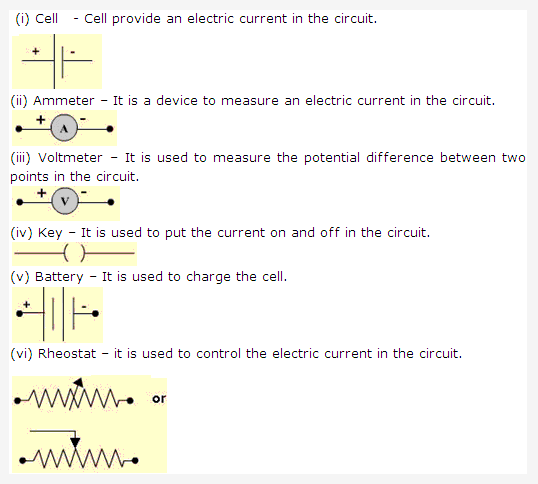
Solution 12:
I = Q/ t So, Q = I.t = 1.2 x 3.0 = 3.6 C.
Solution 13:
A – is a voltmeter to measure the potential difference, B is an electric resistance to control the current in the circuit , C is the ammeter to measure the magnitude of an electric current, D is cell to provide electric current in circuit, E is an electric key to on and off the circuit, F is the rheostat to control the current in circuit.
Solution 14:
The slope of the graph represents that with current flowing through a conductor is directly proportional to the potential difference applied the resistance of conductor is constant.
Solution 15:
Potential difference between two conductors is defined as the amount of work done in moving the unit positive charge from one conductor to another through the wire.
Solution 16:
Yes, electric current is a scalar quantity.
Solution 17:
The electric resistance of the wire depends on the following factors :
- The length of the wire.
- The area of cross-section of the wire.
- The temperature of the wire.
- The material of the wire.
Solution 18:
The S.I unit of resistance is ohm.
Solution 19:
If another bulb is connected in series then the resistance of the wire will increase.
If another bulb is connected in parallel then resistance will decrease.
Solution 20:
V = IR.
Solution 21:
The resistance of the wire is 2 ohms if a current of 1 ampere flows through it when the potential difference across it is 2 volt.
Solution 22:
The current I = V/R = 14/28 = 0.5 Ampere.
Solution 23:
The factors on which resistance of the wire depends are:
- The length of the wire , resistance is directly proportional to the length of wire.
- The cross-section of the wire , resistance is inversely proportional to the cross-section of the wire.
- The temperature of the wire , resistance of wire is directly proportional to the temperature of the wire.
- The material of the wire (good conductors possess less resistance.)
Solution 24:
W = V.Q = 6.3 = 18 Joule.
Solution 25:
The resistance of the conductor is the property due to which it opposes the flow of current in it.
Solution 26:
The potential difference between two points is 1 volt if the work done in transferring 1 coulomb of charge from one point to another point is 1 joule.