
State Board K-12 (All Classes) Private Session 2025-26 Free Open Access

Electronic Structure: The Distribution of Electrons in an Atom

Learning Outcomes After studying this lesson, you shall be able to: Structure of an Atom Distribution of Electrons in an Atom The Structure of an Atom An atom consists of a tiny dense nucleus...

Curriculum State Board
Applicable Grade K-12 (All Classes)
Medium English & Hindi
Resource Format Chapter Q&A / PDF

Textbook Solutions & Academic Guide

Verified chapter-wise solutions, answers, and study notes

Curriculum & Exam Preparation Note: Regular practice of NCERT textbook exercises and chapter-end questions establishes strong conceptual clarity for primary and secondary examinations.

Learning Outcomes

After studying this lesson, you shall be able to:

  1. Structure of an Atom
  2. Distribution of Electrons in an Atom

The Structure of an Atom

  1. An atom consists of a tiny dense nucleus surrounded by electrons.
  2. The nucleus contains positively charged protons and neutral neutrons.
  3. A neutral atom has an equal number of protons and electrons.
  4. Atoms can gain electrons and there by become negatively charged, or they can lose electrons and become positively charged.
  5. However, there won՚t be any change in the number of protons.
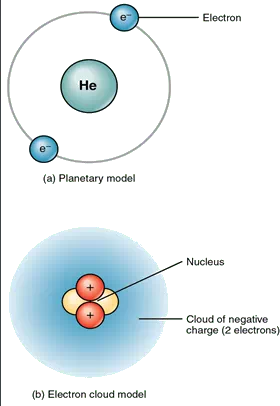
The Structure of an Atom

6. Most of the mass of an atom is in its nucleus and most of the volume of an atom is
occupied by its electrons.

7. The atomic number of an atom equals to the number of protons and the number of
electrons.

8. The mass number of an atom is the sum of its protons and neutrons.

The number of neutrons of an atom can be varied, so an atom can have different mass
number
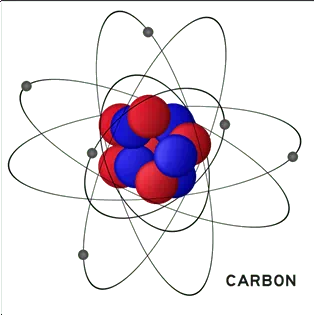
The Structure of an Atom

The Distribution of Electrons in an Atom
The Distribution of Electrons in an Atom
  1. The electrons are the greatest importance in organic chemistry.
  2. A neutral atom of each element contains an equal number of protons and electrons.
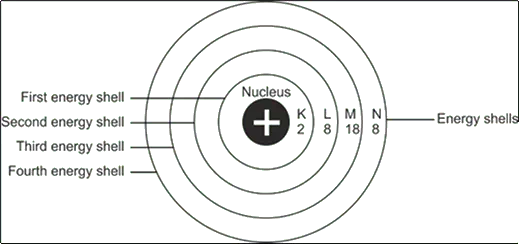
  3. According to quantum mechanics, the electrons in an atom can be thought of as occupying a set of shells.
  4. The first shell is the closest to the nucleus and subsequent shells lies farther from the nucleus.
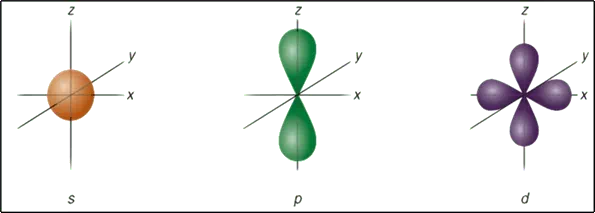
  5. Each shell contains subshells known as atomic orbitals that have a characteristic shape and energy.
  6. They occupy a characteristic volume of the space.
  7. The atomic orbital that is close to the nucleus, is lower in its energy.
The Distribution of Electrons in an Atom
  1. The first shell consists of only atomic orbital.
  2. The second shell consists of s and three degenerate p atomic orbitals and the third shell contains, in addition, five degenerate atomic orbitals.
  3. The fourth and higher shells contain, in addition, seven degenerate f atomic orbitals.
  4. Degenerate orbitals are orbitals that have the same energy.
The Distribution of Electrons in an Atom
  1. Each atomic orbital can have maximum of two electrons.
  2. There are only two electrons in the first shell as it has only s atomic orbitals.
  3. The second shell can have a total of eight electrons for one s and three p atomic orbitals.
  4. The third shell has nine atomic orbitals, ones, three p, and five d atomic orbitals, so eighteen electrons can occupy these nine atomic orbitals.
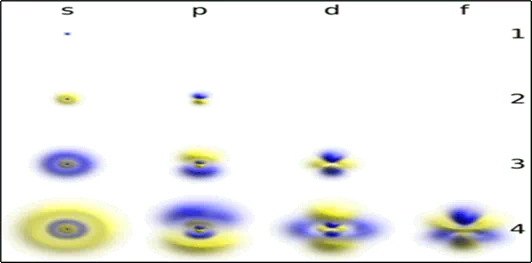
The Distribution of Electrons in an Atom

MCQs

  1. Mass of an atom depends on the number of __ .

a) Electron

b) Proton

c) Neutron

d) Nucleus

Answer: C

2. Each atomic orbital can have maximum of __ electrons.

a) 1

b) 2

c) 18

d) 8

Answer: B

NCERT Solutions for All Classes (1 to 12)

Jump to free NCERT solutions, chapter Q&A, and textbooks for any grade

Popular Reference Solutions & Help Books

Step-by-step solutions for Mathematics and Science reference textbooks

Latest School & Board Updates

Real-time date sheets, admit cards, syllabus revisions, and exam notifications

Haryana Board Senior Secondary (12th) 20 Feb 2025
HBSE 12th 2024 Question Papers
View
Haryana Board Secondary (10th) 20 Feb 2025
HBSE 10th 2024 Question Papers
View
Haryana Board Senior Secondary (12th) 19 Feb 2025
HBSE 9th Model Papers 2025
View
Haryana Board Senior Secondary (12th) 19 Feb 2025
HBSE 11th Model Papers 2025
View
State Board Primary (1-5) 15 Feb 2025
BHU SET 2025 Application Form
View

Frequently Asked Questions

Common queries regarding NCERT textbook solutions & school curriculum

Are these NCERT solutions available 100% free of charge?

Yes. All NCERT solutions, chapter questions, textbook exercises, and download guides published on IndCareer Schools are completely free for students, parents, and educators without requiring any paid subscription or login.

Which subjects are covered for this class?

For Class 1, comprehensive NCERT solutions are provided for Mathematics (Math-Magic / गणित का जादू), English (Marigold & Mridang), and Hindi (Rimjhim / रिमझिम), alongside printable worksheets and textbook PDF downloads.

Are these solutions updated according to the latest CBSE / NCERT guidelines?

Yes. Our academic editorial team continually aligns all solutions and textbook references with the latest National Education Policy (NEP) and the rationalized curriculum issued by NCERT and the Central Board of Secondary Education (CBSE).

How can I download the official NCERT books in PDF format?

You can access official NCERT textbooks by clicking on the textbook links provided in the study content section above or by visiting the Class 1 to 12 NCERT Directory on IndCareer Schools.