
State Board K-12 (All Classes) Private Session 2025-26 Free Open Access

Basic Chemistry: The Concept of Equilibrium, the Context of Chemistry and Energy

Learning Outcomes After studying this lesson, you shall be able to: Equilibrium Energy Equilibrium Although the concept of equilibrium is widely used across sciences, in the context of chemistry,...

Curriculum State Board
Applicable Grade K-12 (All Classes)
Medium English & Hindi
Resource Format Chapter Q&A / PDF

Textbook Solutions & Academic Guide

Verified chapter-wise solutions, answers, and study notes

Curriculum & Exam Preparation Note: Regular practice of NCERT textbook exercises and chapter-end questions establishes strong conceptual clarity for primary and secondary examinations.

Learning Outcomes

After studying this lesson, you shall be able to:

  1. Equilibrium
  2. Energy

Equilibrium

  1. Although the concept of equilibrium is widely used across sciences, in the context of chemistry, chemical reaction is said to be in equilibrium when the reactants and products are in a constant ratio.
  2. The forward reaction and the reverse reactions occur at the same rate when a system is in equilibrium.
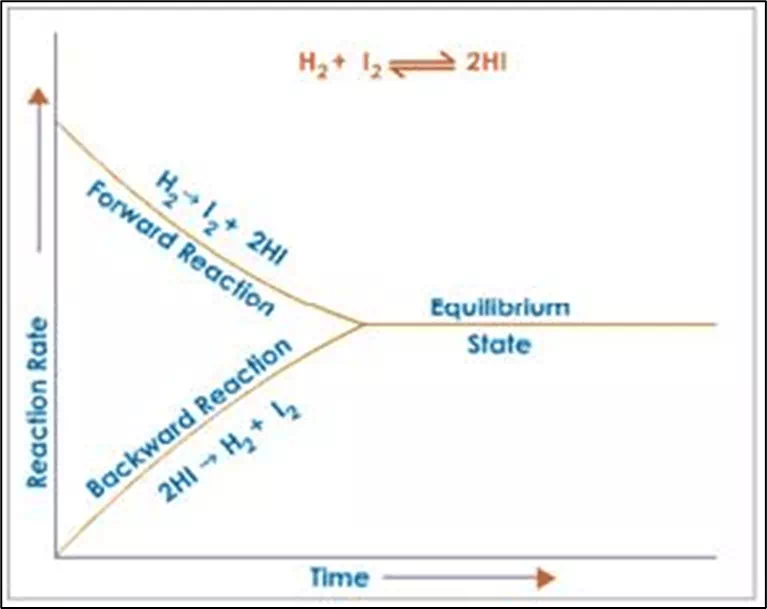
Equilibrium

3. A system of chemical substances at equilibrium even though having an unchanging composition is most often not static.

4. Molecules of the substances continue to react with one another thus giving rise to a dynamic equilibrium.

5. Thus, the concept describes the state in which the parameters such as chemical composition remains unchanged over time.

Energy

  1. In the context of chemistry, energy is an attribute of a substance as a consequence of its atomic,
    molecular or aggregate structure.
  2. Since a chemical transformation is accompanied by a change in one or more of these kinds of structure, it is invariably accompanied by an increase or decrease of energy of the substances involved.
  3. Some energy is transferred between the surroundings and the reactants of the reaction in the form of heat or light; thus, the products of a reaction may have more or less energy than the reactants.
  4. A reaction is said to be exergonic if the final state is lower on the energy scale than the initial state.
  5. in the case of endergonic reactions, the situation is reverse.
  6. A reaction is said to be exothermic if the reaction releases heat to the surroundings.
  7. in the case of endothermic reactions, the reaction absorbs heat from the surroundings.
  8. Chemical reactions are invariably not possible unless the reactants surmount an energy barrier known as the activation energy.
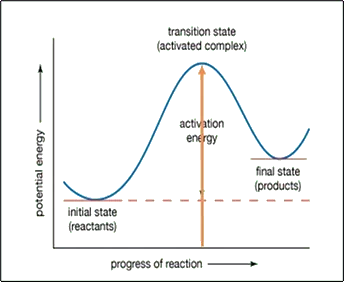
Energy Scale

9. The speed of a chemical reaction (at given temperature T) is related to the activation energy E, by the

10. Boltzmann՚s population factor - that is the probability of molecule to have energy greater than or equal to Eat the given temperature T.

11. This exponential dependence of a reaction rate on temperature is known as the Arrhenius equation.

12. The activation energy necessary for a chemical reaction can be in the form of heat, light, electricity or mechanical force in the form of ultrasound.

MCQs

  1. What is the representation of a reversible reaction?
  1. single arrow
  2. double arrow
  3. Bar
  4. None of the above

Answer: double arrow

  1. What is the term used for a state of a chemical reaction in which forward and reverse reactions take place at the same rate?
  1. chemical equilibrium
  2. Stable reaction
  3. reversible reaction
  4. forward reaction

Answer: A. chemical equilibrium

NCERT Solutions for All Classes (1 to 12)

Jump to free NCERT solutions, chapter Q&A, and textbooks for any grade

Popular Reference Solutions & Help Books

Step-by-step solutions for Mathematics and Science reference textbooks

Latest School & Board Updates

Real-time date sheets, admit cards, syllabus revisions, and exam notifications

Haryana Board Senior Secondary (12th) 20 Feb 2025
HBSE 12th 2024 Question Papers
View
Haryana Board Secondary (10th) 20 Feb 2025
HBSE 10th 2024 Question Papers
View
Haryana Board Senior Secondary (12th) 19 Feb 2025
HBSE 9th Model Papers 2025
View
Haryana Board Senior Secondary (12th) 19 Feb 2025
HBSE 11th Model Papers 2025
View
State Board Primary (1-5) 15 Feb 2025
BHU SET 2025 Application Form
View

Frequently Asked Questions

Common queries regarding NCERT textbook solutions & school curriculum

Are these NCERT solutions available 100% free of charge?

Yes. All NCERT solutions, chapter questions, textbook exercises, and download guides published on IndCareer Schools are completely free for students, parents, and educators without requiring any paid subscription or login.

Which subjects are covered for this class?

For Class 1, comprehensive NCERT solutions are provided for Mathematics (Math-Magic / गणित का जादू), English (Marigold & Mridang), and Hindi (Rimjhim / रिमझिम), alongside printable worksheets and textbook PDF downloads.

Are these solutions updated according to the latest CBSE / NCERT guidelines?

Yes. Our academic editorial team continually aligns all solutions and textbook references with the latest National Education Policy (NEP) and the rationalized curriculum issued by NCERT and the Central Board of Secondary Education (CBSE).

How can I download the official NCERT books in PDF format?

You can access official NCERT textbooks by clicking on the textbook links provided in the study content section above or by visiting the Class 1 to 12 NCERT Directory on IndCareer Schools.