State Board K-12 (All Classes) Private Session 2025-26 Free Open Access

Basic Chemistry: Atomic Number and Atomic Mass, Isotopes and Radio Isotopes

Table of Contents Atomic number and atomic mass Periodic Table and Chemical Bonds Isotopes Radioisotopes Learning Outcomes After studying this lesson, you shall be able to: Atomic number and atomic...

Curriculum State Board
Applicable Grade K-12 (All Classes)
Medium English & Hindi
Resource Format Chapter Q&A / PDF

Textbook Solutions & Academic Guide

Verified chapter-wise solutions, answers, and study notes

Curriculum & Exam Preparation Note: Regular practice of NCERT textbook exercises and chapter-end questions establishes strong conceptual clarity for primary and secondary examinations.

Table of Contents

  1. Atomic number and atomic mass
  2. Periodic Table and Chemical Bonds
  3. Isotopes
  4. Radioisotopes

Learning Outcomes

After studying this lesson, you shall be able to:

  1. Atomic number and atomic mass
  2. Isotopes
  3. Radio isotopes

Atoms and Elements

Atomic Number and Atomic Mass

  1. The atomic number of an atom is the number of protons in the atom
  2. and if the atom is neutral it equals the number of electrons.
  3. The atomic mass is the total mass of the protons and neutrons in the atom.
Atoms and Elements

Element

  1. The concept of chemical element is related to that of chemical substance.
  2. A chemical element is specifically a substance which is composed of a single type of atom.
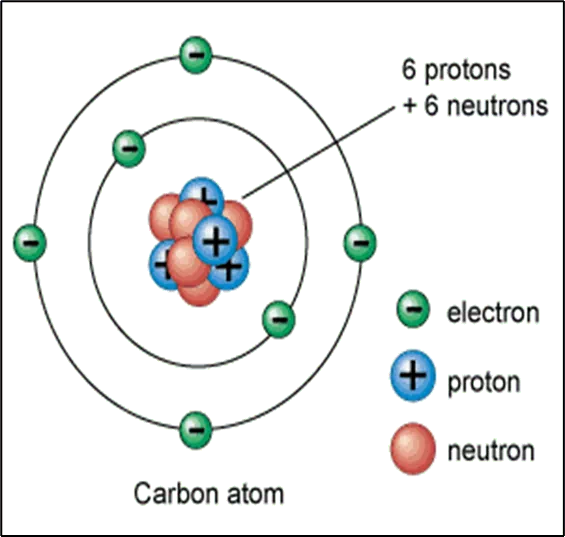
  3. For example, all atoms with 6 protons in their nuclei are atoms of the chemical element carbon, and all atoms with 92 protons in their nuclei are atoms of the element uranium.
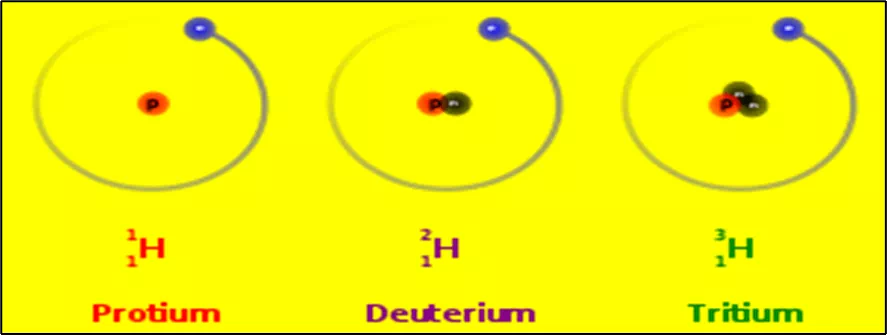
  4. Although all the nuclei of all atoms belonging to one element will have the same number of protons, they may not necessarily have the same number of neutrons; such atoms are termed isotopes.
  5. In fact, several isotopes of an element may exist.
  6. Ninety-four different chemical elements or types of atoms based on the number of protons are observed on earth naturally,having at least one isotope that is stable or has a very long half-life.
  7. Isotopes are atoms that have the same atomic number (number of protons) but differ in atomic mass.
Number of protons

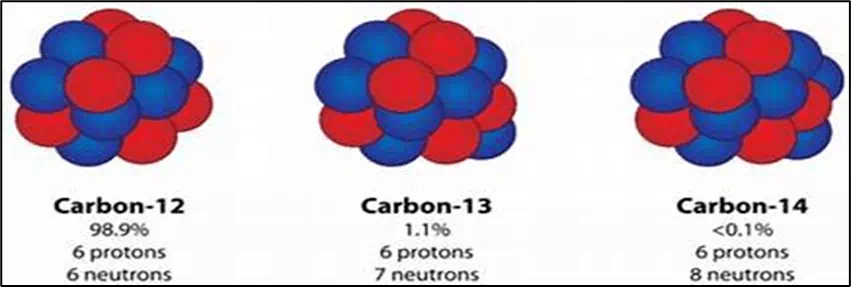
8. For instance, most carbon has six protons and six neutrons and thus atomic mass is approximately 12.

9. Some carbon atoms have an atomic mass of 13 and thus have six protons and seven neutrons.

10. All isotopes of the same element have about the same chemical properties because the number of electrons is the same
Carbon Atoms

Radioisotopes

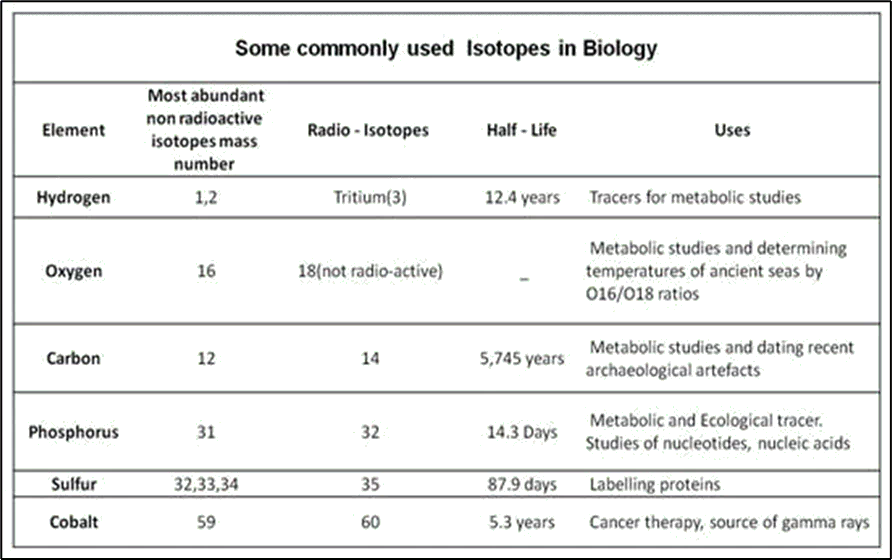
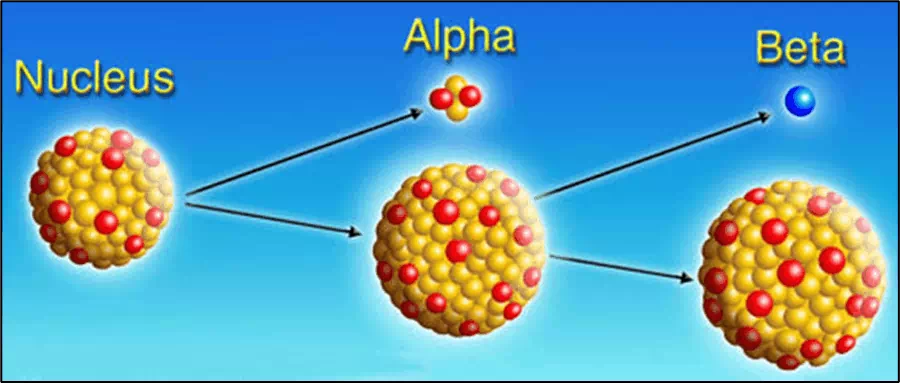
  1. Many elements have multiple isotopes, some of which may be radioactive.
  2. Radioactive isotopes are called radioisotopes and are characterized by a constant rate of decay into other elements orisotopes.
  3. Some common isotopes in biology and their half-lives are here.
Radio-Isotopes
Some Commonly Used Isotopes

4. The half-life of a radioisotope is the time in which it takes half of a starting amount of radioisotope to decay into some thing else.

5. This decay is accompanied by the release of various forms of radiation.

6. This is important for biologists because it allows them to use radioisotopes to trace the fate of elements in biological systems and to date fossils by measuring the ratios of different radioisotopes in the fossil.

MCQs

1. Atoms that have the same atomic number but differ in atomic mass are called?

  1. Isotones
  2. Neutrons
  3. Element
  4. Isotopes

Answer: D. Isotopes

2. Which among the following denotes atomic number?

  1. Electron
  2. Nucleus
  3. Neutron
  4. Proton

Answer: D. Proton

#Atomic number and atomic mass

#Isotopes

#Radio isotopes

NCERT Solutions for All Classes (1 to 12)

Jump to free NCERT solutions, chapter Q&A, and textbooks for any grade

Popular Reference Solutions & Help Books

Step-by-step solutions for Mathematics and Science reference textbooks

Latest School & Board Updates

Real-time date sheets, admit cards, syllabus revisions, and exam notifications

Haryana Board Senior Secondary (12th) 20 Feb 2025
HBSE 12th 2024 Question Papers
View
Haryana Board Secondary (10th) 20 Feb 2025
HBSE 10th 2024 Question Papers
View
Haryana Board Senior Secondary (12th) 19 Feb 2025
HBSE 9th Model Papers 2025
View
Haryana Board Senior Secondary (12th) 19 Feb 2025
HBSE 11th Model Papers 2025
View
State Board Primary (1-5) 15 Feb 2025
BHU SET 2025 Application Form
View

Frequently Asked Questions

Common queries regarding NCERT textbook solutions & school curriculum

Are these NCERT solutions available 100% free of charge?

Yes. All NCERT solutions, chapter questions, textbook exercises, and download guides published on IndCareer Schools are completely free for students, parents, and educators without requiring any paid subscription or login.

Which subjects are covered for this class?

For Class 1, comprehensive NCERT solutions are provided for Mathematics (Math-Magic / गणित का जादू), English (Marigold & Mridang), and Hindi (Rimjhim / रिमझिम), alongside printable worksheets and textbook PDF downloads.

Are these solutions updated according to the latest CBSE / NCERT guidelines?

Yes. Our academic editorial team continually aligns all solutions and textbook references with the latest National Education Policy (NEP) and the rationalized curriculum issued by NCERT and the Central Board of Secondary Education (CBSE).

How can I download the official NCERT books in PDF format?

You can access official NCERT textbooks by clicking on the textbook links provided in the study content section above or by visiting the Class 1 to 12 NCERT Directory on IndCareer Schools.