

Contents
- 1 Quick Facts: HR Management at a Glance
- 2 The Roadmap: How to Become an HR Manager in India
- 3 Entrance Exams & Admission (2026)
- 4 Top 5 HR Institutes in India
- 5 Expert Quote
- 6 Student Interview: Day in the Life
- 7 Skills for Success
- 8 Salary & Growth Prospects (India 2026)
- 9 Similar Career Options
- 10 Pros & Cons of an HR Career
- 11 FAQ
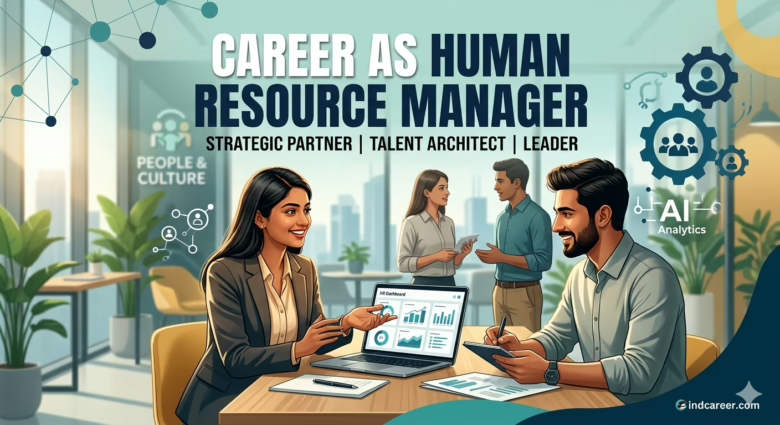
In the era of “Human-Centric Tech,” the role of an HR Manager has shifted from administrative record-keeping to becoming a strategic business partner. As Indian startups and MNCs prioritize employee retention and organizational culture in 2026, HR professionals are now the architects of the modern workplace, managing everything from AI-driven recruitment to mental health advocacy.
Quick Facts: HR Management at a Glance
| Feature | Details |
| Duration | 2 Years (MBA/PGDM), 3 Years (BBA/BMS) |
| Eligibility | Graduation in any stream (Min. 50% marks) |
| Key Entrance Exams | CAT, XAT, TISSNET/CUET-PG, NMAT, SNAP |
| Starting Salary | ₹6.0 Lakhs – ₹12.0 Lakhs per annum (Tier-1) |
| Top Recruiters | Google, Deloitte, Reliance, Tata Group, Amazon |
The Roadmap: How to Become an HR Manager in India
1. School Level (Foundation)
Students from any stream (Commerce, Humanities, or Science) can pursue HR. However, having a background in Commerce or Humanities with Psychology can provide an early understanding of organizational behavior and economics.
2. Undergraduate Degrees
While you can enter HR with any degree, the most direct paths are:
- BBA/BMS in HR: Provides a foundational understanding of business and people management.
- Psychology (Hons): Excellent for those interested in the behavioral aspects of HR and Industrial Psychology.
3. Postgraduate Specialization (The Game Changer)
In India, a Master’s degree is almost mandatory for high-growth HR roles.
- MBA in Human Resource Management: The most recognized qualification.
- MA in HRM & Labour Relations: Specifically offered by institutes like TISS, focusing on social sciences and labor laws.
- PGDM in HR: Equivalent to an MBA, offered by top private B-schools.
Entrance Exams & Admission (2026)
To get into a premier HR program, you must clear one of these national-level hurdles:
- CAT (Common Admission Test): The gateway to IIMs and several top-tier private institutes.
- XAT (Xavier Aptitude Test): Conducted by XLRI Jamshedpur, specifically known for having the best HR program in India.
- TISSNET / CUET-PG: Required for the Tata Institute of Social Sciences (TISS), focusing heavily on General Awareness and Social Issues.
- NMAT/SNAP: Entry points for NMIMS and Symbiosis (SCMHRD), both of which have elite HR specializations.
Top 5 HR Institutes in India
- XLRI – Xavier School of Management, Jamshedpur: Often cited as the “HR Capital of India.”
- TISS, Mumbai: Renowned for its focus on Labour Relations and highly affordable fee structure.
- MDI, Gurgaon: Offers a specialized PGP-HRM program with excellent corporate tie-ups.
- SCMHRD, Pune: A premier institute under Symbiosis specifically dedicated to HR Excellence.
- IIM Ranchi / IIM Indore: Leading IIMs that offer specialized HR tracks.
Expert Quote
“In 2026, the HR Manager is no longer a ‘support’ function; they are data-driven strategists. We are looking for professionals who can interpret workforce analytics to predict attrition and use ‘Design Thinking’ to craft employee experiences that rival customer experiences.”
— Sanjay Verma, Chief People Officer at a Global Tech Firm.
Student Interview: Day in the Life
Interviewee: Ananya K., 2nd Year MBA-HR Student, SCMHRD.
Q: Is HR just about ‘hiring and firing’ as the stereotypes suggest?
Ananya: Not at all. Today, my day involves analyzing employee engagement data, sitting in on board meetings for workforce planning, and designing remote-work policies that actually work.
Q: How much ‘Math’ is involved?
Ananya: More than you’d think! HR Analytics is huge now. You need to be comfortable with statistics and data visualization tools to justify your decisions to the CEO.
Q: What is the biggest challenge?
Ananya: Staying empathetic while making tough business decisions. It’s a delicate balance.
Skills for Success
- Technical: HRIS (Workday/Oracle), People Analytics, Labor Law Compliance, Talent Acquisition Suites.
- Soft Skills: Conflict Resolution, Strategic Thinking, Ethical Judgment, and Negotiation.
Salary & Growth Prospects (India 2026)
| Experience Level | Annual Salary (Range) | Key Roles |
| Entry-Level (0-2 yrs) | ₹6.0 LPA – ₹12.0 LPA | HR Generalist, Talent Scout |
| Mid-Level (3-8 yrs) | ₹12.0 LPA – ₹22.0 LPA | HR Business Partner (HRBP) |
| Senior-Level (10+ yrs) | ₹25.0 LPA – ₹60.0+ LPA | CHRO, VP of People & Culture |
Similar Career Options
- Industrial Relations Specialist
- Organizational Development (OD) Consultant
- Corporate Trainer / L&D Manager
- Executive Recruiter (Headhunter)
- Diversity & Inclusion (D&I) Lead
- Employee Relations Manager
Pros & Cons of an HR Career
Pros
- Strategic Influence: You shape the culture and future of the company.
- Networking: You interact with every department and level of management.
- Global Mobility: Modern HR practices are standardized across global MNCs.
Cons
- Conflict Heavy: Managing grievances and terminations can be emotionally draining.
- Perception Bias: Often misunderstood by other departments as “non-productive” staff.
- Compliance Pressure: Keeping up with ever-changing labor laws and tax regulations.
FAQ
Yes. In fact, many tech firms prefer “Tech-HRs” (Engineers with an MBA-HR) because they understand the technical requirements of the staff they are hiring.
While not legally mandatory, 90% of high-paying HR roles in India require an MBA or PGDM from a recognized institute.
Usually no, but Senior HR Managers and Campus Recruiters may travel frequently for recruitment drives or visiting different regional offices.
Excellent. PSUs like ONGC, NTPC, and IOCL recruit HR Officers through UGC-NET or dedicated entrance exams with high pay scales and job security.
AI is replacing the repetitive tasks (screening resumes, scheduling), but it cannot replace the human element of negotiation, empathy, and organizational strategy.