Curriculum & Exam Preparation Note: Regular practice of NCERT textbook exercises and chapter-end questions establishes strong conceptual clarity for primary and secondary examinations.
NCERT Exemplar Class 9 Science Chapter 3: Atoms And Molecules. NCERT Exemplar Solutions for Class 9 Science Chapter 3 Atoms And Molecules prepare students for their Class 9 exams thoroughly.
Science problems and solutions for the Class 9 pdf are provided here which are similar to the questions being asked in the previous year's board.
NCERT Exemplar Class 9 Science Chapter 3: Atoms And Molecules
Class 9: Science Chapter 3 solutions. Complete Class 9 Science Chapter 3 Notes.
Multiple Choice Questions
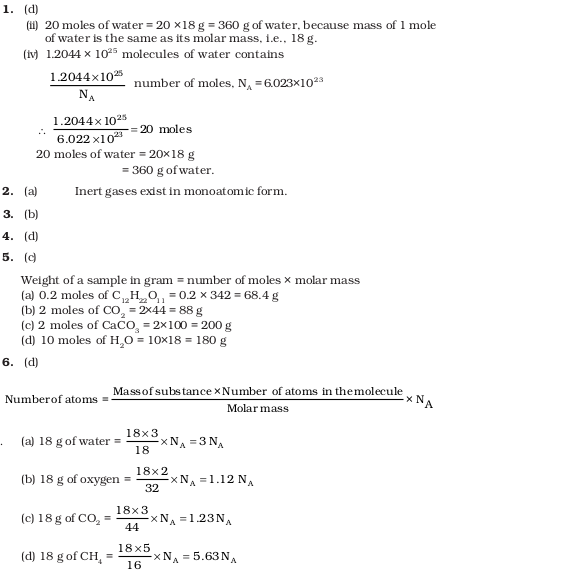
- Which of the following correctly represents 360 g of water?
(i) 2 moles of H20
(ii) 20 moles of water
(iii) 6.022 × 10²³ molecules of water
(iv) 1.2044×1025 molecules of water- (a) (i)
- (b) (i) and (iv)
- (c) (ii) and (iii)
- (d) (ii) and (iv)
- Which of the following statements is not true about an atom?
- (a) Atoms are not able to exist independently
- (b) Atoms are the basic units from which molecules and ions are formed
- (c) Atoms are always neutral in nature
- (d) Atoms aggregate in large numbers to form the matter that we can see, feel or touch
- The chemical symbol for nitrogen gas is
- (a) Ni
- (b) N2
- (c) N+
- (d) N
- The chemical symbol for sodium is
- (a) So
- (b) Sd
- (c) NA
- (d) Na
- Which of the following would weigh the highest?
- (a) 0.2 mole of sucrose (C12H22O11)
- (b) 2 moles of CO2
- (c) 2 moles of CaCO3
- (d) 10 moles of H2O
- Which of the following has maximum number of atoms?
- (a) 18g of H2O
- (b) 18g of O2
- (c) 18g of CO2
- (d) 18g of CH4
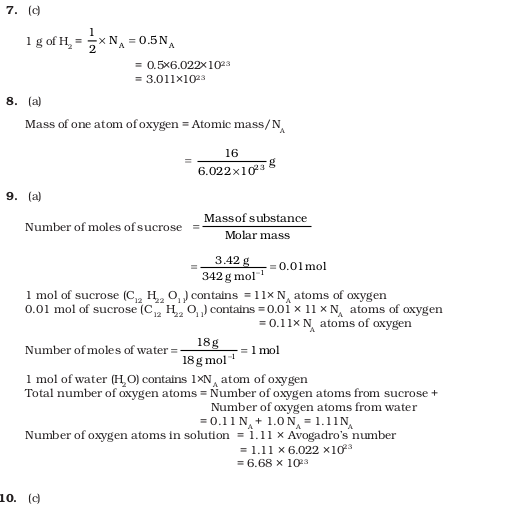
- Which of the following contains maximum number of molecules?
- (a) 1g CO2
- (b) 1g N2
- (c) 1g H2
- (d) 1g CH4
- Mass of one atom of oxygen is
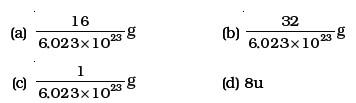
- 3.42 g of sucrose are dissolved in 18g of water in a beaker. The number of oxygen atoms in the solution are
- (a) 6.68 × 10²³
- (b) 6.09 × 10²²
- (c) 6.022 × 10²³
- (d) 6.022 × 10²¹
- A change in the physical state can be brought about
- (a) only when energy is given to the system
- (b) only when energy is taken out from the system
- (c) when energy is either given to, or taken out from the system
- (d) without any energy change
Short Answer Type Questions
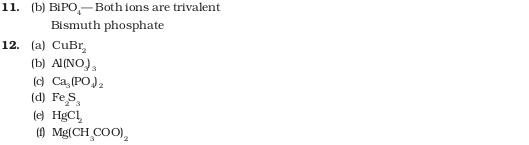
- Which of the following represents a correct chemical formula? Name it.
- (a) CaCl
- (b) BiPO4
- (c) NaSO4
- (d) NaS
- Write the molecular formulae for the following compounds
- (a) Copper (II) bromide
- (b) Aluminium (III) nitrate
- (c) Calcium (II) phosphate
- (d) Iron (III) sulphide
- (e) Mercury (II) chloride
- (f) Magnesium (II) acetate
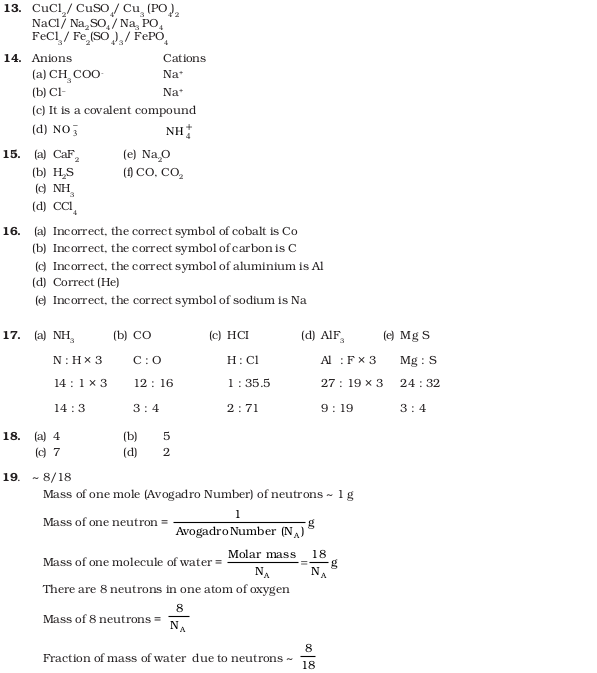
- Write the molecular formulae of all the compounds that can be formed by the combination of following ions
Cu2+, Na+, Fe3+, C1–, SO42-, PO43- - Write the cations and anions present (if any) in the following compounds
- (a) CH3COONa
- (b) NaCl
- (c) H2
- (d) NH4NO3
- Give the formulae of the compounds formed from the following sets of elements
- (a) Calcium and fluorine
- (b) Hydrogen and sulphur
- (c) Nitrogen and hydrogen
- (d) Carbon and chlorine
- (e) Sodium and oxygen
- (f) Carbon and oxygen
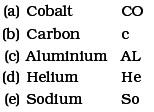
- Which of the following symbols of elements are incorrect? Give their correct symbols
- Give the chemical formulae for the following compounds and compute the ratio by mass of the combining elements in each one of them. (You may use appendix-III).
- (a) Ammonia
- (b) Carbon monoxide
- (c) Hydrogen chloride
- (d) Aluminium fluoride
- (e) Magnesium sulphide
- State the number of atoms present in each of the following chemical species
- (a) CO32–
- (b) PO33–
- (c) P2O5
- (d) CO
- What is the fraction of the mass of water due to neutrons?
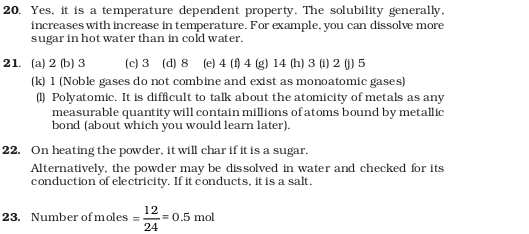
- Does the solubility of a substance change with temperature? Explain with the help of an example.
- Classify each of the following on the basis of their atomicity.
- (a) F2
- (b) NO2
- (c) N2O
- (d) C2H6
- (e) P4
- (f) H2O2
- (g) P4O10
- (H) O3
- (i) HCl
- (j) CH4
- (k) He
- (l) Ag
- You are provided with a fine white coloured powder which is either sugar or salt. How would you identify it without tasting?
- Calculate the number of moles of magnesium present in a magnesium ribbon weighing 12 g. Molar atomic mass of magnesium is 24g mol–1.
Long Answer Type Questions
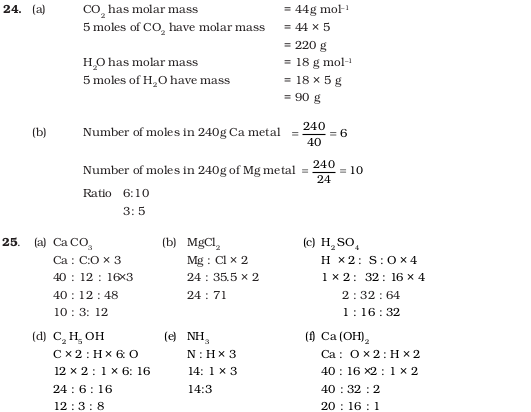
- Verify by calculating that
- (a) 5 moles of CO2 and 5 moles of H2O do not have the same mass.
- (b) 240 g of calcium and 240 g magnesium elements have a mole ratio of 3:5.
- Find the ratio by mass of the combining elements in the following compounds. (You may use Appendix-III)
- (a) CaCO3
- (b) MgCl2
- (c) H2SO4
- (d) C2H5OH
- (e) NH3
- (f) Ca(OH)2
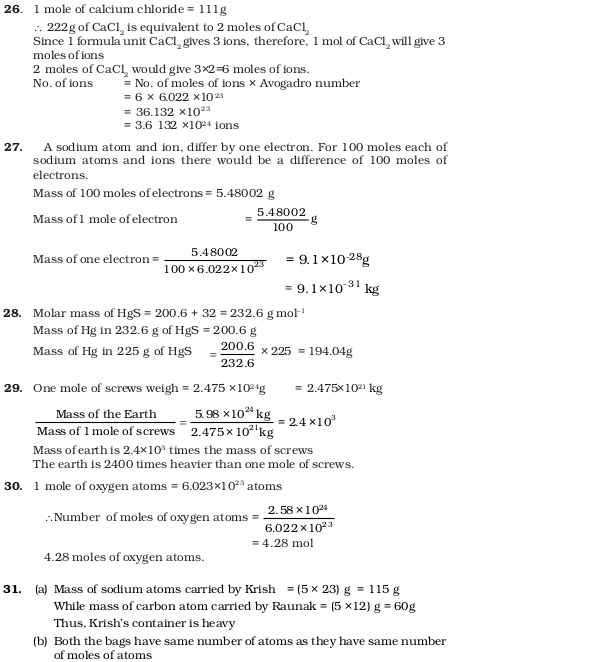
- Calcium chloride when dissolved in water dissociates into its ions according to the following equation.
CaCl2(aq) → Ca2+(aq) + 2Cl–(aq)
Calculate the number of ions obtained from CaCl2 when 222 g of it is dissolved in water. - The difference in the mass of 100 moles each of sodium atoms and sodium ions is 5.48002 g. Compute the mass of an electron.
- Cinnabar (HgS) is a prominent ore of mercury. How many grams of mercury are present in 225 g of pure HgS? Molar mass of Hg and S are 200.6 g mol–1 and 32 g mol–1 respectively.
- The mass of one steel screw is 4.11g. Find the mass of one mole of these steel screws. Compare this value with the mass of the Earth (5.98 × 1024kg).
Which one of the two is heavier and by how many times? - A sample of vitamic C is known to contain 2.58 ×1024 oxygen atoms. How many moles of oxygen atoms are present in the sample?
- Raunak took 5 moles of carbon atoms in a container and Krish also took 5 moles of sodium atoms in another container of same weight. (a) Whose container is heavier? (b) Whose container has more number of atoms?
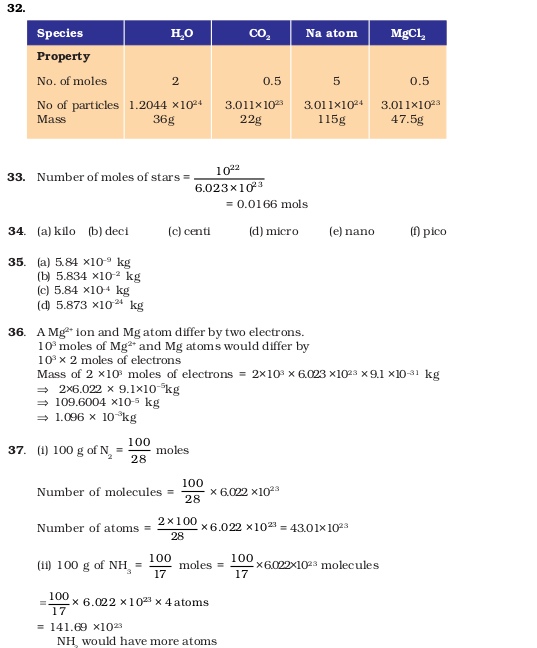
- Fill in the missing data in the Table 3.1
Table 3.1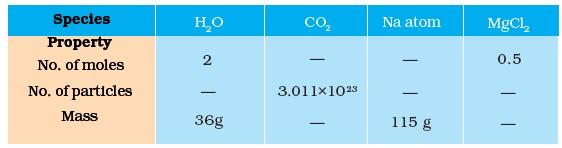
- The visible universe is estimated to contain 1022 stars. How many moles of stars are present in the visible universe?
- What is the SI prefix for each of the following multiples and sub multiples of a unit?
- (a) 103
- (b) 10-1
- (c) 10-2
- (d) 10-6
- (e) 10-9
- (f) 10-12
- Express each of the following in kilograms
- (a) 5.84 × 10⁻³mg
- (b) 58.34 g
- (c) 0.584g
- (d) 5.873 × 10⁻²¹g
- Compute the difference in masses of 10 3 moles each of magnesium atoms and magnesium ions.
(Mass of an electron = 9.1 × 10⁻³¹kg) - Which has more number of atoms?
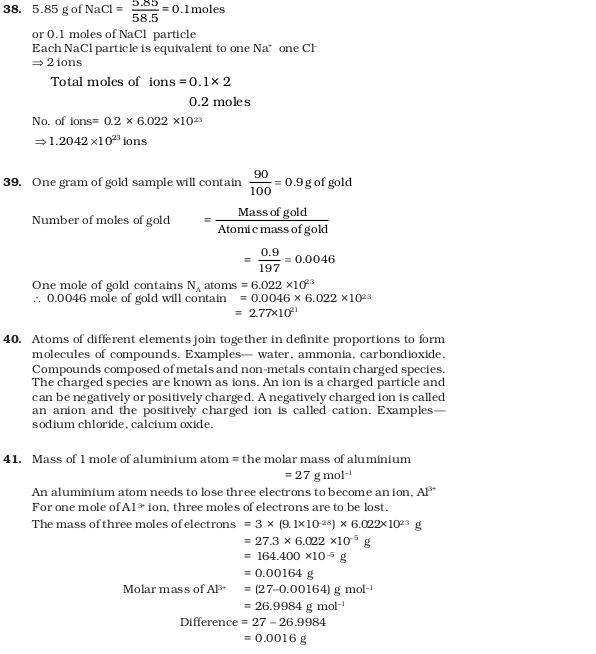
100g of N2 or 100 g of NH3 - Compute the number of ions present in 5.85 g of sodium chloride.
- A gold sample contains 90% of gold and the rest copper. How many atoms of gold are present in one gram of this sample of gold?
- What are ionic and molecular compounds? Give examples.
- Compute the difference in masses of one mole each of aluminium atoms and one mole of its ions. (Mass of an electron is 9.1 × 10⁻²⁸g). Which one is heavier?
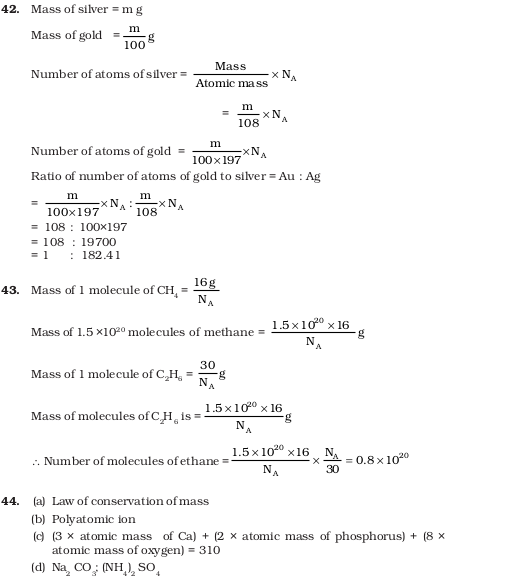
- A silver ornament of mass ‘m’ gram is polished with gold equivalent to 1% of the mass of silver. Compute the ratio of the number of atoms of gold and silver in the ornament.
- A sample of ethane (C2H6) gas has the same mass as 1.5 × 10²⁰ molecules of methane (CH4). How many C2H6 molecules does the sample of gas contain?
- Fill in the blanks
- (a) In a chemical reaction, the sum of the masses of the reactants and products remains unchanged. This is called ————.
- (b) A group of atoms carrying a fixed charge on them is called ————.
- (c) The formula unit mass of Ca3(PO4)2 is ————.
- (d) Formula of sodium carbonate is ———— and that of ammonium sulphate is ————.
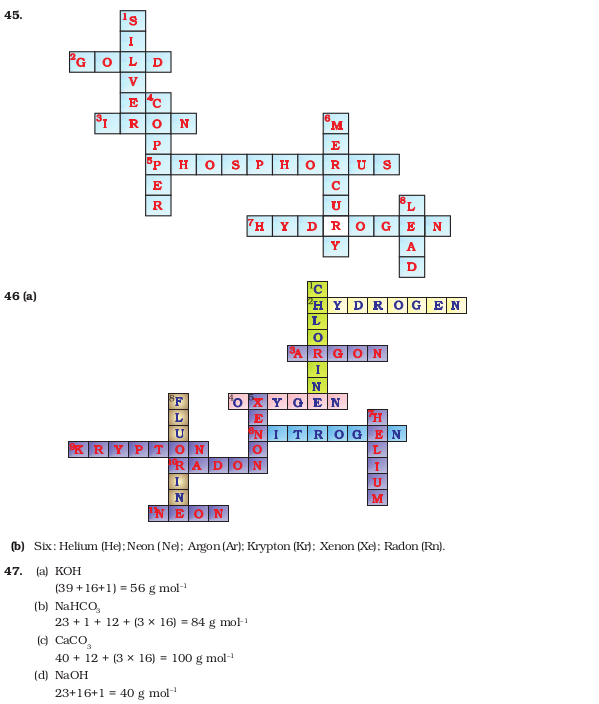
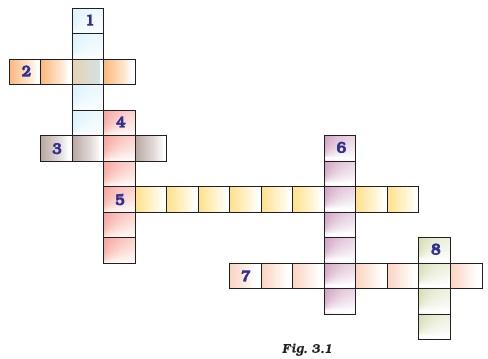
- Complete the following crossword puzzle (Fig. 3.1) by using the name of the chemical elements. Use the data given in Table 3.2.
Table 3.2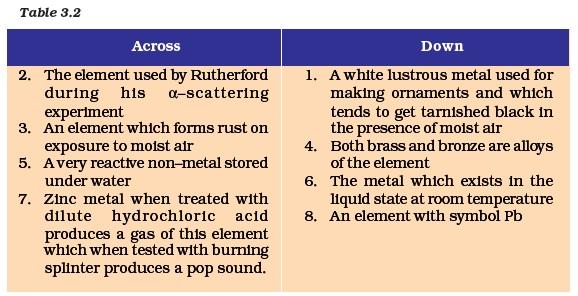
- (a) In this crossword puzzle (Fig 3.2), names of 11 elements are hidden.
Symbols of these are given below. Complete the puzzle.- 1. Cl
- 2. H
- 3. Ar
- 4. O
- 5. Xe
- 6. N
- 7. He
- 8. F
- 9. Kr
- 10. Rn
- 11. Ne
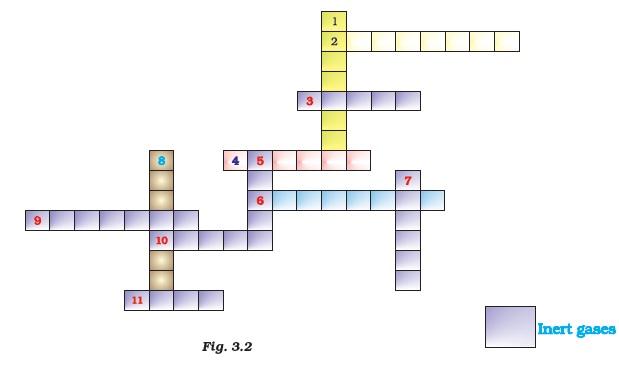
- (b) Identify the total number of inert gases, their names and symbols from this cross word puzzle.
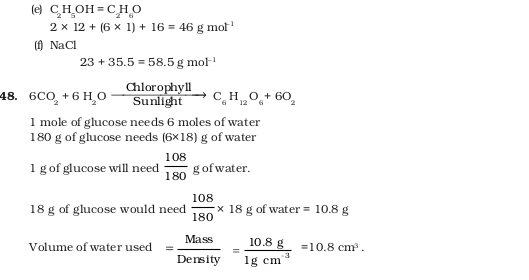
- Write the formulae for the following and calculate the molecular mass for each one of them.
- (a) Caustic potash
- (b) Baking powder
- (c) Lime stone
- (d) Caustic soda
- (e) Ethanol
- (f) Common salt
- In photosynthesis, 6 molecules of carbon dioxide combine with an equal number of water molecules through a complex series of reactions to give a molecule of glucose having a molecular formula C6H12O6. How many grams of water would be required to produce 18 g of glucose? Compute the volume of water so consumed assuming the density of water to be 1g cm–3.
Answers