
Curriculum & Exam Preparation Note: Regular practice of NCERT textbook exercises and chapter-end questions establishes strong conceptual clarity for primary and secondary examinations.
NCERT Exemplar Class 11 Biology Chapter 14: Respiration in Plants. NCERT Exemplar Solutions for Class 11 Biology Chapter 14 Respiration in Plants prepare students for their Class 11 exams thoroughly.
Biology problems and solutions for the Class 11 pdf are provided here which are similar to the questions being asked in the previous year's board.
NCERT Exemplar Class 11 Biology Chapter 14: Respiration in Plants
Class 11: Biology Chapter 14 solutions. Complete Class 11 Biology Chapter 14 Notes.
Multiple Choice Questions
- The ultimate electron acceptor of respiration in an aerobic organisms is:
- a. Cytochrome
- b. Oxygen
- c. Hydrogen
- d Glucose
- Phosphorylation of glucose during glycolysis is catalysed by
- a. Phosphoglucomutase
- b. Phosphoglucoisomerase
- c. Hexokinase
- d. Phosphorylase
- Pyruvic acid, the key product of glycolysis can have many metabolic fates. Under aerobic condition it forms
- a. Lactic acid
- b. CO2 + H2O
- c. Acetyl CoA + CO2
- d. Ethanol + CO2
- Electron Transport System (ETS) is located in mitochondrial
- a. Outer membrane
- b. Inter membrane space
- c. Inner membrane
- d. Matrix
- Which of the following exhibits the highest rate of respiration?
- a. Growing shoot apex
- b. Germinating seed
- c. Root tip
- d. Leaf bud
- Choose the correct statement:
- a. Pyruvate is formed in the mitochondrial matrix.
- b. During the conversion of succinyl Co-A to succinic acid a molecule of ATP is synthesized.
- c. Oxygen is vital in respiration for removal of hydrogen.
- d. There is complete breakdown of glucose in fermentation.
- Mitochondria are called powerhouses of the cell. Which of the following observations support this statement?
- a. Mitochondria synthesise ATP
- b. Mitochondria have a double membrane
- c. The enzymes of the Krebs cycle and the cytochromes are found in mitochondria.
- d. Mitochondria are found in almost all plants and animal cells.
- The end product of oxidative phosphorylation is
- a. NADH
- b. Oxygen
- c. ADP
- d. ATP+H2O
- Match the following and choose the correct option from those given below.
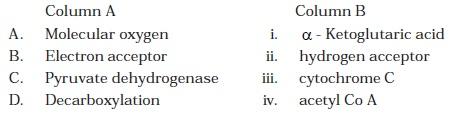
Options- a. A-ii, B-iii, C-iv, D-i
- b. A-iii, B-iv, C-ii, D-i
- c. A-ii, B-i, C-iii, D-iv
- d. A-iv, B-iii, C-i, D-ii
Very Short Answer Type Questions
- Energy is released during the oxidation of compounds in respiration. How is this energy stored and released as and when it is needed?
- Explain the term “Energy Currency”. Which substance acts as energy currency in plants and animals?
- Different substrates get oxidized during respiration. How does Respiratory Quotient (RQ) indicate which type of substrate, i.e., carbohydrate, fat or protein is getting oxidized?
R.Q = (A/B)
What do A and B stand for?
What type of substrates have R.Q. of 1, < 1 or > 1? - Fo-F1 particles participate in the synthesis of ________________.
- When does anaerobic respiration occur in man and yeast?
- Which of the following will release more energy on oxidation? Arrange them in ascending order.
- a. 1 gm of fat
- b. 1 gm of protein
- c. 1 gm of glucose
- d. 0.5 g of protein + 0.5g glucose
- The product of aerobic glycolysis in skeletal muscle and anaerobic fermentation in yeast are respectively _____________ and ________________.
Short Answer Type Questions
- If a person is feeling dizzy, glucose or fruit juice is given immediately but not a cheese sandwich, which might have more energy. Explain.
- What is meant by the statement “aerobic respiration is more efficient.”?
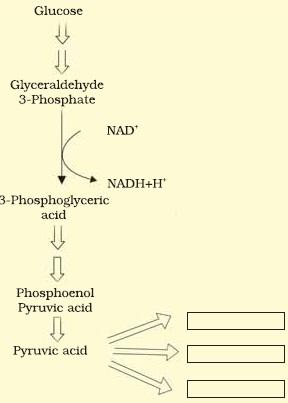
- Pyruvic acid is the end product of glycolysis. What are the three metabolic fates of pyruvic acid under aerobic and anaerobic conditions? Write in the space provided in the diagram.
- The energy yield in terms of ATP is higher in aerobic respiration than during anaerobic respiration. Why is there anaerobic respiration even in organisms that live in aerobic condition like human beings and angiosperms?
- Oxygen is an essential requirement for aerobic respiration but it enters the respiratory process at the end? Discuss.
- Respiration is an energy releasing and enzymatically controlled catabolic process which involves a step-wise oxidative breakdown of organic substances inside living cells.
In this statement about respiration explain the meaning of 1) Step-wise oxidative breakdown 2) Organic substances (used as substrates). - Comment on the statement – Respiration is an energy producing process but ATP is being used in some steps of the process.
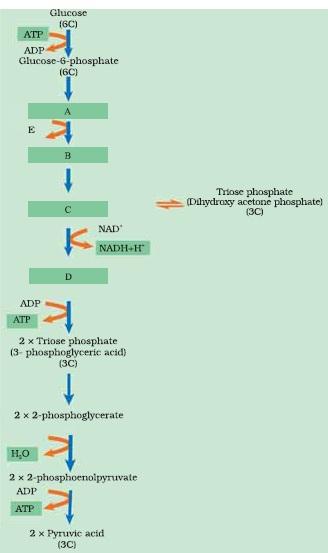
- The figure given below shows the steps in glycolysis. Fill in the missing steps A, B, C, D and also indicate whether ATP is being used up or released at step E?
- Why is respiratory pathway referred to as an amphibolic pathway? Explain.
- We commonly call ATP as the energy currency of the cell. Can you think of some other energy carriers present in a cell? Name any two.
- ATP produced during glycolysis is a result of substrate level phosphorylation. Explain.
- Do you know any step in the TCA cycle where there is substrate level phosphorylation. Which one?
- In a way green plants and cyanobacteria have synthesized all the food on the earth. Comment.
- When a substrate is being metabolized, why does not all the energy that is produced get released in one step. It is released in multiple steps.What is the advantage of step-wise release?
- Respiration requires O2.. How did the first cells on the earth manage to survive in an atmosphere that lacked O2?
- It is known that red muscle fibres in animals can work for longer periods of time continuously. How is this possible?
- The energy yield in terms of ATP is higher in aerobic respiration than during anaerobic respiration. Explain.
- RuBP carboxylase, PEPcase, Pyruvate dehydrogenase, ATPase, cytochrome oxidase, Hexokinase, Lactate dehydrogenase.
Select/choose enzymes from the list above which are involved in- a. Photosynthesis
- b. Respiration
- c. Both in photosynthesis and respiration
- How does a tree trunk exchange gases with the environment although it lacks stomata?
- Write two energy yielding reactions of glycolysis.
- Name the site (s) of pyruvate synthesis. Also, write the chemical reaction wherein pyruvic acid dehydrogenase acts as a catalyst.
- Mention the important series of events of aerobic respiration that occur in the matrix of the mitochondrion as well as one that take place in inner membrane of the mitochondrion.
- Respiratory pathway is believed to be a catabolic pathway. However, nature of TCA cycle is amphibolic. Explain.
Long Answer Type Questions
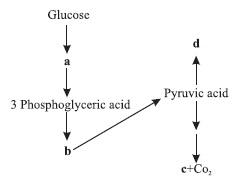
- In the following flow chart, replace the symbols a,b,c and d with appropriate terms. Briefly explain the process and give any two application of it.
- Given below is a diagram showing ATP synthesis during aerobic respiration, replace the symbols A, B, C, D and E by appropriate terms given in the box.
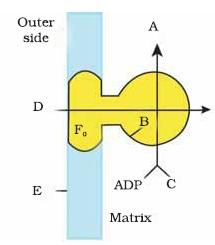
F1, Particle, Pi, 2H+ , Inner mitochondrial membrane, ATP, Fo particle, ADP - Oxygen is critical for aerobic respiration. Explain its role with respect to ETS.
- Enumerate the assumptions that we undertake in making the respiratory balance sheet. Are these assumptions valid for a living system? Compare fermentation and aerobic respiration in this context.
- Give an account of Glycolysis. Where does it occur? What are the end products? Trace the fate of these products in both aerobic and anaerobic respiration.
Answers to Multiple Choice Questions
| 1- b; | 2- c; | 3- c; | 4- b; | 5- b; | 6- c; |
| 7- a; | 8- d; | 9- a; |