
Welcome to the Class 10 Maths Formulas! We will cover a wide range of mathematical formulas that are essential for students preparing for their Class 10 board exams in India. These formulas are grouped by chapter, including Real Numbers, Polynomials, Pair of Linear Equations in Two Variables, Quadratic Equations, Arithmetic Progressions, Trigonometry, Coordinate Geometry, Geometry, and Statistics and Probability.
Class 10 Maths Formulas
By mastering these formulas, you will be able to solve complex mathematical problems with ease and confidence. Let's get started!
Important Class 10 Math Formulas
A list of some basic class 10 maths formulas related to most important topics covered under various school boards is given below:
- (a + b)3 = a3 + b3 + 3ab(a + b)
- (a – b)3 = a3 - b3 - 3ab(a – b)
- (x + y + z)2 = x2 + y2 + z2 + 2xy + 2yz + 2xz
- an = a + (n - 1) d
- Sn= n/2 [2a + (n - 1)d]
- sin2 θ + cos2 θ = 1 ⇒ sin2 θ = 1 - cos2 θ ⇒ cos2 θ = 1 - sin2 θ
- cosec2 θ - cot2 θ = 1 ⇒ cosec2 θ = 1 + cot2 θ ⇒ cot2 θ = cosec2 θ - 1
- sec2 θ - tan2 θ = 1 ⇒ sec2 θ = 1 + tan2 θ ⇒ tan2 θ = sec2 θ - 1
- sin θ cosec θ = 1 ⇒ cos θ sec θ = 1 ⇒ tan θ cot θ = 1
- Vol of Sphere = 4/3 ×π r3
- Surface Area of Sphere = 4πr2
Real Numbers
| Natural Numbers | N ={ 1, 2,3,4,5 … } |
| Whole Numbers | W={ 0, 1, 2, 3, 4, 5… } |
| Rational Numbers | Those numbers which can be presented in the form of a/b are called Rational Numbers. |
| Real Numbers | Real Numbers can be found on a number line |
| LCM (P, Q, R) | P.Q.R.H.C.F(P, Q, R) / [HCF ( P, Q) . HCF( Q, R) . HCF ( P, R)] |
| HCF (P, Q, R) | P.Q.R.L.C.M(P, Q, R) / [LCM ( P, Q) . LCM ( Q, R) . LCM ( P, R)] |
Polynomials
- (a+b)2 = a2+2ab+b2
- (a−b)2=a2−2ab+b2
- (x+a)(x+b) = x2+(a+b)x+ab
- a2−b2 = (a+b)(a−b)
- a3−b3 = (a−b)(a2+ab+b2)
- a3+b3 = (a+b)(a2−ab+b2)
- (a+b)3 = a3+3a2b+3ab2+b3
- (a−b)3 = a3−3a2b+3ab2−b3
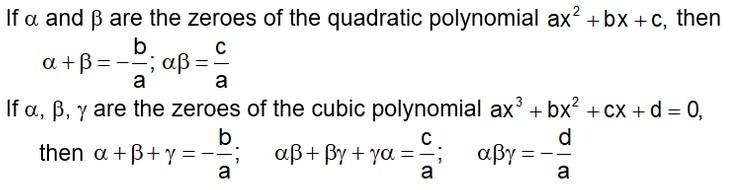
Class 10 Algebra Formulas
- (a + b)2 = a2 + 2ab + b2
- (a - b)2 = a2 - 2ab + b2
- (a + b) (a - b) = a2 - b2
- (x + a)(x + b) = x2 + (a + b)x + ab
- (x + a)(x - b) = x2 + (a - b)x - ab
- (x - a)(x + b) = x2 + (b - a)x - ab
- (x - a)(x - b) = x2 - (a + b)x + ab
- (a + b)3 = a3 + b3 + 3ab(a + b)
- (a - b)3 = a3 - b3 - 3ab(a - b)
- (x + y + z)2 = x2 + y2 + z2 + 2xy + 2yz + 2xz
- (x + y - z)2 = x2 + y2 + z2 + 2xy - 2yz - 2xz
- (x - y + z)2 = x2 + y2 + z2 - 2xy - 2yz + 2xz
- (x - y - z)2 = x2 + y2 + z2 - 2xy + 2yz - 2xz
- x3 + y3 + z3 - 3xyz = (x + y + z)(x2 + y2 + z2 - xy - yz - xz)
Pair of Linear Equations in Two Variables
- Linear equation in one variable: ax +b =0, a≠0 and a&b are real numbers
- Linear equation in two variables: ax+ by+ c =0 , a≠0 & b≠0 and a,b & c are real numbers
- Linear equation in three variables: ax+ by+ cz= 0, a≠0 , b≠0, c≠0 and a,b,c,d are real numbers
- a1x+b1y+c1=0
- a2x+b2y+c2=0
Where a1, b1, c1, a2, b2, c2 are all real numbers and a12+ b12 ≠ 0, a22+ b22 ≠ 0
Quadratic Equations
x = (α, β) = [-b ± √(b2 – 4ac)]/2a provided b2 – 4ac >= 0
A quadratic equation ax2 + bx + c = 0 has
(i) two distinct real roots, if b2 – 4ac > 0,
(ii) two equal roots (i.e., coincident roots), if b2 – 4ac = 0, and
(iii) no real roots, if b2 – 4ac < 0
Arithmetic Progression Formulas
The nth term of AP = nth term = a + (n-1) d
Sum of n terms in AP = Sn = n/2[2a + (n − 1) × d]
Sum of all terms in AP with the last term ‘l’ = n/2(a + l)
Triangles
Here,
A = Area of Triangle
B = Base of Triangle
H = Height of a Triangle
Area of Triangle = A = ½ (b × h) square units
Area of an Isosceles Triangle = 1/4 b√(4a2 – b2)
Area of a Right Triangle = A = 1/2 × Base × Height
Area of an Equilateral Triangle = A = (√3)/4 × side2
Coordinate Geometry
- Distance Formula to find distance between two points P(x1,y1) and Q(x2,y2) is = √[(x2 – x1)2 + (y2 – y1)2 ]
- Distance of a point P(x, y) from the origin is = √x2 + y2
- The coordinates of the point P(x, y) which divides the line segment joining the points A(x1 , y1 ) and B(x2 , y2 ) internally in the ratio m1 : m2 = Section Formula = ((m1x2 + m2x1)/m1+ m2 , (m1y2 + m2y1)/m1+ m2)
- The mid-point of the line segment joining the points P(x1, y1) and Q(x2, y2 ) = [(x1+x2/2), (y1+y2/2)
Trigonometry Formulas
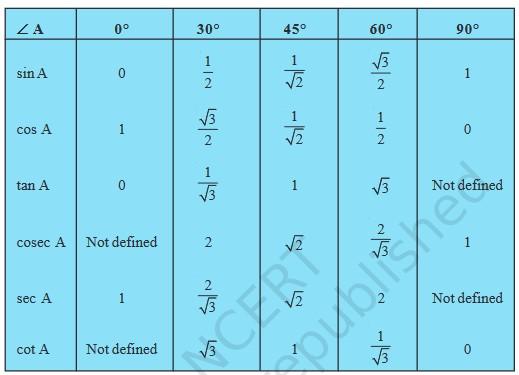
Trigonometric Table for Class 10
- sin(90° - A) = cos A
- cos(90° - A) = sin A
- tan(90° - A) = cot A
- cot(90° - A) = tan A
- sec(90° - A) = cosec A
- cosec(90° - A) = sec A
- sin2 θ + cos2 θ = 1 ⇒ sin2 θ = 1 - cos2 θ ⇒ cos2 θ = 1 - sin2 θ
- cosec2 θ - cot2 θ = 1 ⇒ cosec2 θ = 1 + cot2 θ ⇒ cot2 θ = cosec2 θ - 1
- sec2 θ - tan2 θ = 1 ⇒ sec2 θ = 1 + tan2 θ ⇒ tan2 θ = sec2 θ - 1
- sin θ cosec θ = 1 ⇒ cos θ sec θ = 1 ⇒ tan θ cot θ = 1
| Basic Trigonometric Formulas | |
| Property | Mathematical value |
| sin A | Perpendicular/Hypotenuse |
| cos A | Base/Hypotenuse |
| tan A | Perpendicular/Base |
| cot A | Base/Perpendicular |
| cosec A | Hypotenuse/Perpendicular |
| sec A | Hypotenuse/Base |
| Reciprocal Relations | |
| tan A | sin A/cos A |
| cot A | cos A/sin A |
| cosec A | 1/sin A |
| sec A | 1/cos A |
Trigonometry Table
Circle Formulas
When r = radius of the circle,
- Circumference of the circle = 2 π r
- Area of the circle = π r2
- Area of a sector of a circle with radius r and angle with degree measure θ = (θ/360) × π r2
- Length of an arc of a sector of a circle with radius r and angle with degree measure θ = (θ/360) × 2 π r
The tangent to a circle equation x2 + y2 = a2 for a line y = mx + c is given by the equation y = mx ± a √[1+ m2].
The tangent to a circle equation x2 + y2 = a2 at (a1,b1) is xa1 + yb1 = a2
Areas Related to Circles
Area of segment of a circle = Area of the corresponding sector – Area of the corresponding triangle.
Surface Area and Volume Formulas
Sphere:
- Volume of Sphere = 4/3 ×π r3
- Lateral Surface Area of Sphere (LSA) = 4π r2
- Total Surface Area of Sphere (TSA) = 4πr2
Right Circular Cylinder:
- Volume of Right Circular Cylinder = πr2h
- Lateral Surface Area of Right Circular Cylinder (LSA) = 2×(πrh)
- Total Surface Area of Right Circular Cylinder (TSA) = 2πr×(r + h)
Hemisphere:
- Volume of Hemisphere = ⅔ x (πr3)
- Lateral Surface Area of Hemisphere (LSA) = 2πr2
- Total Surface Area of Hemisphere (TSA) = 3πr2
Prism:
- Volume of Prism = B × h
- Lateral Surface Area of Prism (LSA) = p × h
CUBOID
- Surface Area of a cuboid of length (l), breadth (b), and height (h) = 2 (lb + bh + lh)
- Lateral Surface Area of cuboid = 2 (l + b)h
CUBE
- Surface Area of a cube = 6 ✕ l2 where l is the length
- Lateral Surface Area of cube = 4 ✕ l2, where l is the length
- Volume of cube = l2
CONE
- Lateral Surface Area of Cone = πrL
- Total surface area of cone = πr ( L+ r)
- Volume of Cone = ⅓ (πr2 h)
- Volume of a frustum of a cone = 1/3 πh(r₁2 + r₂2 + r₁r₂)
Statistics

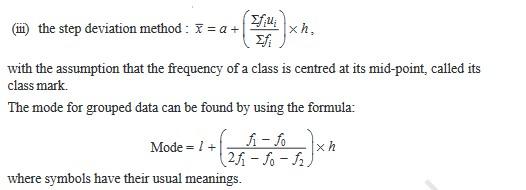
The mean for grouped data can be found by: l + (n/2-cf/f) × h.
Probability
The theoretical (classical) probability of an event E, written as P(E), is defined as
P (E) = Number of outcomes favourable to E / Number of all possible outcomes of the experiment, where we assume that the outcomes of the experiment are equally likely
- The probability of a sure event (or certain event) is 1
- The probability of an impossible event is 0
- The probability of an event E is a number P(E) such that 0≤ PE≤ 1