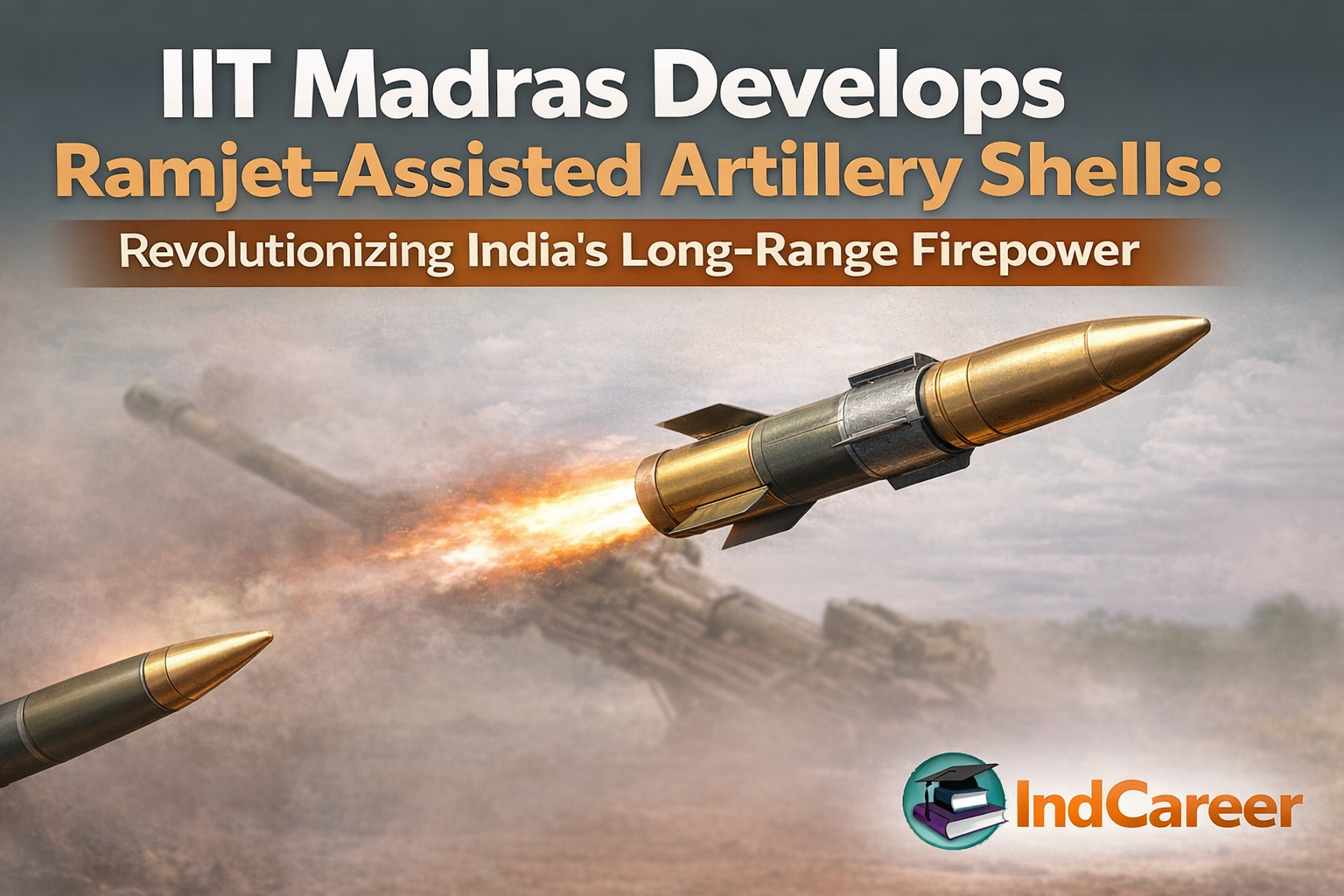
IIT Madras Develops Ramjet-Assisted Artillery Shells: Revolutionizing India’s Long-Range Firepower
At a Glance: IIT Madras Ramjet Artillery Project
| Organization | Project Type | Key Innovation | Status | Official Website |
| IIT Madras & Indian Army | Defense R&D | Ramjet-Propelled 155mm Shells | Successful Field Trials (Pokhran/Deolali) | iitm.ac.in |
Why This Matters
The development of ramjet-assisted artillery shells by IIT Madras is a “game-changer” for Indian defense. Traditionally, increasing the range of artillery required either larger guns (which reduces mobility) or expensive rocket-assisted projectiles (which often sacrifice the explosive payload/lethality). By integrating a ramjet engine—which uses the shell’s own forward velocity to compress air for combustion—IIT Madras has found a way to increase range by nearly 50% while maintaining the shell’s original destructive power.
For students and aspirants in Aerospace Engineering and Defense Research, this project signifies a shift toward Indigenous Modernization. It proves that India can upgrade existing “legacy” hardware (like the 155mm Bofors or Dhanush guns) into high-tech precision systems at a fraction of the cost of new missile batteries. This success, fueled by the “Professor of Practice” initiative, bridges the gap between academic theory and frontline military application.
Technical Specifications & Requirements
Based on the research and press release, here are the core requirements and features of the new technology:
- Platform Compatibility: Designed specifically for 155 mm artillery guns, the standard caliber for the Indian Army.
- Propulsion Mechanism: Replaces the standard “base-bleed” unit with a solid-fuel ramjet engine.
- Performance Metric: Targets a range extension from the standard 30-40 km to over 60+ km.
- Core Principle: Employs atmospheric oxygen for combustion, meaning the shell carries more fuel/explosives rather than an oxidizer.
- Key Components for R&D: * High-speed air intake system.
- Solid propellant grain.
- Nozzle assembly designed for gun-launch G-forces.
Historical Trends & Research Analysis
Historically, the Indian Army has relied on “Base Bleed” technology to reduce base drag and increase range by roughly 10-20%. However, global trends have been moving toward Precision Guided Munitions (PGMs) and Ramjet projectiles.
- 2020: Project initiated in collaboration with the Indian Army.
- 2023-2024: Initial concept validation using a custom-built 76 mm gun at IIT Madras.
- September 2025: Major breakthrough at Deolali (School of Artillery). Trials confirmed the shell could survive the “muzzle exit” (the violent force of being fired) and successfully ignite the ramjet in mid-air.
- December 2025: High-zone firing trials at Pokhran validated stable flight at maximum operational pressures.
Compared to previous years, where range was limited by the barrel length and gunpowder volume, 2026 marks the first time India has successfully tested sustained flight propulsion within an artillery shell.
Step-by-Step Evolution of the Technology
For those following the development or studying defense technology, the process follows these critical stages:
- Internal Ballistics: Ensuring the ramjet components do not break inside the gun barrel during the explosion.
- Muzzle Exit: Managing the transition from the high-pressure barrel to the open atmosphere.
- Ignition: The shell must be traveling at supersonic speeds (typically Mach 2+) for the ramjet to “breathe” and ignite.
- Sustained Flight: The engine provides thrust for several seconds, flattening the trajectory and extending the distance.
- Impact: Ensuring the internal guidance (if added later) and high explosives function upon reaching the 60km mark.
Pro-Tips for Defense Aspirants & Researchers
- Focus on ‘Dual-Use’ Tech: If you are a student, note that Prof. Ramakrishna highlighted that this technology is being adapted for rockets next. Researching ramjet applications in small-scale rocketry is a high-growth area.
- Career Pathway: Look into the DRDO-Industry-Academia Centers of Excellence (DIA-CoE) at IITs if you wish to work on similar “Atmanirbhar Bharat” projects.
- Stay Updated on Ballistics: Follow the Journal of Civil and Military Explosives for deeper technical papers on the solid propellants used in these specific shells.
Direct Links & Resources
- Official Announcement: IIT Madras News Room
- Department Profile: IITM Aerospace Engineering
- Collaborating Agency: [suspicious link removed]
- Helpdesk/Inquiries: IITM Media Cell Contact